Every morning you hold a Nifty option, something invisible happens before 9:15 AM even opens. A portion of your premium has already disappeared — not because the market moved, not because volatility changed, but simply because another day passed. This is theta. And most Indian option traders have no idea how much it's costing them.
The Tax Nobody Talks About
India's options market is the largest in the world by volume. More than 1.1 crore retail traders participate in F&O every year. And according to SEBI's own data, 93% of them lose money — an average of ₹2 lakh per trader, totalling over ₹1.8 lakh crore in aggregate retail losses over three years.
The reasons most people cite: wrong direction, bad timing, greed, FOMO.
The real primary mechanism: theta decay.
Not bad luck. Not manipulation. A completely predictable, mathematically certain, daily erosion that works against every option buyer, every single day, regardless of market direction.
Understanding theta does not just make you a better options trader. It changes how you think about every position you hold. This article explains exactly what theta is, how much it costs in real rupees on real Nifty positions, why it accelerates near expiry, and the four things the profitable minority does differently.
What Theta Actually Is
Theta is one of the five option Greeks — the set of risk measures that explain how an option's price responds to different inputs. Delta measures direction sensitivity. Vega measures volatility sensitivity. Gamma measures how fast delta changes. Rho measures interest rate sensitivity. And theta measures time sensitivity — specifically, how much an option's premium decreases with each passing day, all else held equal.
The formal definition: theta is the partial derivative of an option's price with respect to time. In practice, it tells you the daily rupee erosion in your option's value if nothing else changes.
Theta is always negative for option buyers. When you are long a call or put, your theta is negative — time is working against you. When you sell options, your theta is positive — time is working in your favour.
A Nifty ATM option with a theta of −10 will lose approximately ₹10 per unit per day from time decay alone. With a Nifty lot size of 75, that is a daily loss of ₹750 from your pocket, even if Nifty doesn't move a single point.
What Theta Costs Per Day
A Nifty ATM option with theta = −10 costs the buyer ₹750 per lot per day (₹10 × 75 lot size) in pure time decay — before any transaction costs, slippage, or directional loss. Hold it for 5 days with no movement and you've lost ₹3,750 per lot to theta alone. Most retail option buyers never calculate this before entering.
The Non-Linear Decay Curve — Why the Last Week Is Brutal
Here is where most traders make their most costly mistake: they assume theta decay is gradual and consistent throughout the option's life. It is not. Theta is radically non-linear.
The decay curve has three distinct phases:
| Days to Expiry | Theta behaviour | Example: Nifty ATM option |
|---|---|---|
| 30+ days | Slow, barely noticeable | −₹3 to −₹5/day per lot |
| 15–7 days | Noticeable acceleration | −₹8 to −₹15/day per lot |
| Last 7 days | Exponential — "the crashing wave" | −₹20 to −₹60/day per lot |
| Expiry day | Near-total destruction | −₹80 to −₹200/day per lot |
This is why the phrase "theta accelerates toward expiry" is not just theoretical. The option you bought on Monday for ₹120 (per unit) might lose ₹8 on Tuesday, ₹8 on Wednesday, ₹15 on Thursday, ₹30 on Friday — and then if you're holding a weekly option into the following week, the curve goes vertical.
A concrete example with real numbers:
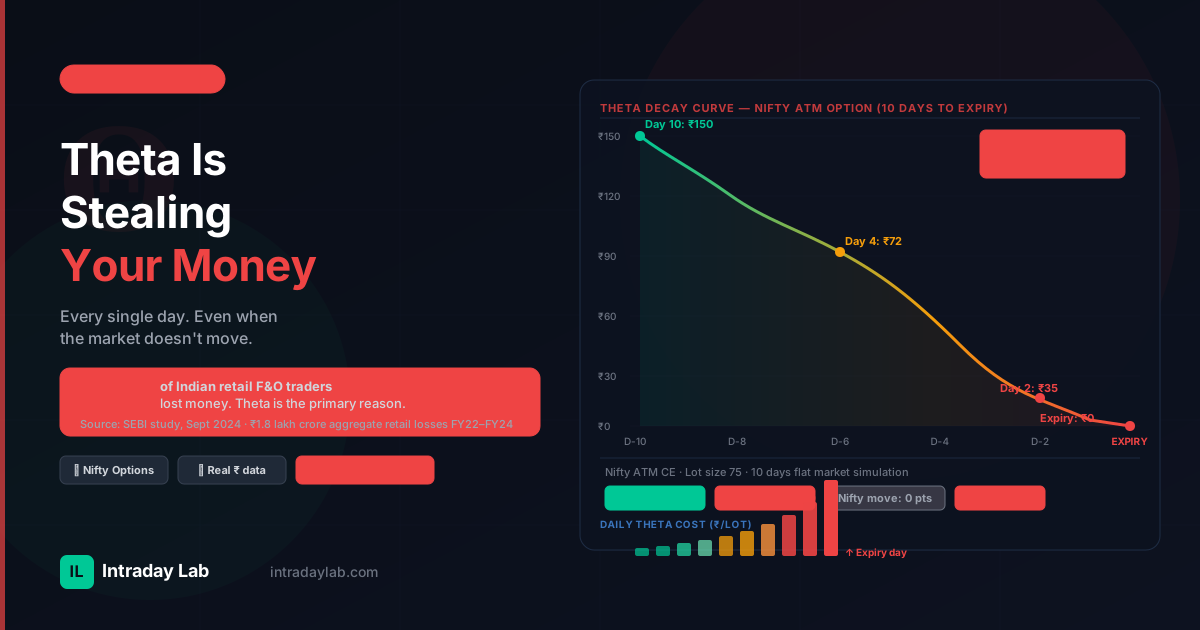
Assume Nifty is at 24,000. You buy the 24,000 CE (ATM call) with 10 days to expiry. Premium: ₹150 per unit. Lot size: 75. Total outlay: ₹11,250.
Over the following 10 days, if Nifty stays exactly at 24,000 (no directional movement, no volatility change):
| Day | Remaining Premium | Daily Loss | Cumulative Loss |
|---|---|---|---|
| Day 10 | ₹150 | — | — |
| Day 8 | ₹130 | −₹10 | −₹1,500 |
| Day 6 | ₹105 | −₹12 | −₹3,375 |
| Day 4 | ₹72 | −₹17 | −₹5,850 |
| Day 2 | ₹35 | −₹22 | −₹8,625 |
| Day 1 | ₹14 | −₹32 | −₹10,200 |
| Expiry | ₹0 | −₹14 | −₹11,250 |
The option loses 100% of its value over 10 flat days. And critically: the majority of that decay is concentrated in the final 3 days. The first 7 days cost you ₹5,850. The last 3 days cost you ₹5,400. Nearly half the total premium evaporates in 30% of the remaining time.
This is the crashing wave — and it explains why traders who buy options on Wednesday or Thursday of expiry week are almost always on the losing end.
Weekly Nifty options lose approximately 70% of their remaining extrinsic value in the final 24 hours before expiry. Buying ATM or OTM weekly options on Wednesday or Thursday — especially before 11 AM — means you are entering a theta buzzsaw. The market can move in your direction and you still lose money, because theta is destroying your premium faster than delta is building it.
How Theta Varies by Moneyness
Theta does not affect all options equally. The relationship between theta and an option's moneyness (ITM, ATM, OTM) is critical to understand.
ATM options have the highest theta. This is counterintuitive to most beginners, who assume the most expensive options would decay the slowest. The opposite is true. ATM options carry the most time value (extrinsic value), and it is extrinsic value that decays — not intrinsic value. An ATM option has zero intrinsic value and 100% time value. All of it is subject to theta decay.
Deep ITM options have the lowest theta. A deep in-the-money call already has most of its value as intrinsic value (the difference between Nifty's price and the strike). That intrinsic value doesn't decay. Only the small time value component erodes.
Far OTM options have low absolute theta but terrible relative decay. A far OTM option might have a theta of only −₹1 per day. But if the option costs ₹8, that is a 12.5% daily decay rate — among the most destructive in percentage terms.
| Option Type | Absolute Theta | % of Premium | What This Means |
|---|---|---|---|
| Deep ITM | Low (−₹2 to −₹5) | Low % | Mostly intrinsic — safer to hold |
| ATM | Highest (−₹10 to −₹30) | High % | Maximum time value exposure |
| OTM | Medium absolute | Very high % | Small premium, fast % decay |
| Far OTM | Very low absolute | Extreme % | Near-zero premium evaporates fast |
The practical implication: buying far OTM "lottery ticket" options on expiry day is the single most theta-destructive trade an Indian retail trader can make. These options might cost ₹5–₹10, appear cheap, and offer massive leverage — but they lose 50–100% of their remaining value in hours. This is where the bulk of the SEBI-documented ₹1.8 lakh crore in retail losses originates.
The India VIX Connection — When Theta Has a Partner in Crime
Theta does not operate alone in the real market. It works alongside vega (volatility sensitivity), and understanding their interaction is what separates informed traders from the 93% who lose.
India VIX is NSE's fear index — a measure of implied volatility derived from Nifty options pricing. When VIX is high, option premiums are inflated. When VIX falls, they deflate — independent of theta.
Here is the double-trap that destroys Indian option buyers around events:
Step 1 — Before the event (RBI policy, Budget, elections, corporate results): India VIX rises. Option premiums inflate dramatically. Buyers pay elevated premiums because "something big is going to happen."
Step 2 — After the event, regardless of outcome: India VIX crashes. This is called IV crush (implied volatility crush). Premiums deflate suddenly — not because the market didn't move, but because the uncertainty is gone.
Step 3 — While all this is happening: Theta is still running in the background, draining the option every day.
A trader who buys a Nifty ATM call before a Budget announcement might be right about the direction — Nifty goes up 300 points — and still lose money, because the VIX crush and theta combined deflate the premium faster than delta builds it.
This is not a rare edge case. It is a structural feature of every major event in the Indian calendar — Union Budget, RBI policy meetings, Nifty results, election results. The pattern repeats precisely because implied volatility spikes before events and collapses after them, every single time.
The Event Trade Double-Trap
Buying options before major events (RBI, Budget, elections) when India VIX is already elevated means paying a premium inflated by both time value and uncertainty. After the event, VIX crushes and theta continues — you need the market to move fast enough and far enough to overcome both. Most retail traders who buy pre-event options lose even when they correctly predict the direction.
Why Weekly Options Are a Theta Accelerator
SEBI's 2024 regulatory intervention — which restricted weekly options to one benchmark index per exchange — was directly targeted at the retail loss pattern created by weekly option buying.
Here is why weekly options are structurally dangerous for buyers:
Weekly options start their life already on the steep part of the theta curve. A monthly option at 30 days to expiry has the gentle early-decay theta profile. A weekly option at 7 days to expiry — which is all it ever has — starts in the aggressive mid-curve zone and moves immediately toward the vertical crashing-wave zone.
The decay is not 7× faster on a weekly — it is compounded geometrically. The theta on a 7-day ATM option is not simply 7× the theta on a 30-day option. Due to the non-linear T^0.5 relationship in the Black-Scholes model, weekly options decay at an accelerated per-day rate compared to monthly equivalents.
The margin for error is zero. With a monthly option, if you are 3 days early on a trade, you have time to be right. With a weekly option, 3 days is often the entire remaining life of the contract. Theta has no patience for being early.
The data from Indian markets reflects this: weekly option buyers are the single largest contributor to the retail loss pool in SEBI's research. The combination of low absolute premium (making the trade feel "safe"), high percentage theta decay, and zero time buffer for trade recovery creates systematic losses for buyers.
Overnight Theta — The Cost You Pay While You Sleep
One of the most misunderstood aspects of theta in Indian markets: overnight decay is disproportionately large.
Indian markets are open from 9:15 AM to 3:30 PM — 6 hours 15 minutes per day. But the theta calculation treats the overnight period (3:30 PM to 9:15 AM the next day) as a continuous passage of time. The market is closed for roughly 17+ hours, but the clock doesn't stop.
This means that on a Thursday close, when you hold a Nifty option into Friday, you are paying for approximately 2.7 days of calendar time (Thursday evening through Friday trading — roughly 18 hours of non-trading time plus Friday's session). But on a normal Tuesday-to-Wednesday hold, you pay for roughly 1 day.
The extreme case: weekend theta. When you hold an option over the weekend (Friday close to Monday open), you pay for approximately 3 calendar days of theta (Friday evening through Sunday), but the market only opens on Monday. This is the "weekend effect" that professional options traders track carefully. Sellers love holding options over the weekend — they collect two extra days of theta without any market risk. Buyers who hold over weekends pay for time that produces no opportunity for market movement.
For a Nifty ATM weekly option with theta = −₹15/unit, a Friday-to-Monday hold costs approximately ₹45 per unit (3 days × ₹15) = ₹3,375 per lot in overnight weekend decay alone.
The 4 Things the Profitable 7% Do Differently
SEBI's 2024 study identified that only 7.2% of individual F&O traders made a profit over three years. Analysing the behavioural and strategic patterns of this group reveals four clear differences from the majority.
1. They buy time, not lottery tickets.
The profitable minority almost never buys far OTM weekly options. When they buy options, they buy ATM or slightly ITM options with adequate time to expiry (typically 15–30 days minimum). This buys them time for the trade to work without the crashing-wave theta profile. The "cheap" ₹5 OTM weekly option that seems like limited risk is, in percentage terms, the most aggressively decaying contract in the market.
2. They calculate theta in rupees before every trade.
Before entering, they answer: "If the market stays flat for 3 days, how much will I lose to theta?" This converts an abstract Greek into a concrete hurdle. If the daily theta cost is ₹1,500 per lot, the position needs to gain at least ₹1,500/day just to break even against time decay — before any directional profit. Most retail buyers never calculate this.
3. They treat theta as a structural edge when selling, not a risk to avoid.
The profitable minority uses defined-risk selling strategies (bull put spreads, bear call spreads, iron condors) that put theta on their side. They are not exposed to unlimited risk — the bought leg of the spread caps losses — but they collect premium that decays predictably over time. Theta works for them rather than against them.
4. They have time-based exit rules, not just price-based exits.
Most retail buyers have a mental stop-loss based on premium percentage: "I'll exit if I lose 50%." But profitable traders add a time-based exit: "If the expected move has not materialised within 3 days, I exit regardless of premium." This prevents the worst theta trap — holding an option that's "almost right" through the crashing-wave period, watching it go to zero while "waiting for the move."
Theta is not just a danger to avoid — it is the most reliable edge in options. The market does not always move. Implied volatility does not always expand. But time always passes. Professional options sellers have built consistent income around this certainty. The key is defined risk: selling options with a bought hedge in place means theta works for you within a bounded, calculable worst-case loss.
Practical Framework: Reading Theta Before You Trade
Before every Nifty or BankNifty options trade, answer these four questions:
Q1: What is my daily theta cost in rupees? Take the theta value from the option chain (NSE website, Zerodha Kite, or Sensibull shows this in real-time). Multiply by lot size. That is your daily cost just to hold the position.
Q2: How many days does my trade thesis need to play out? If you expect a move in 2 days, you need an option with enough theta budget to survive 2 days of flat market. A weekly option with 3 days left has almost no budget.
Q3: Is India VIX elevated? Check India VIX before buying. If VIX is above 18–20, premiums are inflated by event uncertainty. You are paying a premium that will deflate post-event regardless of direction. Consider waiting, or consider selling spreads to benefit from the VIX crush.
Q4: What is the theta "hurdle rate" for profitability? Calculate: if theta costs ₹1,500/day per lot, Nifty needs to move approximately how many points per day (using the option's delta) just for the position to break even? If the hurdle rate is unrealistically high, the trade is structurally negative-expectancy before the market even opens.
For a Nifty ATM call at 24,000 with delta 0.5 and theta −10:
- Daily theta cost: ₹10 × 75 = ₹750 per lot
- Daily delta gain per 1 Nifty point: ₹0.5 × 75 = ₹37.50 per lot
- Nifty must move = ₹750 ÷ ₹37.50 = 20 points per day just to break even against theta
If Nifty moves 20 points per day, you break even. If it moves more, you profit. If it moves less — or sideways or against you — you lose. Every day.
Over 6+ years of Nifty data, the average daily range is roughly 130–150 points. But that range is measured peak to peak (high to low) — not as a clean directional 150-point move. The actual open-to-close directional move is far smaller on most days. Many days Nifty moves 20–40 points directionally and reverses. On those days, the theta hurdle rate is barely cleared — and with transaction costs and slippage, the trade is often negative.
This is the mathematical reason why 93% of buyers lose. It is not just about bad direction calls. It is structural.
The 20-Point Daily Hurdle
A basic Nifty ATM call with standard theta requires Nifty to move 20+ points per day in your favour just to break even against time decay. On the majority of trading days — especially in the lunch chop zone (11:50 AM – 12:10 PM, our best-time-to-trade data confirms this) — Nifty's directional movement falls well short of this threshold. Theta wins by default.
Frequently Asked Questions
Conclusion
Theta is the most honest force in the options market. It doesn't care about your view, your technical analysis, or your confidence level. It runs every day, at an accelerating rate, on every option you hold. And unlike directional risk — which might resolve in your favour tomorrow — theta only goes one direction. Time only moves forward.
The SEBI data makes this concrete: 93% of Indian retail F&O traders lose money. The aggregate loss is ₹1.8 lakh crore. The primary mechanism is not bad direction calls. It is structural — daily theta erosion on positions held too long, in the wrong contract (far OTM weekly options), entered at the wrong time (pre-event when VIX is elevated), without calculating the daily rupee cost before entry.
Understanding theta changes how you trade options at a fundamental level. Before every entry, the question shifts from "which direction will Nifty move?" to "is this option's expected directional movement large enough, fast enough, and certain enough to overcome the daily theta tax I will pay while holding it?"
For most retail traders, the answer to that second question — when calculated honestly in rupees — reveals that most of their trades are structurally negative-expectancy before the market opens.
That is not a reason to stop trading options. It is a reason to trade them better.
All premium calculations in this article use illustrative Nifty options values based on typical market conditions. Actual theta values vary by strike, expiry, and implied volatility. Always check live option chain data (NSE website, Zerodha Kite, or Sensibull) before trading. SEBI loss statistics sourced from SEBI's September 2024 study of 93 lakh individual F&O traders across FY2022–FY2024. This article is for educational purposes and does not constitute financial advice.