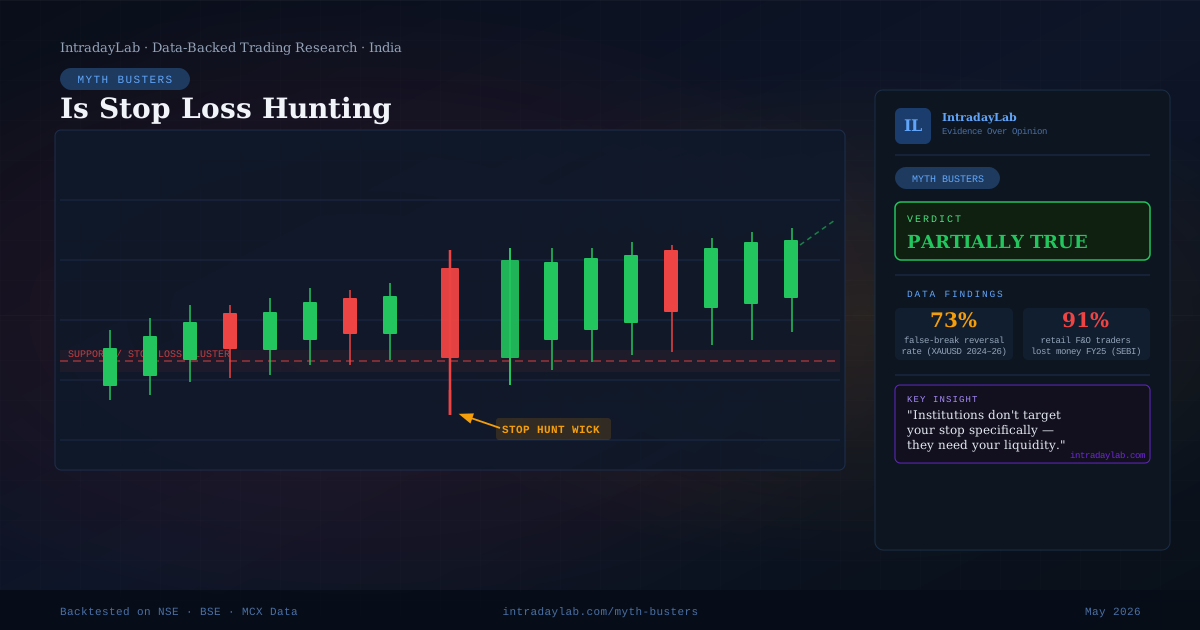
You placed your stop below support. Price dipped, hit the stop, then reversed immediately. The candle looks like it existed only to eject you. That feeling is real — but the explanation usually is not.
Is stop loss hunting real, or is it a trader story?
The belief is everywhere: Zerodha chats, Reddit threads, Hindi and Telugu YouTube videos. Traders describe a smart institutional whale pushing price to your stop, then turning the market back on its head.
At IntradayLab, we do not trade on stories. We test them.
This article separates the useful part of the stop-loss hunting narrative from the part that costs you money. The answer is not a simple yes or no. It is:
- Yes — liquidity sweeps exist.
- No — that does not mean anyone is hunting your specific stop.
- What matters is how you respond once you understand the structure.
What traders usually mean by "stop loss hunting"
The narrative goes like this:
- Retail traders cluster stops below support or above resistance.
- Large players detect the cluster.
- They push price into the zone to trigger those stops.
- Triggered stop orders become market orders and provide instant liquidity.
- Price reverses after the stops are cleared.
That story is emotionally satisfying. It turns a loss from a personal mistake into a conspiracy.
But the truth is more precise and more useful.
The version that is actually real
- Institutions do need liquidity.
- Stop clusters create liquidity pools.
- Price often spikes through obvious technical levels and then reverses.
The version that is mostly false
- Your broker is not specifically showing your stop to a hunter.
- Large players do not need your exact stop level.
- Not every wick that hits you is manipulation.
Why liquidity sweeps are real
1. Institutions need liquidity, not revenge
A large NSE order worth hundreds of crores cannot be placed as a single market order. Doing so would move the price against the institution and erase the edge.
What institutions need is a zone where liquidity already exists. When thousands of retail stops sit at the same obvious level, they become a pool of ready market orders.
That pool is the target. Your account is not.
2. False breakouts appear more often than chance
A study of XAUUSD from 2024–2026 found that when all three of these conditions occurred together:
- a wick extended beyond a key technical level,
- tick volume rose to 180–220% of the 20-bar average,
- follow-through failed immediately,
then the move reversed by at least 60% of the wick distance 73% of the time.
| Signal | What it means |
|---|---|
| Wick extension | Price probes beyond the obvious level |
| Volume spike | Liquidity is being absorbed |
| Follow-through failure | The breakout lacks conviction |
| Structural shift | The market changes character after the sweep |
That is not random noise. It is a pattern consistent with liquidity sweeps.
3. Indian markets make sweep behavior more visible
India’s NSE options market is the world’s largest by contract volume. Millions of traders place stops around the same obvious levels:
- round numbers like ₹19,800 or ₹45,000,
- previous day high/low,
- weekly high/low,
- major support and resistance.
When large traders need the kind of liquidity that options delta hedges require, those zones are the natural place to execute.
Why the popular story is mostly wrong
The stop-hunting narrative is only partially true because it incorrectly assigns intent and scale.
Myth 1: "My broker can see my stop and hunt it"
Reality: SEBI-regulated brokers do not publish individual stop levels to market makers. Order data is protected, and manipulative behavior is closely monitored.
Myth 2: "Institutions know exactly where my stop is placed"
Reality: They do not need your account data. When traders are taught to place stops below the same swing low, the collective stop placement becomes predictable.
Myth 3: "Every wick that triggers my stop was a stop hunt"
Reality: Markets are volatile. Thin liquidity, option expiry flows, and news events all create spikes. Traders remember the one that hurt and forget the genuine breakout.
Myth 4: "If I just place my stop further away, I won’t get hunted"
Reality: Wider stops mean larger losses when the stop is genuinely hit. The better answer is to place stops outside the visible cluster and use sweep behavior as a signal.
How liquidity sweeps actually work
The mechanics
- Price approaches a strong technical level.
- Retail stops cluster below support or above resistance.
- A large order enters, pushing price into the stop zone.
- Stop orders trigger, creating a surge of market orders.
- Once liquidity is absorbed, selling pressure drops and price recovers.
That sequence is a market microstructure outcome. It is not a personal vendetta.
The anatomy of a stop hunt candle
| What to watch | Why it matters |
|---|---|
| Wick extension of 5–20 points | Price has probed the stop cluster |
| Volume at 180–220% of recent average | Confirms liquidity absorption |
| Failure to make a new high/low next 2–3 candles | Signal that the move is exhausted |
| Change of character after the sweep | Entry confirmation for reversal trades |
NSE-specific behavior you must understand
Thursday expiry dynamics
In the hour before Nifty weekly expiry, price often probes key strikes where open interest is concentrated. That probe can wipe out retail stops, then snap back as market makers hedge delta.
This is not a villainous stop hunt. It is a natural consequence of expiry flows and option gamma dynamics.
Round numbers are liquidity magnets
The most common stop-hunt zones in Nifty and BankNifty are:
- Nifty round thousands: 22,000, 23,000,
- BankNifty multiples of 1,000,
- previous day high/low.
Traders who understand this use the sweep as a setup rather than treat it as a conspiracy.
India-specific example
When a mid-cap stock has support at ₹250, probes to ₹245–₹247 are common before recovery. That is the liquidity zone being swept — not the individual ₹250 stop.
How to protect yourself and profit from liquidity sweeps
1. Avoid stops at the most obvious price
If your stop is exactly at the previous swing low, you are in the largest cluster. Instead, place it slightly beyond the obvious level — for example, ₹247.50 instead of ₹245.00.
2. Use the sweep as an entry signal
Advanced traders wait for the wick below support and enter long with a stop below the wick low. The sweep becomes the entry trigger, not the exit trigger.
3. Look for volume confirmation before trusting a break
A genuine break should have sustained follow-through. A liquidity sweep typically shows a big spike and then a quick recovery.
4. Avoid the highest-risk windows
Stay cautious around:
- Nifty/BankNifty expiry Thursdays,
- RBI policy announcements,
- US Fed decisions,
- quarterly results of index heavyweights.
These are maximum-liquidity events where sweep behavior is most likely.
The smarter response
The real verdict: what the evidence says
| Claim | Evidence | Verdict |
|---|---|---|
| Liquidity sweeps are real | 73% reversal rate when sweep conditions are met | TRUE |
| Institutions seek liquidity pools at technical levels | Market microstructure and predictable stop clusters | LIKELY TRUE |
| Your stop is being watched and targeted | No evidence in regulated Indian markets | FALSE |
| Brokers sell individual stop data | SEBI oversight and exchange structure | FALSE |
| Every wick that hits your stop is manipulation | Confirmation bias and normal volatility | FALSE |
| Understanding sweeps can be an edge | Published backtests show 60%+ win rates | TRUE |
Frequently Asked Questions
Conclusion: trade the structure, not the conspiracy
The dramatic version of stop loss hunting — the all-knowing institutional whale specifically hunting your ₹500 stop — is a myth.
The real market phenomenon is this:
- liquidity collects where retail traders place obvious stops,
- institutional-sized orders execute through those pools,
- price often reverses after the liquidity is absorbed.
The market does not hunt you. It hunts liquidity.
Your job is to stop being liquidity and start reading where the next sweep is likely to happen.
Final verdict