This is probably the most-argued question in Indian retail trading communities. Two camps. Both loud. Both convinced they're right. Both are partially correct. Which one is actually better for you depends on factors most traders never bother to measure.
They're Not the Same Kind of Index
Before comparing performance, it's worth understanding what these two indices actually represent — because they behave differently for structural reasons, not random ones.
Nifty 50 tracks India's 50 largest companies across sectors — financials, IT, energy, FMCG, auto, pharma. It is a broad-market index. When the economy moves, Nifty moves. When global sentiment shifts, Nifty reacts. But because 50 companies across diverse sectors are averaged together, extreme moves in any single stock or sector get diluted. Nifty is inherently smoother.
Bank Nifty (officially Nifty Bank) tracks India's 12 most liquid banking stocks. It is a concentrated, sector-specific index. HDFC Bank alone carries approximately 28% weight, ICICI Bank around 23%, and SBI around 11% — meaning just these three stocks together account for over 60% of the entire index. When any one of these moves sharply, Bank Nifty follows.
This concentration is the source of both Bank Nifty's biggest advantage and its biggest danger.
Structural Difference
Nifty 50 is a diversified broad-market index with natural dampening. Bank Nifty is a concentrated play on India's banking sector — more volatile, more news-driven, and more dramatic in both directions.
The Volatility Gap — What the Numbers Actually Show
This is where the comparison gets concrete.
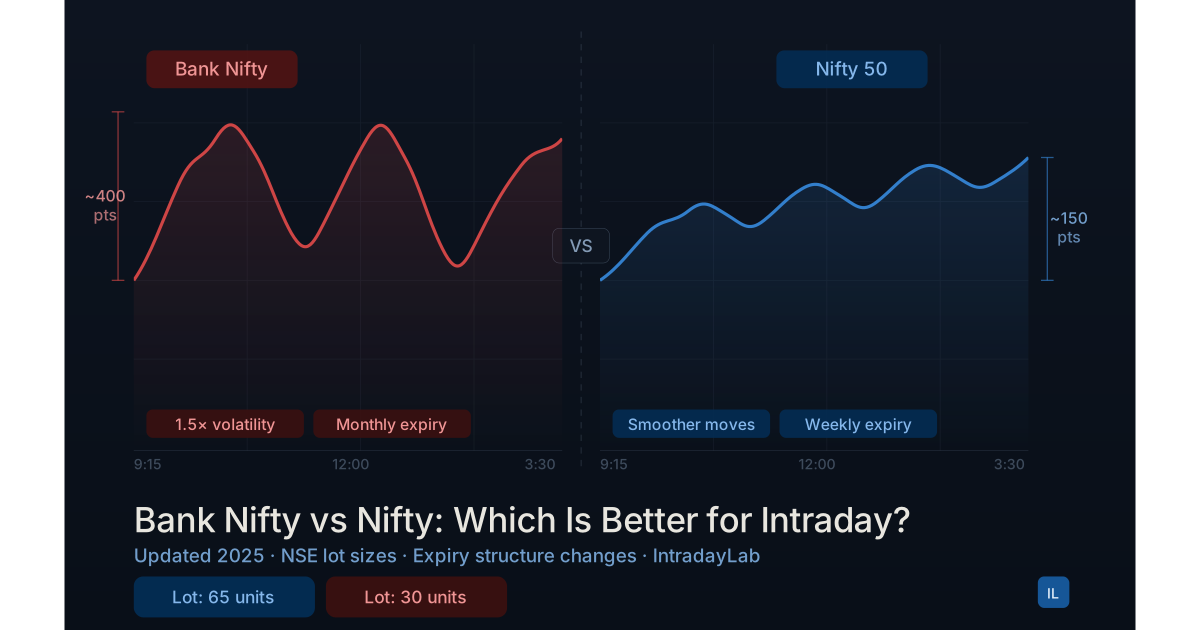
Bank Nifty is more volatile than Nifty. If Nifty's volatility is 1, Bank Nifty volatility is approximately 1.5. That ratio has been consistent across multiple years of data and holds up across different market conditions.
In practical intraday terms, Bank Nifty moves 300–500 points on a typical trading day, while Nifty's daily range tends to run 100–200 points in normal sessions. On high-impact days — RBI policy announcements, major bank results, global risk events — a 25bps RBI rate cut typically moves Bank Nifty 2–3% versus Nifty's 0.8–1.2%.
For option buyers, this volatility gap is the core attraction of Bank Nifty. More movement means more opportunities for premium expansion. A 300-point intraday range on Bank Nifty generates significantly more option premium movement than a 120-point range on Nifty.
For option sellers, that same volatility gap is a risk that demands more active management. Bank Nifty positions can move against you fast — faster than a stop-loss gets processed on a slow connection.
| Metric | Nifty 50 | Bank Nifty |
|---|---|---|
| Typical daily range | 100–200 points | 300–500 points |
| Volatility (relative) | 1.0x | ~1.5x |
| RBI rate cut impact | 0.8–1.2% | 2–3% |
| Typical ATR | ~50–80 | ~150–250 |
The Expiry Structure Change That Most Traders Haven't Fully Adjusted To
This is critical, and as of 2025, many traders are still operating on outdated assumptions.
Weekly Bank Nifty contracts were permanently discontinued from November 20, 2024, following SEBI's directive. Bank Nifty now expires exclusively on the last Tuesday of each month.
This is not a minor administrative change. It fundamentally alters the trading dynamics for Bank Nifty options.
Under the old weekly expiry structure, theta decay was aggressive every week. Option sellers could run weekly strategies consistently. Option buyers had a very short window to be right. That entire framework no longer applies.
Nifty 50, by contrast, still expires weekly — every Thursday. This means all the premium decay patterns, expiry day dynamics, and theta behaviour that weekly expiry traders are familiar with are now exclusive to Nifty.
Bank Nifty's weekly expiry elimination (Nov 2024) is not a minor rule change. It removed an entire class of theta-decay strategies that weekly traders relied on. Nifty is now the only weekly game in town. All expiry day premium decay setups now live exclusively on Thursday Nifty expiry.
For traders who rely on expiry day premium decay setups — the kind documented in our earlier analysis of 100 Nifty expiry sessions — Nifty is now the only weekly vehicle available.
With Bank Nifty on monthly expiry only, premium decay is slower in the early part of the month, making outright directional trades more viable. In the final week before expiry, short straddles and strangles tend to benefit from accelerating theta decay.
Lot Size and Capital — The 2025-2026 Update
Both indices had their lot sizes revised effective from December 30, 2025. The Nifty 50 lot size was reduced from 75 to 65, bringing the contract value to approximately ₹16.1 lakh (at current levels near ₹24,000). Bank Nifty's lot size was reduced from 35 to 30 (at current levels near ₹54,000–55,000).
At current levels, here's what one lot costs in option premium for a typical ATM strike:
| Index | Lot Size | ATM Premium (Approx) | One Lot Cost | Margin Required |
|---|---|---|---|---|
| Nifty 50 | 65 | ₹120–150 | ₹7,800–9,750 | ₹1.77L |
| Bank Nifty | 30 | ₹180–250 | ₹5,400–7,500 | ₹1.75L |
The numbers are now broadly comparable for buyers. Bank Nifty's smaller lot size compensates for its higher per-unit premium. For sellers, margin requirements per lot are similar — though Bank Nifty's higher volatility means stop-loss distances need to be wider, which effectively increases the capital at risk per trade.
Capital Insight
The lot size reduction in December 2025 made both indices roughly equivalent in terms of entry cost and margin. The real difference is not capital requirement — it's the stop-loss distance required due to volatility differences.
Predictability — Where Nifty Has a Clear Edge
Here's something traders underestimate until they've been burned by it: Bank Nifty can be moved by a single news event affecting one bank.
HDFC Bank's movement alone can determine Bank Nifty's direction on a given day. A quarterly result that disappoints, a credit rating change, an RBI action targeting specific banks — any of these can create sharp, fast, unpredictable moves in Bank Nifty that have nothing to do with the broader market.
Nifty, spread across 50 companies in diverse sectors, is far more insulated from single-stock events. A poor result from one IT major moves Nifty, but not dramatically. The same concentration risk doesn't exist.
For traders who use technical setups — chart patterns, VWAP, support/resistance — Nifty tends to respect these levels more consistently. Bank Nifty's moves more frequently override technical structure when banking-specific news is in play.
This is why experienced technical traders often find Nifty more reliable to chart and trade. The setups "work" more often because fewer random variables can invalidate them mid-session.
When Bank Nifty Is the Better Choice
None of this means Bank Nifty is inferior. For certain trader profiles and certain market conditions, it's demonstrably the better instrument.
High-volatility, high-conviction days — When there's an RBI policy meeting, major bank earnings, or a clear global trigger, Bank Nifty's amplified movement translates directly into larger premium moves and larger potential returns per trade. On these days, a correctly positioned Bank Nifty option can generate 3–5x the point move of an equivalent Nifty option.
Directional scalping — The wider daily range and higher per-point premium value make Bank Nifty attractive for scalpers who work in and out of positions quickly on 1- or 3-minute charts. More movement means more scalp opportunities per session.
Sector knowledge edge — If you understand the banking sector, follow RBI policy closely, and track individual bank earnings cycles, Bank Nifty is the index where that knowledge creates genuine edge. Most retail Nifty traders have no such information advantage. Banking sector specialists do.
Monthly expiry selling strategies — With the new monthly expiry structure, Bank Nifty's option premiums in the first week of the month are elevated (high implied volatility), and the final week before expiry sees accelerated decay. Structured selling strategies — strangles, iron condors — work across a longer time window than the weekly Nifty equivalent.
Bank Nifty excels on four specific use cases: high-vol event days, fast scalping, sector-knowledge traders, and monthly expiry selling strategies. If your trading doesn't fit these categories, Nifty is likely the better choice.
When Nifty Is the Better Choice
Beginners and developing traders — The smoother price action, more predictable technical behaviour, and weekly expiry structure make Nifty the clearly better learning environment. Mistakes are recoverable. Gaps and spike moves are less severe.
Weekly expiry premium strategies — With Bank Nifty's weekly expiry gone, Nifty is now the only weekly game in town. Every expiry day strategy, every theta decay setup, every short-term option selling approach — all of it now runs on Nifty's Thursday expiry.
Technical traders — VWAP, EMA, breakout levels, and support/resistance work with higher reliability on Nifty than on Bank Nifty. If your edge is technical, Nifty gives that edge better conditions to manifest.
Lower stress, consistent execution — Consistent profitability in trading is as much about execution quality as strategy quality. Nifty's calmer movement allows more deliberate entries and exits. Bank Nifty's speed punishes hesitation in a way that Nifty typically does not.
Trading with limited capital — While lot sizes are similar, the real advantage for capital-constrained traders is stop-loss width. A ₹500 Nifty stop-loss costs ₹32,500 per lot. A ₹500 Bank Nifty stop-loss costs ₹15,000 per lot (due to smaller lot size) — but you may need ₹1,000+ stops due to volatility, making the math less favorable anyway.
The Head-to-Head Summary
| Factor | Nifty 50 | Bank Nifty |
|---|---|---|
| Daily range | 100–200 pts typical | 300–500 pts typical |
| Volatility | Lower, more consistent | ~1.5x Nifty |
| Expiry structure | Weekly (Thursday) | Monthly (last Tuesday) |
| Lot size (2026) | 65 units | 30 units |
| Margin requirement | ₹1.77L | ₹1.75L |
| Predictability | Higher — 50 diverse stocks | Lower — 12 concentrated banks |
| News sensitivity | Broad macro | Banking sector specific |
| Technical reliability | High — patterns respected | Medium — news overrides |
| Best for | Beginners, technical traders, weekly strategies | Experienced traders, high-vol days, sector players |
| Premium per lot | ₹7,800–9,750 ATM | ₹5,400–7,500 ATM |
The Honest Answer
There is no objectively better index. There is only the index that suits your strategy, your experience level, your capital, and your ability to handle volatility.
If you're still developing your edge, trade Nifty. The weekly expiry structure alone makes it the richer training environment right now. The technical setups are more reliable. The damage from a bad trade is more survivable.
If you have a clear technical or informational edge, enough capital to absorb Bank Nifty's wider stops, and genuine comfort with sector-driven volatility — Bank Nifty's range and premium structure reward that competence directly.
The worst outcome — and the one that causes most account blowups — is trading Bank Nifty's volatility with a Nifty-trader's risk management. Wider stops, faster moves, and monthly expiry require a different framework. Don't bring a Nifty playbook to a Bank Nifty session.
Trading Bank Nifty with Nifty risk management is a blowup waiting to happen. Bank Nifty requires wider stops, tighter position sizing, and complete acceptance that one bad news event can gap against you hard. If you can't accept 500–1000 point swings, you're not ready for Bank Nifty.
Know which instrument you're in. Know why you chose it. The rest follows.
Frequently Asked Questions
Data references: NSE F&O circulars Oct–Dec 2025, January 2026. Lot size data effective January 2026. Volatility comparisons based on historical ATR and realized volatility data. RBI rate-move impact figures based on observed index behaviour across 2023–2026 policy cycles. Premium cost estimates based on typical ATM pricing as of May 2026. This is a comparative analysis, not investment advice.