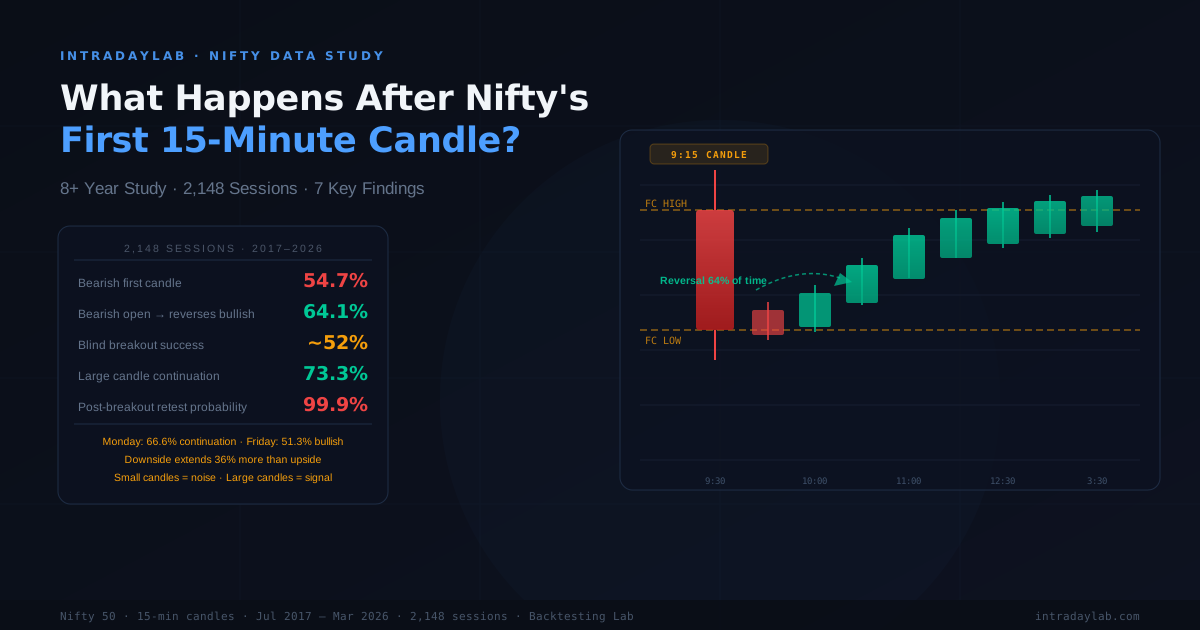
Every intraday trader watches the first 15-minute candle. Most are using it completely wrong. We analyzed 2,148 Nifty 50 sessions across 8+ years to find out what actually happens after 9:30 AM. The findings contradict almost everything popular breakout strategies claim.
The Most Watched 15 Minutes in Indian Markets
At 9:15 AM, Nifty opens. For the next 15 minutes, every serious intraday trader watches the same thing: the first candle forming.
This is when overnight news prices in. When institutional orders hit the tape. When retail traders make their first emotional decisions. The first 15-minute candle — the 9:15 to 9:30 AM bar — has become the foundation of some of the most popular intraday strategies in India, most notably the Opening Range Breakout.
But popularity is not the same as profitability. And the data from 2,148 real trading sessions reveals something very different from what most breakout strategies claim.
This is what actually happens.
What We Analyzed
| Parameter | Detail |
|---|---|
| Instrument | Nifty 50 index |
| Timeframe | 15-minute candles |
| Period | July 2017 to March 2026 |
| Sessions analyzed | 2,148 trading days |
| Focus | First candle: 9:15–9:30 AM |
No cherry-picking. No curve fitting. Every single session in the dataset was included.
Finding 1: Nifty Opens Bearish More Than You Think
Before looking at breakouts and strategies, here is the baseline reality about the first candle itself.
Nifty opens with a bearish first candle on 54.7% of all trading days — that is 1,175 out of 2,148 sessions. Bullish first candles occur on only 45.3% of days.
This consistent bearish open-bias persists across the entire 8+ year dataset regardless of whether Nifty was in a bull or bear market. The reason is structural: institutional sell orders and stop-loss triggers from overnight positions dominate the first minutes of trading.
But here is where the data becomes genuinely surprising.
The Bearish Open Paradox
Nifty opens with a bearish first candle on 54.7% of days. Yet on those days, the market closes green 64.1% of the time. The most common pattern in Nifty history: bearish 9:15 candle → bullish close. Sellers dominate the open. Buyers dominate the close.
Finding 2: Blind Breakout Trading Is a Coin Flip
This is the finding that should make every first-candle breakout trader pause.
After 9:30 AM, breakouts of the first candle range are extremely common:
- 71.4% of days see price break above the first candle high
- 76.2% of days see price break below the first candle low
- 48.0% of days see price break both sides
The breakouts themselves are nearly universal. But here is the critical number:
High breakout success rate: 53.2%. Low breakout success rate: 51.2%.
That is statistically indistinguishable from a coin flip. Trading every first-candle breakout blindly has essentially zero statistical edge over 2,148 sessions.
This does not mean breakout trading does not work. It means that context — specifically candle size, day of week, and gap conditions — is what creates the edge. Without those filters, the breakout is random.
71–76% of sessions break the first candle range — but only ~52% of those breakouts sustain. Entering on every first-candle breakout produces near-random outcomes over a large sample. The breakout itself is not the edge. What comes before it — candle size, day, context — is where the edge lives.
The Complete Data Explorer
Every number in this study is available in the interactive tool below — six data views built from the actual 2,148-session dataset. Use the tabs to explore each finding.
Interactive Data Explorer
First 15-Minute Candle — Full Analysis
2,148 trading sessions · Jul 2017 – Mar 2026 · Nifty 50 · 15-min data
Continuation vs Reversal
The Most Counterintuitive Finding
Nifty opens bearish on 54.7% of days — that's a consistent open-side bearish bias. Yet on those bearish-open days, the market closes green 64.1% of the time. Sellers dominate the 9:15 AM open; buyers dominate the 3:30 PM close. Fading the bearish open has historically been the profitable bias.
Finding 3: Candle Size Is the Real Signal
This is the most actionable finding in the entire study — and the one most traders completely ignore.
| Category | Size | Continuation | Breaks Range | Avg Day Move |
|---|---|---|---|---|
| Small | < 0.10% | 52.6% | 78–79% | 0.47% |
| Medium | 0.10–0.24% | 63.4% | 73–75% | 0.51% |
| Large | > 0.24% | 73.3% | 62–75% | 0.79% |
The pattern is stark. Small first candles break their range constantly — but continue in the breakout direction only 52.6% of the time. That is noise. The breakout triggers your entry and the trade immediately reverses.
Large first candles (above 0.24% range) tell a completely different story: 73.3% continuation rate and an average intraday move of 0.79% — nearly double the small-candle average. When the market makes a decisive 9:15 AM candle, the rest of the day follows with 73% probability.
The practical rule: large first candle = signal. Small first candle = noise.
For context, 0.24% of Nifty at 22,000 is approximately 53 points. Many experienced traders use 40–50 points as their minimum first-candle range before considering a breakout trade — this aligns precisely with what the data recommends.
The Size Filter
Large first candles (above ~50 Nifty points) produce 73.3% continuation — a genuine statistical edge. Small candles (below ~22 points) produce 52.6% — essentially random. This single filter separates signal from noise in every first-candle setup.
Finding 4: Downside Extends 36% Further Than Upside
After the first candle closes, how far does Nifty typically move?
- Average upside extension above FC high: +0.25%
- Average downside extension below FC low: −0.34%
- Average total intraday range post-first-candle: 0.60%
- Maximum single-day upside ever recorded: +11.9%
The downside extends 36% further than the upside on average. This is the well-documented asymmetry between fear and greed in equity markets. When Nifty falls, it falls sharper and faster than equivalent upside moves. This explains why short-side ORB setups historically generate more profit than long setups, even in a bull market.
For stop-loss placement, this asymmetry matters: a downside break of the first candle typically produces a −0.34% adverse move — more than the typical winning upside move of +0.25%. This is another structural reason why blind breakout trading produces near-zero edge.
Finding 5: The 99.9% Retest — Almost Certain
The most striking single statistic in the entire dataset:
After breaking the first candle high, price returns to retest that level on 99.9% of sessions.
After breaking the first candle low, price returns to retest that level on 99.9% of sessions.
This is not manipulation. It is predictable intraday volatility. The first candle's high and low are almost never permanent one-sided moves — they always get retested within the same session.
The practical implication: entering on the initial breakout candle exposes you to the near-certain retest. A trader who buys the high breakout at 9:35 will very likely see price return to that exact level during the session — triggering stops placed just below the first candle high, before the real directional move begins.
This is the mechanism behind what traders call "stop hunts." It is predictable. And it can be avoided.
The smarter entry structure: wait for the breakout → wait for the 99.9%-probable retest → enter when the retested level holds as support or resistance → trade the confirmed directional move with the retest as your stop reference.
Finding 6: Day of Week Has Real, Measurable Structure
| Day | Bullish FC | Continuation | Avg Move | Notable |
|---|---|---|---|---|
| Monday | 46.3% | 66.6% | 0.62% | Strongest trend day |
| Tuesday | 42.5% | 62.9% | 0.57% | Most bearish opens |
| Wednesday | 45.0% | 60.8% | 0.58% | Highest false breakout rate |
| Thursday | 42.2% | 62.7% | 0.56% | F&O expiry pressure |
| Friday | 51.3% | 62.1% | 0.61% | Most bullish opens |
Monday has the highest continuation (66.6%) and the least downside breaks (71.3%). Weekend global drift carries direction cleanly into Monday. For first-candle trend strategies, Monday is the single most reliable day in the entire dataset.
Friday has the most bullish first candles (51.3%) — short-covering before the weekend creates a systematic buy bias at open. Second-highest average move (0.61%).
Thursday and Tuesday show only ~42% bullish first candles and the highest downside break rates (77–78%). F&O expiry pressure on Thursday creates consistent mid-week bearish opening tilt.
Wednesday is the false breakout capital of the week: 74.8% of Wednesdays break the first candle high (highest upside break rate) but continuation is only 60.8% (lowest of the week). More breakouts, fewer sustaining — the highest noise-to-signal ratio.
Finding 7: Gap Days Are Not Special
Most traders treat gap-up and gap-down opens as fundamentally different from flat opens. The data disagrees.
Gap day continuation: 63.0% No-gap day continuation: 61.8%
A 1.2 percentage point difference across 1,353 gap days and 795 flat days. The market's directional behaviour after the first candle does not depend on whether the open was a gap.
However, one gap-related asymmetry is meaningful:
- Gap-up fills same day: 51.7% — buyers who created the gap-up are less committed
- Gap-down fills same day: 42.9% — sellers who created the gap-down are more committed
When Nifty gaps down, 57.1% of the time that gap does not fill during the session. Gap-down opens tend to be more durable than gap-up opens — consistent with the broader downside asymmetry finding throughout this study.
How to Actually Use the First Candle
The data produces a clear, evidence-based framework:
Step 1 — Read the candle size first. Large candle (>0.24%, approximately 50+ Nifty points): signal day, trade breakouts with confidence. Small candle (<0.10%): noise day, treat as context only, reduce position size or stand aside.
Step 2 — Check the day of the week. Monday: most reliable trend continuation. Wednesday: highest false breakout rate, most caution needed. Friday: most bullish open bias. Thursday/Tuesday: bearish open bias, F&O pressure mid-week.
Step 3 — Note the direction but don't assume it continues. Bearish first candle reverses 64% of the time. Never assume a bearish open means a bearish day unless the candle is large and other context supports it.
Step 4 — Wait for the retest. After any breakout of the first candle range, a 99.9%-probable retest is coming. The retest entry — entering when the broken level holds on the return — is structurally safer than the initial breakout entry.
Step 5 — Bias your direction awareness toward downside. The downside extends 36% further than the upside. Short setups on confirmed large-candle bearish days tend to produce larger absolute moves than equivalent long setups.
Large first candle + Monday or Friday + direction confirmed by candle bias = highest probability trend setup. Small first candle + Wednesday = maximum noise, minimum reliability. The first candle is a context filter, not a buy/sell signal. Used correctly, it tells you how much to trust — and size — the day's directional trade.
Frequently Asked Questions
Conclusion
2,148 sessions of Nifty data produce seven findings that challenge what most intraday traders believe about the first 15-minute candle.
Blind breakouts succeed only 52% of the time — a coin flip. Bearish opens reverse to bullish closes 64% of the time. Small candles produce noise; large candles produce signals. Every breakout gets retested with near-certainty. Downside extends 36% further than upside. Monday is the most reliable trend day. Gap size tells you almost nothing about direction.
None of these are opinions. They are the output of 2,148 trading sessions measured systematically across 8+ years of real Nifty market data.
The first 15-minute candle is not useless. But it is not what most traders think it is. Used as a standalone signal — "price broke the high, buy" — it produces random outcomes. Used as a context filter — "large candle, Monday, bearish direction that historically reverses, wait for the retest" — it is a powerful framework for structuring the trading day.
The 2,148 sessions confirm: context always beats reaction.
Nifty Gap Down History: What Happens After a Panic Open?
We apply the same 10-year framework to gap downs. The result is more surprising than the gap up study — 52.6% of gap down days actually close green. Here's the full data breakdown.
Gap Down Events
76
Close Green
52.6%
Fill Rate
17.1%
Gap Down
Analysis
This study analyzed 2,148 Nifty 50 trading sessions from July 2017 to March 2026 using 15-minute OHLC data sourced via institutional-grade market data access. All statistics are calculated from the complete dataset with no session exclusions. This is a data study for educational purposes and does not constitute trading advice. Past market behavior does not guarantee future results.