Most traders study charts for months. Almost none spend 10 minutes understanding what their trades actually cost. That gap — between perceived profit and real profit — is where most trading accounts quietly die. This article closes that gap completely.
The Question That Exposes Everything
Before you read further, answer this honestly:
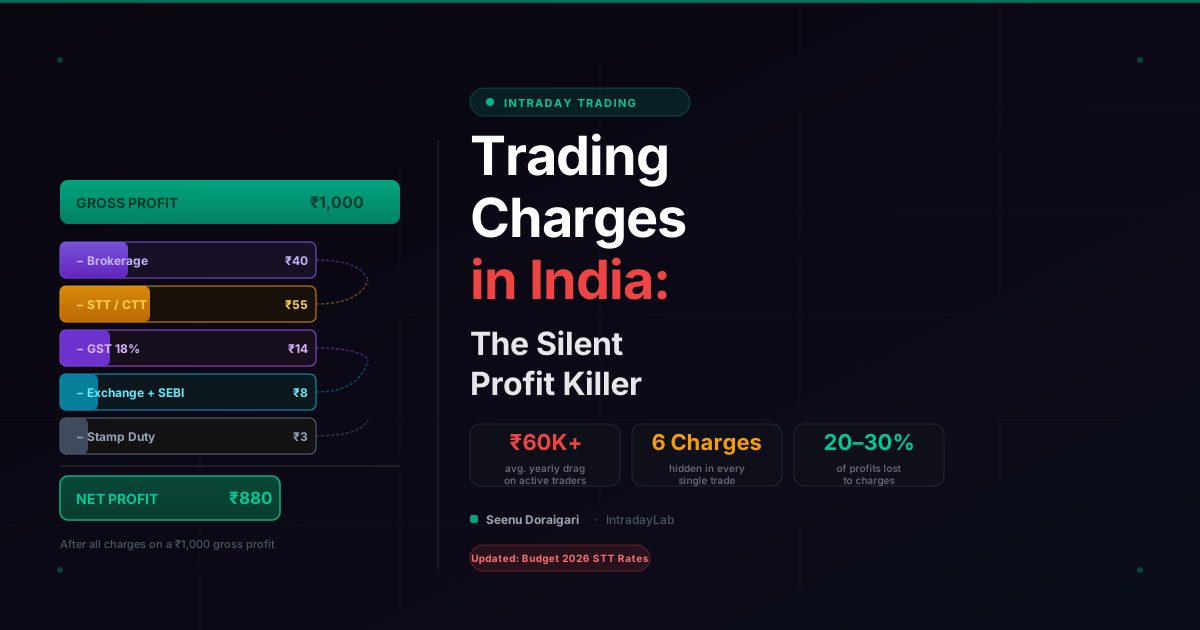
You buy 500 shares of a stock at ₹100. The price moves to ₹102. You sell. Your gross profit is ₹1,000.
How much do you actually keep?
Most traders say: "₹1,000 minus a small broker fee."
The real answer, depending on your broker and segment: ₹850 to ₹940.
That means ₹60 to ₹150 left your account silently, automatically, before you even closed the trade tab. And that's on a single ₹1,000 gross profit. Now multiply across 200 trades a month.
This is the silent profit killer nobody talks about.
Why Charges Matter More Than Strategy
Here's a statement that will sound wrong at first:
A mediocre strategy with excellent cost management can outperform a great strategy with poor cost awareness.
This is not a motivational claim. It's arithmetic.
Let's say you have a strategy with:
- 50% win rate
- Average win = ₹500, Average loss = ₹400
- Expectancy per trade = +₹50
Across 200 trades/month, your theoretical edge = ₹10,000.
Now add ₹40 in charges per trade across 200 trades = ₹8,000 in costs.
Your real monthly profit: ₹2,000. Not ₹10,000.
Increase charges to ₹60 per trade and you're left with zero — from a profitable strategy. This is not hypothetical. This is what happens to most intraday traders who are "almost profitable" and can't figure out why.
The Hard Truth
Your strategy's edge is not your profit. Your strategy's edge minus all trading charges is your profit. A 0.15% charge on both sides of a trade means you need the stock to move at least 0.15% just to break even — before making a single rupee.
The 6 Charges Inside Every Indian Trade
Every time you place a trade in India — equity, F&O, or commodity — up to six different charges are automatically deducted from your account. Most traders know one or two. Almost none know all six.
Here they are, in order of typical impact:
1. Brokerage
This is the only charge your broker controls. For discount brokers (Zerodha, Upstox, Angel One, Groww, Fyers, Dhan):
- Equity Intraday: ₹20 flat per order, or 0.03% — whichever is lower
- Equity Delivery: ₹0 (free at all major discount brokers)
- F&O Futures & Options: ₹20–₹25 flat per order
- Commodity: ₹20 flat or 0.03%
Note: brokerage is charged on both buy and sell — so a round trip costs two orders' worth.
At ₹20 per order × 2 (buy + sell), a single intraday trade costs ₹40 in brokerage alone before the trade even moves.
2. STT — Securities Transaction Tax (Revised April 2026)
STT is the biggest hidden cost most traders don't calculate. It is charged by the government and collected automatically by exchanges. You pay it whether you profit or lose.
Updated Budget 2026 rates (effective 1 April 2026):
| Segment | Rate | Applied On |
|---|---|---|
| Equity Delivery | 0.1% | Both buy and sell |
| Equity Intraday | 0.025% | Sell side only |
| F&O Futures | 0.05% (was 0.02%) | Sell side only |
| F&O Options | 0.15% (was 0.10%) | Premium sell side |
| Commodity (CTT) | 0.01% | Sell side only |
The F&O rate hike in Budget 2026 was significant. For a single NIFTY futures trade at 24,800 with lot size 75, the STT alone jumped from approximately ₹279 to ₹744 per round trip. That is a 166% increase in one tax line item alone.
F&O Futures STT was raised 150% to 0.05% effective 1 April 2026. F&O Options STT rose from 0.10% to 0.15%. If you're using a brokerage calculator that hasn't been updated, your cost estimates are significantly wrong. Our calculator uses the current 2026 rates.
3. Exchange Transaction Charges
These are fees charged by the exchange (NSE, BSE, or MCX) for processing your trade. They're tiny per trade but unavoidable.
| Segment | Rate |
|---|---|
| Equity (Intraday & Delivery) | 0.00335% on turnover |
| F&O Futures | 0.00019% on turnover |
| F&O Options | 0.053% on premium turnover |
| Commodity (MCX) | 0.00026% on turnover |
These look small in isolation. But at scale — 200 trades/month — they aggregate meaningfully.
4. GST at 18%
GST is charged on brokerage + exchange transaction charges + SEBI charges — not on STT or stamp duty. At 18%, this means you're paying tax on taxes and fees, which creates a compounding effect.
If your brokerage is ₹40 and exchange + SEBI fee is ₹5, GST = ₹8.10. That's an extra 20% on top of what your broker charges.
5. SEBI Turnover Fee
SEBI charges ₹10 per crore of turnover (0.000001 of turnover) as a regulatory fee. On a ₹1 lakh trade, this is literally ₹0.10. But it's there, it's mandatory, and it scales linearly with your trading volume.
6. Stamp Duty
Stamp duty is charged on the buy side only and is a national uniform rate since July 2020:
| Segment | Rate on Buy Value |
|---|---|
| Equity Intraday | 0.003% |
| Equity Delivery | 0.015% |
| F&O Futures | 0.002% |
| F&O Options | 0.003% |
| Commodity | 0.002% |
This one often gets ignored because it's smaller than the others. Over a year of active trading, it adds up to hundreds of rupees that traders don't account for.
A Real Trade Breakdown: Where Your ₹1,000 Goes
Let's calculate an actual intraday equity trade with Zerodha:
- Stock: 500 shares
- Buy price: ₹100
- Sell price: ₹102
- Gross Profit: ₹1,000
| Charge | Calculation | Amount |
|---|---|---|
| Brokerage | ₹20 × 2 orders | ₹40.00 |
| STT | 0.025% × ₹51,000 (sell value) | ₹12.75 |
| Exchange Fee | 0.00335% × ₹1,01,000 (turnover) | ₹3.38 |
| SEBI Fee | 0.000001 × ₹1,01,000 | ₹0.10 |
| Stamp Duty | 0.003% × ₹50,000 (buy value) | ₹1.50 |
| GST | 18% × (₹40 + ₹3.38 + ₹0.10) | ₹7.83 |
| Total Charges | ₹65.56 | |
| Net Profit | ₹1,000 − ₹65.56 | ₹934.44 |
6.5% of your gross profit is gone. On this trade.
Now consider that in a losing trade, those same ₹65 are added to your loss. A trade that "only" lost ₹500 actually cost you ₹565.56.
The Real Math
On an intraday equity trade, expect 5–8% of gross profit to disappear in charges at standard broker rates. For F&O options, this can exceed 15–25% on smaller premium moves due to the higher STT rate introduced in Budget 2026.
The Monthly and Yearly Reality
Let's model a typical active intraday trader:
- 8 trades per day (4 round trips)
- 20 trading days per month
- 160 trades/month
- Average charge per round trip: ₹55
Monthly charge drain: ₹4,400 Yearly charge drain: ₹52,800
That's over ₹50,000 leaving your account every year — without a single bad trade factored in. Just the mechanical cost of showing up to trade every day.
For an F&O trader:
- 4 options trades per day × 20 days = 80 trades/month
- Average STT per options trade (post Budget 2026): ₹80–₹150
- Monthly STT alone: ₹6,400 to ₹12,000
- Add brokerage, GST, exchange fees: easily ₹12,000–₹20,000/month
These are not estimates designed to shock. They are arithmetic.
Most traders who "almost break even" or "need one more good month" are not failing at strategy. They're failing at cost arithmetic. The charges are extracting their edge month after month, and the strategy never gets a fair chance to prove itself.
The Scalping Problem: Why Low R:R Strategies Struggle
Scalping is the most charge-sensitive trading style that exists.
A scalper targets ₹0.20–₹0.50 per share on large quantities. On 1,000 shares with a ₹0.30 target, gross profit = ₹300.
On that same trade, total charges with Zerodha = approximately ₹50–₹65.
That means 15–20% of the entire profit evaporates before you book anything.
For this trade to even be worthwhile, the stock has to move more than ₹0.065 per share just to cover charges — before you profit a single paisa.
Now imagine doing 30 scalps a day. Charges alone: ₹1,500–₹1,950. Your scalping strategy needs to generate more than this daily gross just to break even — every single day.
This is why most retail scalpers fail. Not because their entries are wrong, but because the math never worked in the first place at their position size and frequency.
What Experienced Traders Know
Professional traders calibrate three things together, not separately:
- Strategy edge — win rate × R:R
- Position sizing — to match risk tolerance
- Charge efficiency — to protect the edge from being taxed away
All three must align. A 1:1 R:R strategy with a 52% win rate has almost no edge — and charges will push it into consistent losses. The same trader switching to 1:2 R:R at 40% win rate can be profitable after charges.
This is not strategy theory. It is cost-adjusted expected value.
How to Use a Calculator Before Every Trade
The professional approach is simple: calculate the exact breakeven before placing the trade.
The breakeven tells you the minimum price move required in your favour before the trade becomes profitable after all charges.
Formula:
Breakeven per share = Total charges ÷ Quantity
If total charges = ₹65.56 on 500 shares, breakeven = ₹0.131 per share.
The stock must move at least ₹0.131 in your direction before you profit. If your target is ₹0.10, the trade is structurally loss-making — charges exceed your target.
Knowing this before entry changes everything.
Before Every Intraday Trade
Open a brokerage calculator. Enter your buy price, sell price, and quantity. Check the net profit and breakeven. If the breakeven is larger than your target, either resize the trade or skip it entirely. This habit alone separates professional traders from retail.
Use Our Brokerage Calculator — Updated for Budget 2026
We built a free, accurate brokerage calculator specifically for Indian traders — covering all 6 top brokers and all segments including the new Budget 2026 STT rates.
What it does:
- Calculates exact brokerage, STT/CTT, GST, exchange fees, SEBI levy, and stamp duty
- Shows visual charge breakdown so you see where your money goes
- Gives you breakeven per unit and return on capital
- Compares all 6 brokers side-by-side on the same trade
- Covers Equity Intraday, Equity Delivery, F&O Futures, F&O Options, and MCX Commodity
👉 Open the Brokerage & Tax Calculator →
It takes 20 seconds. It can save you thousands.
Practical Strategies to Reduce Charge Impact
You can't eliminate charges. But you can manage them intelligently:
1. Trade higher R:R setups A 1:3 R:R trade has the same total charge cost as a 1:1 trade — but 3× the potential reward. Charges become a smaller percentage of profit as your target grows.
2. Avoid overtrading Every additional trade adds a fixed ₹40–₹80 in base charges regardless of outcome. The fewer trades you take — at the same quality — the better your net result.
3. Size positions correctly On smaller quantities, fixed brokerage (₹20/order) becomes a larger percentage of the trade. 50 shares at ₹100 = ₹5,000 trade, but brokerage alone is ₹40 = 0.8% of turnover. At 500 shares, brokerage = 0.08% of turnover. Sizing up at the same risk improves charge efficiency.
4. Use delivery for medium-term trades Zero brokerage on delivery removes the biggest variable charge. If your holding period is more than a day, delivery can be more cost-efficient despite higher STT.
5. Choose brokers wisely for your style For frequent options traders where flat ₹20/trade applies, all discount brokers are roughly equivalent. For high-value single trades, percent-based brokers like Zerodha may cost less than flat ₹25 at Angel One. The difference is small but worth knowing.
The Mindset Shift That Changes Everything
Most traders think about charges once when they open their account. After that, charges become invisible background noise — something that "just happens."
Professional traders treat charges as a live operating cost — the same way a business owner tracks rent, payroll, and utilities.
The difference is not intelligence. It's awareness.
Once you start calculating your real profit — gross minus all charges — several things happen immediately:
- You stop taking impulsive trades that don't meet the breakeven threshold
- You become more selective about setups, which improves win quality
- You start optimizing position size for charge efficiency
- You stop confusing "high activity" with "high profitability"
This is not a trading system change. It is a cost awareness upgrade. And it's free.
Final Thought
There are two types of traders in India.
The first type trades hard, books "profits" frequently, and wonders why their account doesn't grow. At year-end, they've made thousands of gross profit that disappeared into the system.
The second type trades selectively, calculates before entering, and protects what they make. Their number of trades is lower. Their quality of outcome is higher. Their account grows.
The difference is not talent, capital, or years of experience.
It is whether they account for the six charges inside every single trade.
Before your next trade: Calculate your real profit in 20 seconds →