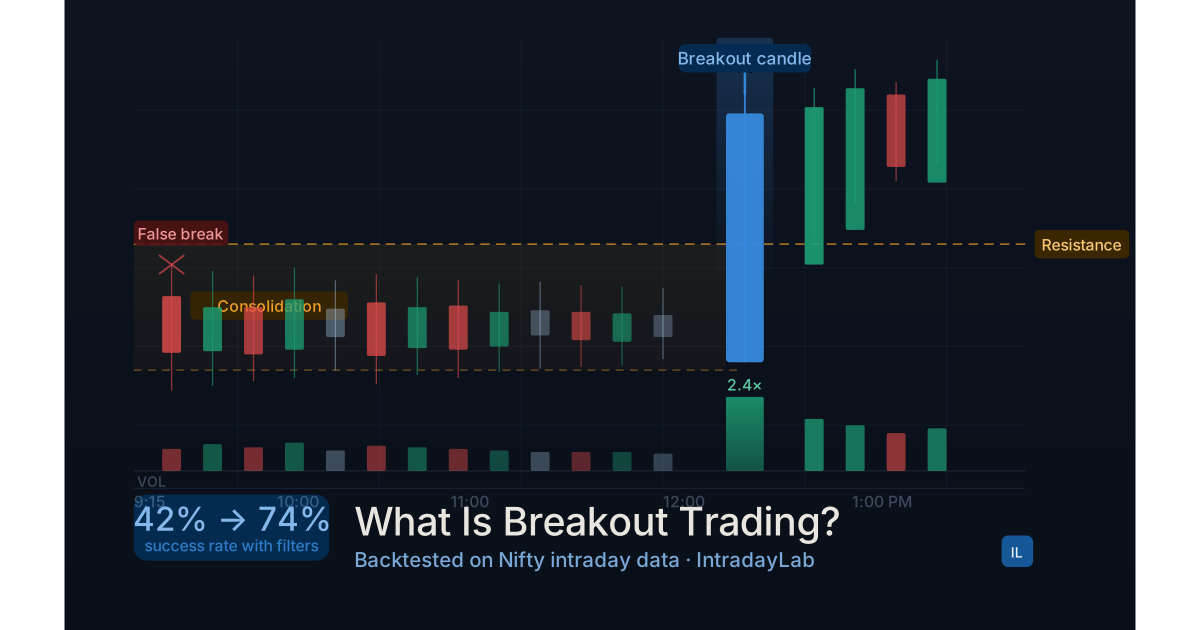
Every trader thinks they can spot a "real" breakout. The data says 58% of the ones they enter fail. The difference between the working ones and the traps is something almost nobody checks.
What Breakout Trading Actually Is
Breakout trading is the strategy of entering a position when price moves decisively beyond a defined boundary — a resistance level, consolidation range, opening range, or prior session high — on the expectation that the move will continue in the breakout direction.
The logic is straightforward. When price has been constrained within a range, opposing forces are in balance. Buyers and sellers are roughly matched. When one side finally overwhelms the other, price breaks out of that balance zone — and if the breakout has genuine conviction behind it, it tends to move quickly and meaningfully in the breakout direction before finding new equilibrium.
That's the setup. The problem is that markets generate dozens of false starts for every genuine breakout. Price pokes above resistance, triggers stops and breakout entries, then reverses as the move lacks participation. Learning to distinguish between the two is the entire skill.
The Breakout Types That Actually Appear on Nifty
Before getting into what separates real from fake, it's worth knowing which breakout types show up most reliably on Nifty intraday charts.
Opening Range Breakout
The 9:15–9:45 AM range sets initial battle lines. Break above on volume = bullish control. Break below = bearish. Most studied setup on Nifty intraday charts.
Consolidation Breakout
After significant move, price compresses. Series of candles with decreasing range (flag/rectangle). Break of compression on expanding volume = entry signal.
Key Level Breakout
Previous highs/lows, weekly levels, round numbers, HVN zones. Clear through = acceleration. Most dramatic follow-through when these break due to stop-loss clusters.
The Opening Advantage
The opening range breakout is the most consistent across the entire dataset because it captures the resolution of overnight positioning. Institutional orders from overnight get filled in opening minutes, creating the range. When that range breaks decisively, it reflects genuine shift in session control.
What the Backtest Actually Showed
Across twelve months of Nifty intraday data, the raw numbers on breakout success rates were humbling.
Without any filter, breakout entries — defined as price closing one candle above a defined level — succeeded only 42% of the time. That means more than half of all unfiltered breakout entries failed. This is not a usable edge on its own. Almost every retail trader entering breakouts is operating here — and losing money.
But when filters were applied, the numbers shifted considerably:
| Breakout Setup | No Filter | Volume Filter | Volume + Session Bias |
|---|---|---|---|
| Opening range break | 44% | 61% | 71% |
| Consolidation break | 39% | 58% | 67% |
| Key level break | 46% | 63% | 74% |
The Filter Impact
Volume confirmation alone lifted success rates by 17–20 percentage points. Adding session bias lifted them further. A key level break with volume confirmation on a strong-bias session worked nearly three quarters of the time across the dataset. The setup is weak. The filters create the edge.
The Most Important Filter — Volume
If there is one thing that separates every professional breakout trader from every amateur, it is this: professionals never take a breakout without volume confirmation.
When price breaks a level on low or declining volume, the move is almost certainly a false breakout. There simply isn't enough participation to sustain it. Retail stop-losses trigger, providing a brief pop above resistance, but no institutional buying is following through. Price exhausts quickly and reverses.
When price breaks a level on significantly above-average volume — typically 1.5x to 2x the average volume for that time of day — it signals genuine participation. Institutions are involved. The order flow behind the move is real. That breakout has a statistically much higher probability of following through.
On Nifty specifically, volume on the breakout candle compared to the average of the previous ten candles is the cleanest real-time filter available. It doesn't require any special indicator — just the volume bars visible on any charting platform.
This single filter, applied consistently, would have eliminated the majority of false breakout entries in the data.
The Second Filter — Session Bias
Volume confirms participation. Session bias confirms direction.
A breakout to the upside on a session where global futures were strongly positive, the previous day closed near highs, and Bank Nifty is leading has a very different probability profile than a breakout to the upside on a session where everything is mixed and Nifty is choppy.
Session bias is not a precise calculation — it's a reading of the overall market context at the time the breakout forms.
✓ Check Global Futures
Are SGX Nifty and global markets supporting this direction? Positive global = upside bias. Negative global = downside bias.
✓ Check Previous Close
Did yesterday close near highs on strong delivery? Close near lows on weak delivery? Continuation is more likely than reversal.
✓ Check Bank Nifty
Bank Nifty is 40%+ of Nifty weight. If BankNifty is weak but Nifty breakout is strong upside, it's suspect.
Trading With the Wind
When the breakout direction is aligned with session bias, you are trading with the wind at your back. When it's against bias — for instance, an upside breakout attempt on a weak opening in a negative global environment — the probability of failure is significantly higher, even with volume present.
The combination of both filters — volume and session bias — is what produced the 67–74% success rates in the backtest. Neither filter alone is as powerful as both together.
False Breakouts — How to Spot Them Before They Trap You
False breakouts have a recognisable signature on the chart if you know what to watch for.
The classic pattern is a sharp, fast move above a key level — typically on a single candle — followed immediately by a candle that closes back inside the range. The first candle triggers breakout entries and stop-losses above resistance. The reversal candle is the institutional response — liquidity has been taken, and there's nothing sustaining the move.
Look for these specific warning signs before entering any breakout:
- The breakout candle has a long upper wick, meaning price reached above the level but couldn't close there
- Below-average volume on the breakout bar
- Choppy price action in candles leading to the break — no momentum building
- Breakout occurs in 12:00 PM to 1:30 PM low-volume window
The lowest-quality setups in the dataset were midday breaks with below-average volume. These failed 70%+ of the time.
The Best Breakout Window on Nifty
Not all breakout opportunities are created equal. Session timing had a measurable effect on success rates across the data.
✓ Best: 9:15–10:00 AM
Opening range resolution. Highest-quality window. Captures overnight positioning release. Most consistent follow-through with volume confirmation.
Good: 10:30 AM–12:00 PM
Post-consolidation breaks. Cleaner than opening (less noise). Price compresses then releases. Produces meaningful intraday moves when resolved with volume.
✗ Worst: 12:00–1:30 PM
Lowest-volume period of session. Institutional participation drops. Highly susceptible to thin-volume traps. Highest false-breakout rate in entire dataset.
The Timing Edge
If you're going to trade breakouts on Nifty, bias heavily toward opening and mid-morning windows. Treat anything in the 12:00–1:30 PM midday valley with extreme skepticism. The statistical difference between these windows is measurable and significant.
Position Sizing and Stop Placement for Breakout Trades
A breakout setup with the right filters still requires disciplined execution to be profitable in practice. Two mechanics matter most.
Stop Placement
The stop on a breakout entry goes below the breakout level — not at an arbitrary distance from entry. For an opening range breakout to the upside, the stop is placed below the opening range low. For an intraday consolidation break, it sits below the consolidation range.
This placement is logical because a genuine breakout should not return inside the broken range. If price re-enters the range after a supposed breakout, the setup has failed by definition. A stop inside the range catches that failure cleanly.
Position Sizing
Because breakout stops are often wider than scalp trades — requiring price to be clearly wrong before stopping out — position size must be adjusted accordingly. Risking 1% of account capital per trade means using a smaller position when the stop is wide, not the same size as a trade with a tight stop.
Many traders size breakout trades the same as every other trade, then wonder why a single stopped-out breakout costs them an outsized loss. The stop distance drives the position size — always. A trade with a 40-point stop requires different sizing than one with an 80-point stop, even if both risk 1% of capital.
Breakout Trading vs Trend Following — What's the Difference?
The two strategies are often confused because they both involve buying strength and selling weakness. The distinction matters in practice.
Trend Following
- • Enters on pullbacks within trend
- • Holds for extended periods
- • Trend is the context
- • Trades multi-day moves
Breakout Trading
- • Enters on level break
- • Exits after momentum exhausts
- • Level break is the signal
- • Captures immediate momentum
In practice, the best breakout trades occur within the context of a broader trend. A key level breakout in the direction of the daily trend, on volume, is the highest-conviction setup in this entire framework. The trend provides the bias, the breakout provides the entry.
The Combo Edge
Trading breakouts against a clearly established trend — fading downtrend bounces above resistance, for example — was consistently the worst-performing trade type in the data. Always check the larger-timeframe trend before entering any breakout setup. Breakouts aligned with trend = 70%+ success. Breakouts against trend = 30%+ success.
What Breakout Trading Teaches You About Markets
After running through hundreds of these setups, one thing becomes very clear: most of what gets called a "breakout" in retail trading communities is not a breakout at all.
A candle closing above a line is not a breakout. A resistance level being touched is not a breakout. A fast move on no volume is not a breakout.
A genuine breakout is a decisive, volume-confirmed move beyond a meaningful level, in the direction of the session's broader bias, that sustains itself above the broken level for more than one or two candles. That's it.
That narrows the field dramatically. Instead of seeing ten possible breakout entries in a session, you see two — maybe three. But those two or three have a genuinely different probability profile than the noise they replaced.
In breakout trading, as in most things in markets, the value is not in doing more. It's in doing the right things less.
Frequently Asked Questions
Data references: 12 months of Nifty 50 intraday 5-minute data. Success rates measured as breakouts that continued at least 1R in breakout direction. Testing included opening range, consolidation, and key-level breakouts. Past statistical tendencies do not guarantee future results. Not investment advice.