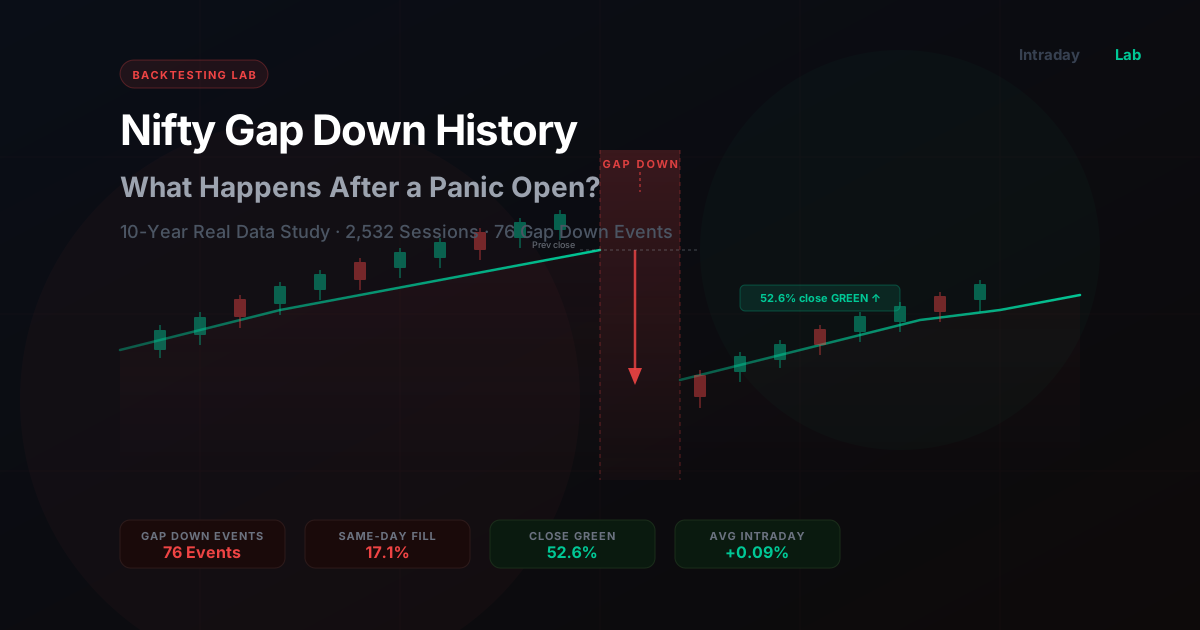
The market opens deep in red. Global cues are negative. News is bad. And within seconds, most traders make the same decision: "Let's short this." The data says that decision is wrong more than half the time.
A Gap Down Open Feels Like Panic
The market opens deep in red.
Charts look weak. News is bad. Global cues are negative. Traders in every Telegram group are already sharing their bearish setups.
And within seconds, the instinct kicks in: short this thing.
But here's the uncomfortable truth the data reveals after 10 years of Nifty sessions:
By the time the market opens, the panic is often already priced in.
So what actually happens after a gap down? Does the market continue falling? Does it reverse sharply? Do gap downs ever fill?
At IntradayLab, we don't guess. We tested it — across every single gap down event in Nifty 50 from 2016 to 2026.
The results will change how you think about panic opens.
What Is a Gap Down in the Stock Market?
A gap down occurs when the market opens significantly lower than the previous day's closing price — with no trades executed in between.
A simple example:
- Previous Close: ₹25,000
- Today's Open: ₹24,700
- This is a gap down of −1.2%
It usually reflects fear accumulated overnight — news that broke after market hours, global market crashes, or institutional positioning before the Indian open.
Why gap downs happen — the main triggers:
- Global market selloffs (US, Asia, Europe)
- Geopolitical events or war escalation
- Poor earnings from index heavyweights
- Unexpected RBI/Fed policy decisions
- Institutional selling pressure before open
But here's what most traders miss: the cause of the gap down is already known before 9:15 AM. Every participant has had hours to absorb the news. Which means the real question isn't what caused the gap — it's what happens in the 6.25 hours that follow.
The Data: 10 Years of Nifty Gap Downs
Methodology: We used daily OHLC data for Nifty 50 from January 2016 to March 2026 — 2,532 trading sessions. A gap down is defined as an opening price at least 1% below the previous session's close. A gap is considered filled if, during the same session, Nifty's high touches or crosses above the previous day's closing price.
This gave us 76 clean gap down events — roughly 6 to 7 per year in normal market conditions.
Chart 1
Gap Down Events by Year (2016–2026)
Tap a bar for yearly stats — 2019 and 2023 had zero gap down events
Two years dominate this dataset: 2020 (18 events) and 2022 (18 events). Notably, 2019 and 2023 had zero gap downs of 1%+ — calm trending markets simply don't produce them. If you're calibrating a strategy on a period that happened to include 2020, you're partly calibrating on a crisis that may not repeat at that frequency.
Key Takeaway
The Finding That Will Surprise You
Let's cut straight to it. This is what the data shows after a gap down open:
52.6% of gap down days close above the open. The average intraday return from open to close is +0.09%. Gap down days are, on average, slightly bullish for intraday traders — not bearish. The panic at the open is frequently an overreaction.
Read that again. More than half of all gap down sessions — days where Nifty opened 1% or more below yesterday's close — ended with the price higher than where it opened.
This directly contradicts the most common retail trading belief: gap down = keep shorting.
The instinct to short a gap down is understandable. It feels like momentum. It looks like weakness. But the data shows that the sellers often exhaust themselves at the open, and buyers step in at the lower prices.
The overall summary:
| Metric | Gap Down Data |
|---|---|
| Total events (2016–2026) | 76 |
| Same-day fill rate | 17.1% |
| Bullish close rate | 52.6% |
| Avg intraday return (open→close) | +0.09% |
| Avg next-day return | −0.04% |
| Median gap size | −1.57% |
| Best single-day intraday bounce | +11.55% (20 Mar 2020) |
| Worst single-day intraday drop | −6.07% (23 Mar 2020) |
Gap Fill Rate: The Number That Shocks Traders
Only 17.1% of gap down days see the price recover all the way back to the previous close.
That is 1 in every 6 events. If you're trading gap downs with an expectation that the gap will fill, you will be wrong 5 out of 6 times.
But here's the nuance that changes everything: when a gap does fill, the average intraday return on that day is +2.05%. When it doesn't fill, the average return is −0.32%.
A gap fill on a gap down day is not just a recovery — it's a signal that an extremely strong reversal is underway. It's the exception, not the rule. But when it happens, it's worth riding.
Don't build your gap down trade around the expectation of a gap fill. It happens only 17.1% of the time. But when it does fill, the avg return is +2.05% — nearly 6× better than a non-fill day. Gap fills on gap down days are high-conviction reversal signals.
Gap Size Changes Everything
Not all gap downs carry the same risk or opportunity. The data splits cleanly into four buckets — and one of them is a trap most traders walk into.
Chart 2
Bullish Close % by Gap Size
Tap a bucket to see full stats — the middle bucket is the real danger zone
The small gap (−1% to −1.5%) — 34 events: The most common. And actually the most bullish — 61.8% close green with an average return of +0.07%. Small gap downs are frequently over-reactions to overnight noise. Buyers absorb the initial selling quickly. If you're going to trade gap downs, this bucket has the cleanest edge.
The medium gap (−1.5% to −2%) — 16 events — THE DANGER ZONE: This is where retail traders get hurt. Only 31.2% close bullish. Fill rate drops to just 6.2%. Average return is −0.10%. These gaps are large enough to reflect real institutional selling conviction, but not large enough to trigger panic exhaustion or oversold bounces. This is the worst bucket by almost every metric. Avoid buying the open here.
The large gap (−2% to −3%) — 14 events: Counterintuitively, better than the medium bucket. Zero gap fills — not a single one in 10 years — but 57.1% closed green with a near-flat average return. The market absorbs large selling, finds support, and recovers intraday without filling the gap. Patient traders who waited for confirmation after the open did fine here.
The extreme gap (below −3%) — 12 events: The scariest opens produce the best contrarian opportunities. 50% closed green, average intraday return of +0.52%, and best next-day return of +0.32%. These are panic events — COVID circuit days dominate this bucket. The best single-day bounce in our dataset (+11.55% on 20 March 2020) came from this category. Extreme fear creates extreme opportunity for those who can stomach the volatility.
Critical Pattern
The −1.5% to −2% medium bucket is the most dangerous for long trades — 6.2% fill rate, 31.2% bullish close, −0.10% avg return. Ironically, smaller gaps (−1% to −1.5%) and larger gaps (−2%+) both perform better. The medium zone is where conviction meets exhaustion most dangerously.
The Monday Effect — It Gets Worse
In our Gap Up analysis, we found that Monday was the most frequent gap up day — and also the most bullish. For gap downs, Monday tells a completely different story.
Chart 3
Gap Down Performance by Day of Week
Monday is the most frequent and worst-performing. Wednesday is the best opportunity.
Bar width = event frequency · Percentage shown = bullish close rate
Monday accounts for 28 of 76 gap down events — 37% of all occurrences. That's almost double the expected 20% if events were uniformly distributed. Two full days of global market activity over the weekend creates the conditions for large opening adjustments every Monday morning.
But unlike Monday gap ups (which closed green 58.3% of the time), Monday gap downs close green only 42.9% of the time — the worst bullish close rate of any day. The weekend's bearish sentiment doesn't just create the gap; it carries through the entire session.
Wednesday is the exact opposite. Gap downs on Wednesday close green 77.8% of the time, with a 55.6% fill rate and +0.86% average return. Mid-week gaps are typically technical in nature rather than macro-driven — the market finds its footing faster. Wednesday gap downs are the best intraday buying opportunity in this entire dataset.
Wednesday gap down events: 77.8% bullish close · 55.6% fill rate · +0.86% avg return. The only day of the week where gap downs reliably reverse. If you must trade gap downs long, Wednesday is your day.
The Clustering Risk Nobody Talks About
One of the most practically important findings in this dataset doesn't show up in standard backtests:
26.3% of gap down events occurred within 4 calendar days of another gap down.
Gap downs cluster. When one arrives, the probability of another within the same week is significantly elevated.
This happens because gap downs are driven by regime changes — COVID in 2020, the Russia-Ukraine rate cycle in 2022. Once a regime of elevated volatility begins, it tends to persist for weeks, not days. 2020 had 18 gap down events. 2022 had 18. Combined they represent 47% of all events in a 10-year dataset.
After the first large gap down, your risk of another within the same week is elevated. Don't bottom-fish aggressively after one gap down. The data suggests waiting for a regime to stabilise — 2019 and 2023 had zero events precisely because the macro environment had stabilised.
What Happens the Next Day?
The day after a gap down, Nifty closes lower 52.6% of the time — a slight bearish carry-forward — with an average next-day return of −0.04%.
This is essentially flat, but directionally opposite to Gap Up's next-day behaviour (+0.10%). Gap downs don't produce the same next-day bullish continuation that gap ups do.
Next-day return by gap bucket:
| Gap Bucket | Next-Day Avg | Pattern |
|---|---|---|
| −1% to −1.5% | −0.39% | Selling continues |
| −1.5% to −2% | +0.26% | Mild recovery |
| −2% to −3% | +0.15% | Mild recovery |
| Below −3% | +0.32% | Oversold bounce |
Counterintuitively, the largest gaps produce the best next-day recoveries. Panic events burn themselves out faster. Small gap downs — the most common — show the weakest next-day recovery, suggesting the bearish sentiment at that scale can carry into the next session.
Gap Down vs Gap Up: The Complete Comparison
Now that we have both studies, we can answer the question most traders actually want answered: Are gap downs more bearish than gap ups are bullish?
Total events (10yr)
85
76★
Gap ups more frequent
Same-day fill rate
29.4%★
17.1%
Gap ups fill 2× more often
Bullish close rate
44.7%
52.6%★
Gap downs close green more
Avg intraday return
−0.25%
+0.09%★
Gap downs net positive intraday
Monday dominance
28.2%
37%★
Gap downs cluster on Monday more
Monday bullish close
58.3%★
42.9%
Monday gap ups hold better
Best single-day return
+4.86%
+11.55%★
COVID bounce on gap down day
Next-day avg return
+0.10%★
−0.04%
Day after gap up slightly better
★ = stronger result · Both studies: 2,532 sessions, 2016–2026, Nifty 50
The answer is nuanced. Gap downs are not more bearish intraday — in fact gap down days close green more often (52.6%) than gap up days do (44.7%). But gap ups fill more than twice as often (29.4% vs 17.1%), and gap ups produce better next-day returns (+0.10% vs −0.04%).
The asymmetry is real, but it's not in the direction most traders assume. Gap downs are actually the better intraday reversal opportunity — the fear at the open is frequently overdone. Gap ups, by contrast, are more likely to fill on the same day but produce weaker intraday directional moves.
The Python Code
The full gap down analysis reuses the same core methodology as our Gap Up study:
import pandas as pd

df = pd.read_csv("nifty_data.csv")
df['Date'] = pd.to_datetime(df['Date'])
df = df.sort_values('Date').reset_index(drop=True)

df['Prev_Close'] = df['Close'].shift(1)
df['Gap_Pct'] = ((df['Open'] - df['Prev_Close']) / df['Prev_Close']) * 100
df['Intraday_Return'] = ((df['Close'] - df['Open']) / df['Open']) * 100
df['Day_Of_Week'] = df['Date'].dt.day_name()

# Gap filled: for gap downs, price HIGH touches or exceeds prev close
df['Gap_Filled'] = (df['High'] >= df['Prev_Close']) & (df['Gap_Pct'] < 0)

# Filter gap down events (≤ −1%)
gap_downs = df[df['Gap_Pct'] <= -1.0].copy()

print(f"Total gap down events: {len(gap_downs)}")
print(f"Fill rate: {gap_downs['Gap_Filled'].mean()*100:.1f}%")
print(f"Bullish close: {(gap_downs['Close'] > gap_downs['Open']).mean()*100:.1f}%")
print(f"Avg intraday: {gap_downs['Intraday_Return'].mean():.2f}%")

# Day-of-week breakdown
print(gap_downs.groupby('Day_Of_Week')[['Gap_Filled','Intraday_Return']].agg({
    'Gap_Filled': 'mean',
    'Intraday_Return': 'mean'
}).round(3))
The complete analysis with clustering detection, bucket-wise breakdown, and year-on-year charts is available as a downloadable PDF for our Telegram community.
Trader's Quick Reference
| Scenario | Bias | Fill Likely? | Key Stat | Guidance |
|---|---|---|---|---|
| Gap −1% to −1.5% | Bullish lean | ~27% | 61.8% close green | Watch for open bounce — best common bucket |
| Gap −1.5% to −2% | Bearish | ~6% | 31.2% close green | Danger zone — avoid buying open, wait for signal |
| Gap −2% to −3% | Neutral | 0% | 57.1% close green | No fills but recovers — size down, be patient |
| Gap below −3% | Contrarian buy | 25% | +0.52% avg return | Panic events — best mean-reversion opportunity |
| Monday gap down | Avoid longs | ~11% | 42.9% close green | Weekend fear carries through — worst day |
| Wednesday gap down | Best buy | ~56% | 77.8% close green | Highest fill + bullish rate of the week |
| After one gap down | Reduce risk | — | 26% cluster risk | Regime risk — don't bottom-fish aggressively |
7 Data-Backed Findings
1. Gap downs are NOT automatically bearish intraday. 52.6% of gap down days close above the open. The average open-to-close return is +0.09%. The sellers frequently exhaust themselves at the open.
2. The fill rate is very low — 17.1%. Only 1 in 6 gap downs fills the same day. But when it does fill, avg return is +2.05% — a strong reversal signal worth watching for.
3. The medium gap (−1.5% to −2%) is the danger zone. Counterintuitively worse than both smaller and larger gaps. 6.2% fill rate, 31.2% bullish close. The most dangerous bucket for long trades.
4. Monday is the worst day, Wednesday is the best. Monday: 42.9% bullish close, −0.39% avg return. Wednesday: 77.8% bullish close, +0.86% avg return. Day-of-week matters enormously for gap down trades.
5. Extreme gaps (below −3%) produce the best bounces. +0.52% avg intraday return, +0.32% next-day. The best intraday return ever (+11.55%) came from this bucket. Panic creates opportunity.
6. Gap downs cluster during crisis regimes. 26.3% of events came within 4 days of another gap down. 2020 and 2022 alone accounted for 47% of all gap downs in 10 years. The first big gap down is often a warning, not the all-clear.
7. Gap downs produce better intraday reversals than gap ups. Gap down days close green more often (52.6%) than gap up days (44.7%). The fear premium at the open is frequently overdone — more so than the euphoria premium on gap up days.
Frequently Asked Questions
Conclusion
Ten years of Nifty gap down data produces one finding that should change how you think about panic opens:
The market usually recovers from the gap. It usually does not fill the gap.
Gap down days close above the open 52.6% of the time. The average intraday return is positive. The fill rate is low at 17.1%, but when it fills, it signals a powerful reversal day.
The exceptions matter more here than in any other dataset:
- Avoid medium gaps (−1.5% to −2%) — the data is clear that this is the worst bucket
- Monday gap downs carry bearish momentum through the session
- Wednesday gap downs are the best intraday buying opportunity in this dataset
- After one big gap down, reduce size — clustering risk is real
The traders who lose on gap down days are usually the ones who short the open with conviction, only to watch the market quietly recover through the session. The data says the other trade — buying after the initial panic — is the historically supported one.
Not always. Not with large size. But more often than most traders believe.
All data used in this study is sourced from NSE historical records via institutional-grade market data access. The analysis covers 2,532 trading sessions from January 2016 to March 2026. This is a data study, not trading advice. Past market behaviour does not guarantee future results.