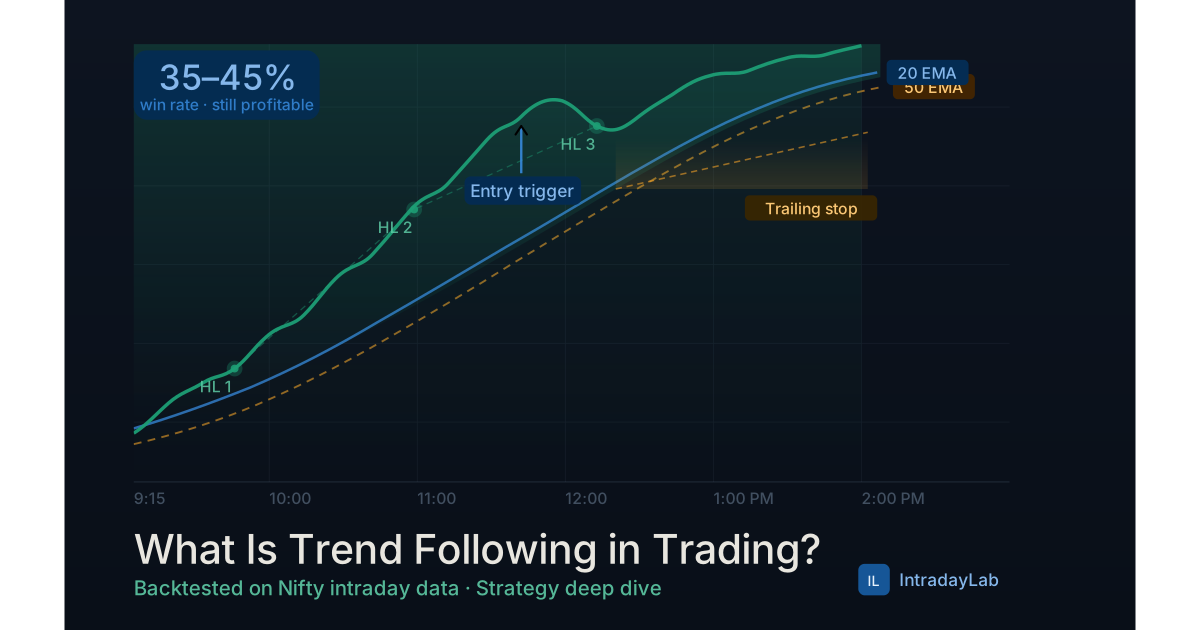
Most traders lose money trying to pick tops and bottoms. Trend following is the exact opposite — it buys after price has already moved up and sells after it has already fallen.
What Trend Following Actually Means
Trend following is a strategy built on one core belief: price that is moving in a direction tends to keep moving in that direction, until something changes.
That's it. No fundamental analysis. No earnings calls. No "fair value" calculations. The price chart is the only input that matters.
A trend follower operating on Nifty buys when Nifty is going up and holds until the trend shows signs of ending. They short when Nifty is going down and hold until that move exhausts. They don't predict the move before it starts — they confirm it has started and join it.
The academic term for this is price momentum. Study after study, across decades of global market data, shows that assets which have been rising tend to continue rising over the near term, and assets that have been falling tend to keep falling. It's one of the most robust anomalies in financial markets — and trend following is the practical strategy built around it.
Why Most Traders Can't Do It
Understanding trend following intellectually is easy. Executing it consistently is one of the hardest things in trading.
The Entry Problem
By the time a trend is confirmed — breakout is clear, momentum is visible, direction is obvious — price has already moved. The trade doesn't feel like an opportunity. It feels like you're late. Your brain registers the gain you already missed and treats the entry as chasing.
The entry that feels most comfortable — buying before the breakout, anticipating the move — is not trend following at all. It's prediction. And it fails far more often. Trend following entries almost always feel wrong in the moment.
Nifty breaking out to a new high after a 200-point rally feels like the worst possible time to buy. A trend follower buys there anyway — because the trend has confirmed.
The Exit Problem
Trends don't end cleanly. They wobble, retrace, test patience, and occasionally reverse sharply before resuming. Most traders exit too early, lock in a small profit, and then watch the trade they exited run another 200 points without them.
How Trend Following Works in Practice
Every trend following system, regardless of complexity, has three components. Understanding these clearly separates traders who apply the strategy correctly from those who apply a distorted version of it.
1. Trend Identification
Determine that a trend exists using defined methods:
- • Price above 50 EMA
- • Higher highs & lows
- • ADX above 25
- • Multiple confirms
2. Entry Trigger
Execute at a specific, logical signal:
- • Breakout above prev high
- • Pullback to 20 EMA
- • Volume-confirmed break
- • Clear risk/reward level
3. Exit Rules
Defined in advance, executed consistently:
- • Trailing stop (not fixed)
- • Trend breaks
- • Momentum reversal
- • Rules, not feelings
The Execution Framework
These three components must be defined before the market opens. The trigger is NOT the trend — it's the moment within a trend that offers best risk-reward. Exit rules must be mechanical, not discretionary. This is what separates working systems from random guessing.
What the Data Shows on Nifty
Trend following on Nifty has a specific statistical signature that every trader should understand before committing to it.
The win rate is low. In well-constructed trend following systems tested on Nifty intraday data, the win rate typically runs between 35% and 45%. That is not a typo. Trend followers lose money on more than half their trades.
The reason the strategy still generates positive expectancy is the reward-to-risk profile. Winning trades average 2.5 to 4 times the size of losing trades. The small, frequent losses are offset by the less frequent but much larger winners — the 3% Nifty trending days where a well-executed trend trade captures 200+ points.
Trend following will feel like it's failing constantly. Three or four small stop-outs in a row is completely normal, even in a working system. The traders who quit after those losses and conclude "trend following doesn't work" are leaving right before the edge manifests. This is where most traders psychologically break.
Here's what the typical distribution looks like across a sample of Nifty trend following trades:
| Outcome | Frequency | Average Size |
|---|---|---|
| Small loss (stopped out) | 38% | −0.8R |
| Scratch / breakeven | 18% | 0R |
| Small win | 22% | +1.2R |
| Large win (trend day) | 22% | +3.8R |
The Math That Matters
The 22% of trades that capture a full trending day carry the entire strategy. Miss those — by exiting too early, using too-tight stops, or not trading on the days they occur — and the system produces nothing. Everything pivots on the few days that work.
Trend Following vs Mean Reversion — Which One Is Right For You?
These two strategies are structural opposites. Understanding both is one of the most useful frameworks in trading.
Mean reversion bets that extended price moves return to average. It has a high win rate, small wins, and occasional large losses when a trend day hits a reversal position hard.
Trend following bets that price continues in its current direction. It has a low win rate, small losses, and occasional large wins when a true trend day develops.
Mean Reversion
- ✓ High win rate (60–70%)
- ✓ Frequent opportunities
- ✗ Small average winner
- ✗ Breaks on trend days
Strong Opening Momentum
The first 30 minutes establish a clear directional bias. Opens strongly, holds the range, no reversal attempt by 10:00 AM. Often precedes sustained moves.
Above-Average Volatility
Trend days require space to move. Sessions with range below 20-day average rarely produce extended moves. High-volatility sessions driven by global cues or institutional positioning.
Volume Confirmation
Volume expands in the direction of the move. Up on rising volume, pullback on declining volume. Volume contraction on breakout = red flag.
The Selection Edge
Not trading on days that don't meet these three criteria is just as important as the entry technique itself. The willingness to skip sessions is what separates traders with edge from those who force low-probability setups.
Most traders accidentally mix the two strategies without realising it. They use mean reversion entries (buying pullbacks, fading extended moves) with trend following exit logic (wide trailing stops), or vice versa. The result is a hybrid that has neither strategy's edge. Pick one. Commit fully.
Nifty spends roughly 30% of its time in meaningful trends and 70% in range-bound or choppy conditions. Mean reversion setups are available more often, but trend following captures the days that produce the largest single-day moves.
The Three Conditions That Make Trend Following Work on Nifty
Not every day is a trend following day. Learning to identify sessions where the approach has a higher probability of working is what separates consistent practitioners from traders who apply it indiscriminately.
Strong Opening Momentum
The first 30 minutes establish a clear directional bias. Opens strongly, holds the range, no reversal attempt by 10:00 AM. Often precedes sustained moves.
Above-Average Volatility
Trend days require space to move. Sessions with range below 20-day average rarely produce extended moves. High-volatility sessions driven by global cues or institutional positioning.
Volume Confirmation
Volume expands in the direction of the move. Up on rising volume, pullback on declining volume. Volume contraction on breakout = red flag.
The Selection Edge
Not trading on days that don't meet these three criteria is just as important as the entry technique itself. The willingness to skip sessions is what separates traders with edge from those who force low-probability setups.
The Biggest Mistakes Traders Make With Trend Following
❌ Tightening Stops
Enter with a stop, price moves in your favour, pulls back slightly, you move stop to breakeven — and get stopped out on normal retracement noise. Then it runs 150 points without you. The stop-tightening trap.
❌ Exiting at Round Numbers
Nifty approaching 24,500 doesn't stop trending because it's round. But traders systematically exit at psychological levels. Trend following requires holding through those levels until the trend deteriorates.
❌ Forcing on Choppy Days
False breakout after false breakout on range-bound sessions. Trend followers force setups where none exist and get stopped out repeatedly. Skipping bad days is part of the edge.
What a Well-Executed Trend Trade Looks Like
To make this concrete, here's the sequence of a clean trend following trade on Nifty:
The previous session closed near its highs with strong institutional buying visible in the delivery data. Global futures are positive overnight. Nifty opens 80 points higher, holds above the opening range high for the first 30 minutes, and makes a new intraday high with expanding volume at 10:15 AM.
That's the entry — a confirmed breakout above the opening range on volume, in the context of a strong previous session close. Stop is placed below the opening range low. No fixed target.
Nifty runs through the morning session, retesting the breakout level once at 11:30 AM before continuing higher. By 1:00 PM the position is +1.8R. Trailing stop has moved up to lock in breakeven.
By 2:30 PM Nifty has moved 180 points from entry. Volume starts declining. The first reversal candle appears. The trailing stop gets hit at +2.6R.
The Discipline That Works
That's trend following. One confirmed entry, disciplined exit mechanics, and a 2.6R result on a day that produced a genuine trend. The same system will produce five or six −0.8R losses in the sessions that don't follow through — and the expectancy still works because the big winners more than compensate.
The Real Reason Trend Following Works Long Term
Markets trend because of human behaviour. When institutions accumulate a position, they can't buy everything at once without moving price against themselves. They buy in stages — price rises, retail traders notice, more buyers enter, institutions add more. That's a trend.
When buying exhausts itself, the move stalls. Late retail buyers hold the top. Selling starts. A new trend in the opposite direction begins.
Trend following doesn't predict any of this. It waits for the cycle to become visible in the price chart and joins the move in progress. It doesn't need to know why institutions are buying — only that they are. And in a market where institutions are always moving size, that edge doesn't disappear.
Frequently Asked Questions
Data references: Nifty 50 intraday and swing analysis. Win rate and reward-to-risk figures are representative of systematic trend following approaches on NSE data. Past statistical tendencies do not guarantee future results. Not investment advice.