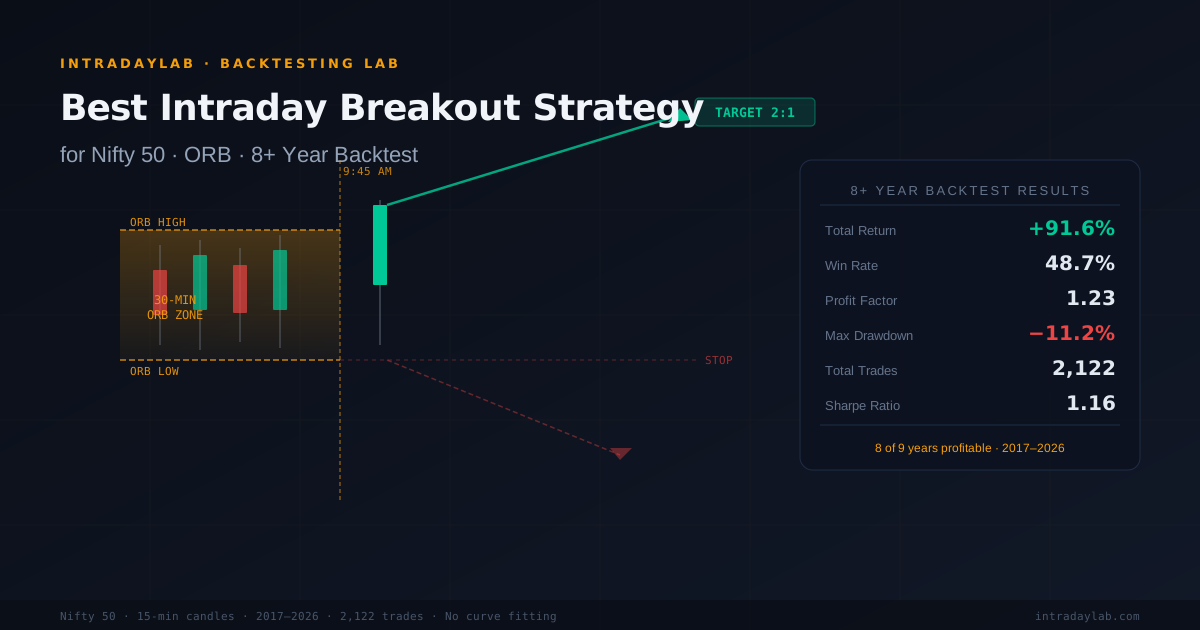
Every intraday trader has tried a breakout strategy. Most failed. Fake moves, sudden reversals, stop-loss hits within minutes. We ran the 30-minute Opening Range Breakout on Nifty across 8+ years and 2,122 trades. Here is every number — the good, the bad, and the boring.
The Problem With Breakout Strategies
Breakout strategies are seductive for a simple reason: the logic is clean.
Price breaks a level → momentum carries it further → you profit.
The problem is that most breakouts fail. Price triggers your entry and immediately reverses — leaving you holding a loss wondering what went wrong. This is the experience of most retail traders who attempt breakout trading in Nifty 50.
But "most breakouts fail" is not the same as "breakout strategies don't work." The question is whether there is a specific, rule-based version that has a statistical edge over many years of real data — one where the wins are sized correctly to more than offset the losses.
That is what this study tests.
What Is an Opening Range Breakout?
The Opening Range Breakout (ORB) is one of the oldest intraday strategies in systematic trading. The concept is simple:
Step 1 — Wait for 9:45 AM IST. Note the high and low of the first two 15-min candles (9:15–9:45 AM). This is your Opening Range.
Step 2 — Entry. Buy if price breaks above the ORB high. Short if it breaks below the ORB low. One trade per day only.
Step 3 — Stop loss. For longs → SL at the ORB low. For shorts → SL at the ORB high. Your risk is the full ORB range.
Step 4 — Target. 2× your risk (2:1 reward-to-risk). If no target is hit, exit at 2:30 PM IST. No overnight positions.
Step 5 — Optional filter. Skip days where the ORB range is below 40 Nifty points. Tiny ranges lead to false breakouts.
No indicators. No moving averages. No VWAP overlays. Pure price action against a structural level the market itself defines each morning.
Key Takeaway
Our Data and Methodology
| Parameter | Detail |
|---|---|
| Instrument | Nifty 50 index (spot) |
| Timeframe | 15-minute OHLC candles |
| Period | July 2017 to March 2026 |
| Total trades | 2,122 |
| Strategy | 30-min ORB, 2:1 RR, EOD exit 2:30 PM |
| Curve fitting | None applied |
Transaction costs and slippage are not included. This is standard for index-level strategy research — it gives you the raw edge before friction. The implications are addressed in the limitations section.
The Core Results
| Metric | Value |
|---|---|
| Total Return | +91.6% |
| Win Rate | 48.7% |
| Profit Factor | 1.23 |
| Max Drawdown | −11.2% |
| Sharpe Ratio | 1.16 |
| Total Trades | 2,122 |
The first thing to notice: the win rate is below 50%. This strategy loses more often than it wins. For most retail traders, that sounds like a bad strategy. It is not.
The edge is not accuracy — it is asymmetry. When the trade works, it captures a full 2:1 reward. When it fails, the loss is capped at the range width. Over 2,122 trades across 8+ years, that asymmetry compounds into a +91.6% total return with a Sharpe ratio of 1.16.
This is a fundamental insight most retail traders never internalise: you do not need to win more than half the time to be profitable. You need your winners to be larger than your losers.
Key Takeaway
The Equity Curve — 8 Years of Truth
This is what the strategy actually looked like in real time — every win, every losing streak, every flat patch. The big surge in 2020 (COVID crash + recovery) is clearly visible. So is the slow grind through 2021–2023. Notice the strategy never fully collapsed — even its worst year (2023) was a −1.2% loss.
Equity Curve
Cumulative PnL % — Jul 2017 to Mar 2026
Monthly cumulative return. No transaction costs. 2,122 trades.
The equity curve reveals something important: this is not a smooth, consistent compounder. Extended flat periods where the strategy produces nothing are normal. The 2020 spike is real, but it was a product of extraordinary volatility — not a repeatable template. A trader who calibrated expectations on 2020 alone would be disappointed in the years that followed.
Year-by-Year Breakdown — No Cherry Picking
The most important test of any strategy: does it work every year, or just when conditions are perfect? Below is the complete record. Eight out of nine full years were profitable. 2023 was the only losing year — a classic sideways, choppy market that kills breakout strategies.
Year-by-Year Breakdown
Annual PnL % — 2017 to 2025
Click a bar to highlight that year in the table below. 8 of 9 years profitable.
| Year | Trades | Win Rate | Total PnL | Avg/Trade | Verdict |
|---|---|---|---|---|---|
| 2017 | 111 | 49.5% | +5.38% | +0.048% | Positive start |
| 2018 | 245 | 50.6% | +17.20% | +0.070% | Strong year |
| 2019 | 241 | 47.7% | +7.75% | +0.032% | Steady |
| 2020 | 250 | 48.4% | +20.93% | +0.084% | Volatile gold |
| 2021 | 247 | 48.6% | +9.78% | +0.040% | Slow grind |
| 2022 | 247 | 54.3% | +17.45% | +0.071% | Best win rate |
| 2023 | 240 | 44.6% | -1.15% | -0.005% | Choppy year |
| 2024 | 241 | 44.8% | +11.75% | +0.049% | Recovery |
| 2025 | 242 | 51.2% | +4.78% | +0.020% | Moderate |
The year-by-year data makes one thing clear: the strategy is genuinely consistent across different market regimes — COVID crash (2020), rate hike volatility (2022), slow trending markets (2017–2019), recovery years (2024). The only condition where it fails is extended sideways low-volatility.
What the Data Actually Tells You
Win rate of 48.7% sounds near-random. But the edge is in the math: average winning trade (+0.48%) beats average losing trade (−0.37%). That asymmetry — held consistently over 2,122 trades — builds the +91.6%. The analysis below breaks down exactly where the edge comes from.
Deep Dive Analysis
What the Data Actually Tells You
Win rate 50.4% · 425 trades
Win rate 47.1% · 429 trades
Win rate 47.2% · 424 trades
Win rate 49.6% · 422 trades
Win rate 49.8% · 418 trades
Four findings from the deep dive are worth highlighting:
Friday dominates. Friday contributes more than 40% of total strategy returns despite being one of five trading days. Weekly F&O expiry positioning and end-of-week directional flow create cleaner breakouts. Tuesday is the opposite — only 4% of total returns across 429 trades.
Short trades generated 75% of total profits. Despite Nifty's structural bull market, the short side drove three-quarters of the profit. Markets fall faster than they rise. Downside breakouts are sharper and more sustained than upside ones.
Larger opening ranges produce better trades. Large-range sessions (avg 144 points) returned +30.3% vs tiny-range sessions (avg 35 points) at +18.6%. A wide opening range signals genuine volatility — exactly what the strategy needs.
Most trades exit at end of day. 51% of all trades close at 2:30 PM, never having hit target or stop. Only 13% hit the full 2:1 target — but those 273 trades disproportionately drive profitability. The 2:30 PM exit is non-negotiable.
Filters That Improve the Strategy
The raw backtest is profitable. These filters reduce low-quality setups:
| Filter | Rule | Reason |
|---|---|---|
| Range width | Skip if ORB < 40 pts | Tiny ranges = false breakouts |
| Day of week | Avoid Tuesday | Weakest day — only 4% of total PnL |
| Day preference | Focus on Thu & Fri | 65%+ of total PnL in just two days |
| Gap filter | Skip days with >0.8% open gap | Large gaps distort the opening range |
These are not curve-fitted to maximize backtest returns. They are logical constraints that reduce structural noise in the setup.
Limitations: What This Backtest Doesn't Tell You
No transaction costs are included. Brokerage, STT, and slippage across 2,122 trades will reduce real-world returns — expect 15–25% lower than the raw numbers. This uses Nifty 50 spot data, not futures pricing. The worst consecutive losing streak was 10 trades. The strategy underperforms significantly in sideways, low-volatility markets.
| Risk | Detail |
|---|---|
| No transaction costs | Real returns ~15–25% lower after brokerage, STT, slippage |
| Index vs futures | Backtest uses spot price; futures carry premium and rollover costs |
| Max consecutive losses | 10 losing trades in a row — can you hold discipline through that? |
| Sideways markets | Strategy underperforms significantly in low-volatility range-bound years |
| Position sizing | Never risk more than 1–2% per trade — wide ORB ranges mean large absolute SL |
The Strategy Code
import pandas as pd
import datetime

df = pd.read_csv("nifty_15min.csv")
df['Datetime'] = pd.to_datetime(df['Datetime'])
df = df.sort_values('Datetime').reset_index(drop=True)
df['Date'] = df['Datetime'].dt.date
df['Time'] = df['Datetime'].dt.time

orb_results = []

for date, group in df.groupby('Date'):
    group = group.reset_index(drop=True)

    orb_candles = group[group['Time'] <= datetime.time(9, 45)]
    if len(orb_candles) < 2:
        continue

    orb_high  = orb_candles['High'].max()
    orb_low   = orb_candles['Low'].min()
    orb_range = orb_high - orb_low

    if orb_range < 40:
        continue

    post_orb    = group[group['Time'] > datetime.time(9, 45)].reset_index(drop=True)
    trade_taken = False

    for i, row in post_orb.iterrows():
        if trade_taken or row['Time'] >= datetime.time(14, 30):
            break

        if row['High'] > orb_high:
            entry, stop, direction = orb_high, orb_low, 'LONG'
            target = entry + 2 * (entry - stop)
            trade_taken = True
        elif row['Low'] < orb_low:
            entry, stop, direction = orb_low, orb_high, 'SHORT'
            target = entry - 2 * (stop - entry)
            trade_taken = True
        else:
            continue

        risk = abs(entry - stop)
        outcome, pnl_r = 'EOD', 0

        for _, tr in post_orb[i+1:].iterrows():
            if direction == 'LONG':
                if tr['Low'] <= stop:    outcome = 'SL';     pnl_r = -1; break
                if tr['High'] >= target: outcome = 'TARGET'; pnl_r =  2; break
            else:
                if tr['High'] >= stop:   outcome = 'SL';     pnl_r = -1; break
                if tr['Low'] <= target:  outcome = 'TARGET'; pnl_r =  2; break

        if outcome == 'EOD':
            eod   = post_orb.iloc[-1]['Close']
            pnl_r = (eod - entry) / risk if direction == 'LONG' else (entry - eod) / risk

        orb_results.append({'Date': date, 'Direction': direction,
                            'ORB_Range': orb_range, 'Outcome': outcome, 'PnL_R': pnl_r})

results_df = pd.DataFrame(orb_results)
wins   = results_df[results_df['PnL_R'] > 0]
losses = results_df[results_df['PnL_R'] < 0]

print(f"Total Trades : {len(results_df)}")
print(f"Win Rate     : {(results_df['PnL_R'] > 0).mean()*100:.1f}%")
print(f"Profit Factor: {wins['PnL_R'].sum() / abs(losses['PnL_R'].sum()):.2f}")
Final Verdict
The 30-minute Opening Range Breakout is a real, tested edge on Nifty 50 — not a magic system. It works because of risk-reward asymmetry across a large sample: +91.6% over 8+ years, 8 of 9 years profitable, Sharpe 1.16, max drawdown −11.2%. The edge is clearest on Fridays, on the short side, and on wide-range days. Trade it only if you can accept a sub-50% win rate and stay disciplined through 8–10 trade losing streaks. The edge is in the math, not the individual trade.
Frequently Asked Questions
Conclusion
Eight years of Nifty data produces one honest conclusion about the Opening Range Breakout strategy: it works, but it does not win often.
The strategy generated 2,122 trades, a 48.7% win rate, a 1.23 profit factor, and +91.6% total return across a period that included a global pandemic, multiple election cycles, global rate tightening, and one persistently sideways year that produced the only annual loss.
The edge is real. It is not large, and it is not consistent across all market conditions. Short trades outperform longs. Friday outperforms every other day. Wide ranges outperform narrow ones. These structural characteristics are where the edge lives — and they are facts from the data, not opinions.
A trader who applies this strategy consistently — with proper filters, proper position sizing, and genuine discipline at the stop-loss and end-of-day exit — has a documented statistical basis for trading this approach in Indian markets.
That is more than most strategies can claim.
Nifty Gap Down History: What Happens After a Panic Open?
We apply the same 10-year framework to gap downs. The result is more surprising than the gap up study — 52.6% of gap down days actually close green. Here's the full data breakdown.
Gap Down Events
76
Close Green
52.6%
Fill Rate
17.1%
Gap Down
Analysis
All data used in this study is sourced from NSE historical records via institutional-grade market data access. The analysis covers 2,122 trades from July 2017 to March 2026 using 15-minute OHLC data for Nifty 50 index. Transaction costs and slippage are not included. This is a data study, not trading advice. Past strategy performance does not guarantee future results.