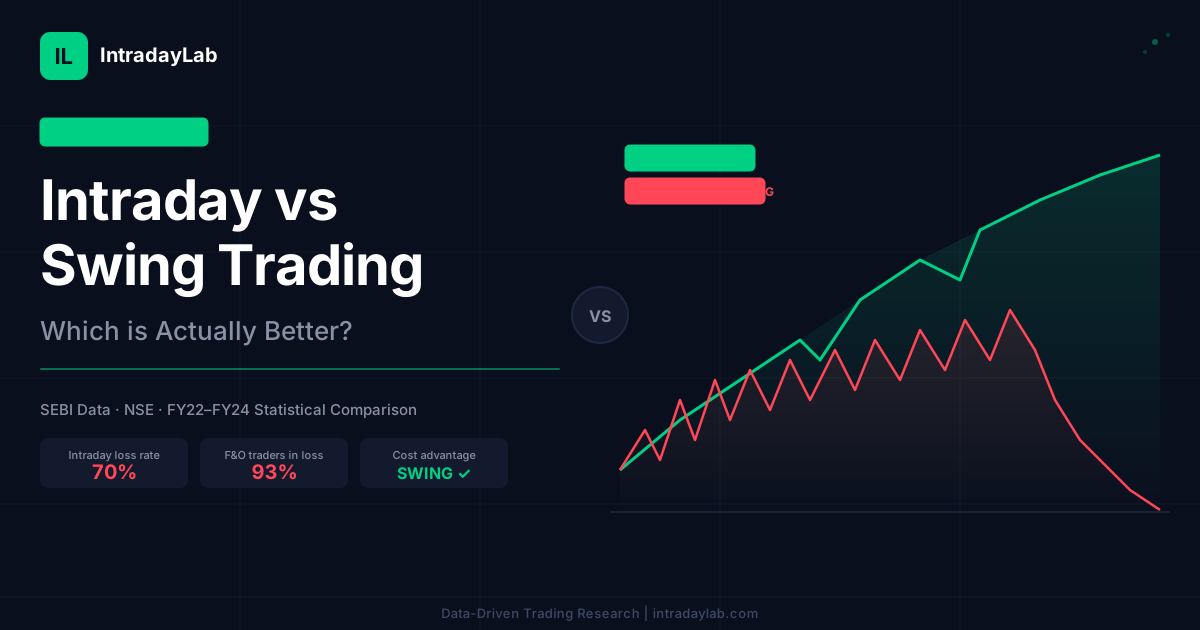
Ask ten traders which is better — intraday or swing trading — and you'll get ten different opinions. Ask SEBI, and the answer gets uncomfortable.
Between FY22 and FY24, 93% of individual F&O traders lost money. Cumulative retail losses crossed ₹1.8 lakh crore. And in the equity cash segment specifically, SEBI's intraday study found 7 out of 10 individual intraday traders lose money — consistently, year after year.
But here's what almost nobody talks about: swing trading has its own dirty failure statistics too.
This isn't an article telling you which style "suits your personality." This is a statistical comparison — costs, win rates, drawdown profiles, and the actual numbers from real Indian market data. By the end, you'll know which style gives the average Indian retail trader a higher probability of surviving — and what conditions flip that equation.
DATA BOX — The Numbers Nobody Puts Side By Side
- 70% of intraday traders in the NSE cash segment lose money (SEBI, FY23)
- 93% of F&O traders lost money in FY22–FY24 (SEBI September 2024 study)
- 16% of active retail traders lost their entire capital in FY25 (Zerodha CEO Nithin Kamath, citing SEBI data)
- Intraday traders in NSE cash: 69 lakh individuals in FY23, up 4.6x from FY19
- Loss-making intraday traders trade more frequently than profitable ones — SEBI finding
- Top 6% of intraday traders account for over 90% of total intraday turnover on NSE
The Core Difference Nobody Explains Correctly
Most comparisons talk about "time horizon." Intraday = same day. Swing = days to weeks. That much everyone knows.
What's rarely explained is the structural difference in how each style makes and loses money.
Intraday trading is a high-frequency, low-margin game. You're fighting for small moves multiple times per day, competing with algos, HFTs, and proprietary desks that have latency and data advantages you don't. Every trade carries transaction costs. Every mistake is immediate.
Swing trading is a low-frequency, high-conviction game. You hold positions overnight. You carry gap risk — the market opening at a completely different price than where it closed. But you're not fighting for ₹5 moves on a 5-minute chart; you're positioning for ₹200–500 moves over 3–10 days. The edge is structural, not speed-based.
Neither is inherently safer. But the type of risk is completely different.
The Real Cost Comparison (This Is Where Most People Lose)
This is the most important section in this article. Most traders compare strategies by gross returns and ignore costs entirely. That's how they end up consistently losing money while their backtest showed profits.
Here's a real cost comparison for a ₹5 lakh capital account on NSE:
Intraday Trade — Nifty 50 Futures (1 Lot, Round Trip)
| Cost Component | Amount |
|---|---|
| Brokerage (₹20 × 2 orders) | ₹40 |
| STT (on sell side only, intraday) | ₹0 (STT waived for intraday equity; applicable for F&O) |
| Exchange transaction charges | ₹10–15 |
| GST on brokerage + charges | ₹8–10 |
| SEBI turnover fees | ₹2–3 |
| Slippage (market order, 1–2 pts) | ₹50–100 |
| Total per round trip | ₹110–168 |
For a trader taking 8–10 intraday trades per day, that's ₹880–₹1,680 in daily costs — before a single rupee of profit or loss on positions. Over 20 trading days a month: ₹17,600–₹33,600 in pure friction costs.
Swing Trade — Nifty 50 Futures (1 Lot, 5-Day Hold)
| Cost Component | Amount |
|---|---|
| Brokerage (₹20 × 2 orders) | ₹40 |
| STT on F&O | ~₹15–20 |
| Exchange + GST + SEBI fees | ₹12–18 |
| Slippage (limit order, patient entry) | ₹25–50 |
| Total per round trip | ₹92–128 |
A swing trader taking 4–6 trades per month pays: ₹368–₹768 in monthly friction costs.
The math is stark. An active intraday trader can pay 20–50x more in transaction costs than a swing trader for the same capital base. This structural cost difference alone explains a significant portion of the intraday loss statistics SEBI documents.
Cost Reality
Intraday friction can consume more than ₹17,000–₹33,000 per month before any profits. Swing trading is not “cheap,” but its cost profile is far closer to a realistic edge for most retail traders.
Win Rate vs. Profit Factor: What the Data Actually Says
Win rate alone is a useless metric. A strategy with a 40% win rate can be highly profitable if winners are 3x the size of losers. A 70% win rate strategy can destroy capital if losses are 5x the size of wins.
Here's what realistic win rates and profit factors look like across both styles for retail traders on NSE, based on aggregated strategy studies and practitioner data:
| Metric | Intraday (Scalp/Momentum) | Swing Trading (Trend/Breakout) |
|---|---|---|
| Typical win rate | 45–55% | 38–48% |
| Average winner (Nifty futures) | ₹1,500–3,000 | ₹4,000–9,000 |
| Average loser | ₹1,000–2,000 | ₹2,000–3,500 |
| Profit factor (net) | 1.0–1.4 | 1.2–1.8 |
| Trades per month | 80–160 | 4–8 |
| Monthly cost drag | ₹15,000–30,000 | ₹400–800 |
| Net monthly return potential (₹5L capital) | ₹5,000–20,000 | ₹8,000–25,000 |
Two things stand out immediately. First, swing trading has a lower typical win rate than intraday — but larger individual winners make up for it. Second, once you factor in cost drag, the net monthly return potential of a swing strategy at ₹5 lakh capital is comparable to or better than intraday, with drastically fewer decisions required.
Profit Factor Matters
A 45–55% win rate with larger winners can beat a higher hit rate and smaller edge. In retail NSE trading, swing strategies often rely on fewer, bigger winners rather than more frequent small wins.
Drawdown Profiles: Where Each Style Kills Traders
Intraday drawdown is fast and psychological. Three losing trades before noon and most traders are making emotional decisions for the rest of the session. SEBI's data confirmed this: loss-making intraday traders trade more after losses, not less — classic revenge trading. The average loss for intraday traders with annual turnover exceeding ₹1 crore was still ₹34,977 per year in FY23. They were trading huge volume and still losing.
Swing drawdown is slow and capital-based. A swing trader holding 3 open positions through a sharp RBI surprise or a global selloff can see 15–20% drawdown in 48 hours. The psychological stress is different — not panic from rapid losses, but the grinding anxiety of watching open positions deteriorate over days. Gap openings (market opening 100+ points away from previous close) are a risk that intraday traders never face. Nifty 50 gaps of 50+ points at open happen roughly 15–20 times per year.
Neither drawdown profile is "safer." They require different psychological structures to survive.
The Overnight Gap Risk Problem (Swing's Hidden Cost)
This one doesn't show up in simple statistical comparisons but it's real.
Swing traders carry overnight positions. And the Indian market is highly sensitive to global cues. When the US Fed surprises markets, when FII selling accelerates, when a budget announcement shocks — the NSE can open 1–3% away from where it closed. In Nifty 50 futures terms, that's a 200–600 point gap.
If your stop-loss was placed at 50 points from entry and the market gaps 300 points against you — your stop-loss is irrelevant. You exit at market open, wherever that is.
In FY24, based on Nifty 50 historical data, there were approximately 23 overnight gaps of 100 points or more at open. A swing trader holding positions through even 3–4 of these events without proper position sizing can see a month's profit wiped out.
The intraday trader faces zero gap risk. That structural protection has genuine value.
Gap Risk Reality
Swing trading does not eliminate market risk; it shifts it to overnight gaps. Proper sizing that limits worst-case gap losses to 2% of capital is the only reliable protection.
Who Actually Makes Money? (The Profile Data Reveals)
SEBI's data gives us some unusual but revealing findings about profitable traders across both styles.
Female intraday traders had a lower proportion of loss-makers than male traders — and among profitable traders, female traders showed higher average profits. The interpretation: less overtrading, more disciplined rule-following.
Profitable intraday traders trade less frequently than unprofitable ones. The top performers are selective — waiting for high-probability setups rather than generating activity for its own sake.
Swing traders who succeed almost universally share one attribute: they treat overnight risk as a position-sizing problem, not a stop-loss problem. They size positions so that a worst-case gap opening doesn't exceed 2% of capital — regardless of where the stop-loss is placed.
In both styles, the top 6–7% of traders account for the vast majority of profitable volume. This isn't democratically distributed. The profitable traders have systematic, tested approaches. The losing traders are mostly reacting.
The Regime Question: When Intraday Wins, When Swing Wins
Market regime matters more than style preference. Neither approach performs uniformly across all conditions.
| Market Condition | Intraday Edge | Swing Edge |
|---|---|---|
| High volatility (VIX India > 18) | High — large intraday ranges create opportunity | Risky — gaps and whipsaws erode swing positions |
| Low volatility, trending (VIX < 13) | Low — small ranges, high cost drag relative to movement | High — clean trends with tight overnight risk |
| Sideways/range-bound | Moderate — range fade strategies work | Low — breakouts fail repeatedly |
| Strong directional trend | Moderate — momentum trades work but reversals are sharp | High — trailing stops capture extended moves |
| Budget/event days (RBI, Budget, elections) | Very high — large intraday moves, no overnight exposure | Risky — gap risk is extreme |
India VIX is publicly available on NSE. Tracking it weekly as a regime filter — and adjusting your style accordingly — is one of the highest-leverage habits a retail trader can build.
The Verdict: Not Which Is "Better" — Which Fits Your Actual Edge
The data doesn't give a clean winner. It gives a set of conditions.
Swing trading has structural advantages for most retail traders: lower cost drag, more time to think, no intraday screen dependency, and position sizes that can be managed rationally. The numbers support this — swing's net return potential competes with intraday at a fraction of the friction cost.
Intraday trading has structural advantages in specific conditions: high-VIX environments, event-driven days, and for traders who have genuinely tested, systematic entries — not discretionary "feel-based" calls. Zero overnight gap risk is a real edge during volatile macroeconomic periods.
What kills traders in both styles is the same thing: overtrading, under-sizing wins, and not accounting for transaction costs in their strategy math.
The SEBI data is unambiguous on one point: loss-making traders in both segments trade more frequently than profitable ones. The profitable minority is disciplined, selective, and treats cost management as seriously as entry signals.
Intraday Reality
70% of NSE intraday cash traders lose money — and the main structural reason is the transaction cost burden.
Swing Trade Edge
Swing trading has lower friction, but it still demands regime awareness and gap-risk sizing to stay viable.
Profit Discipline
Profitable traders in both styles trade less, not more. Selectivity, discipline, and cost control separate winners from the 93% who don't.
Trader's Quick Reference
Intraday vs Swing Trading — Head to Head
| Parameter | Intraday Trading | Swing Trading |
|---|---|---|
| Holding period | Minutes to hours | 2–10 days |
| Trades per month | 40–100 | 4–8 |
| Monthly cost drag (₹5L capital) | ₹15,000–30,000 | ₹400–800 |
| Overnight gap risk | None | Present (100+ pt gaps ~23x/year in Nifty) |
| Screen time required | 6–7 hrs/day | 30–60 min/day |
| SEBI reported loss rate | 70% (cash segment) | No specific SEBI study; estimated 50–60% |
| Works best in | High VIX, event days | Low VIX, trending markets |
| Capital efficiency | Lower (cost drag) | Higher |
| Psychological demand | Extreme (immediate P&L) | Moderate (delayed P&L) |
| Suitable for | Full-time traders, tested systems | Part-time traders, systematic approach |
Frequently Asked Questions
Conclusion
The data is clear enough to act on, even if it doesn't give you a perfect answer.
Intraday trading is structurally harder for retail participants on NSE. The cost burden is brutal, the competition from algo traders and HFTs is real, and SEBI's numbers show the majority lose — consistently, across multiple years and multiple market conditions. That's not an opinion. It's regulatory data from every broker, every account, every trade.
Swing trading has better economics for most retail traders. Lower costs, competitive net return potential, and compatibility with non-full-time participation. Its weaknesses — overnight gap risk and the discipline needed to hold through noise — are manageable with proper position sizing and a regime-aware approach.
But the real answer to "which is better" is this: neither style profits traders who overtrade, ignore costs, and skip the testing phase.
SEBI's most important finding isn't the 70% loss rate — it's that the profitable minority trades less. They are selective. They are systematic. They know their numbers.
Pick the style whose structural risks you can genuinely manage, price its true costs honestly, and build a tested process before risking real capital. That decision — not intraday vs swing — is what separates the 7% who make money from the 93% who don't.