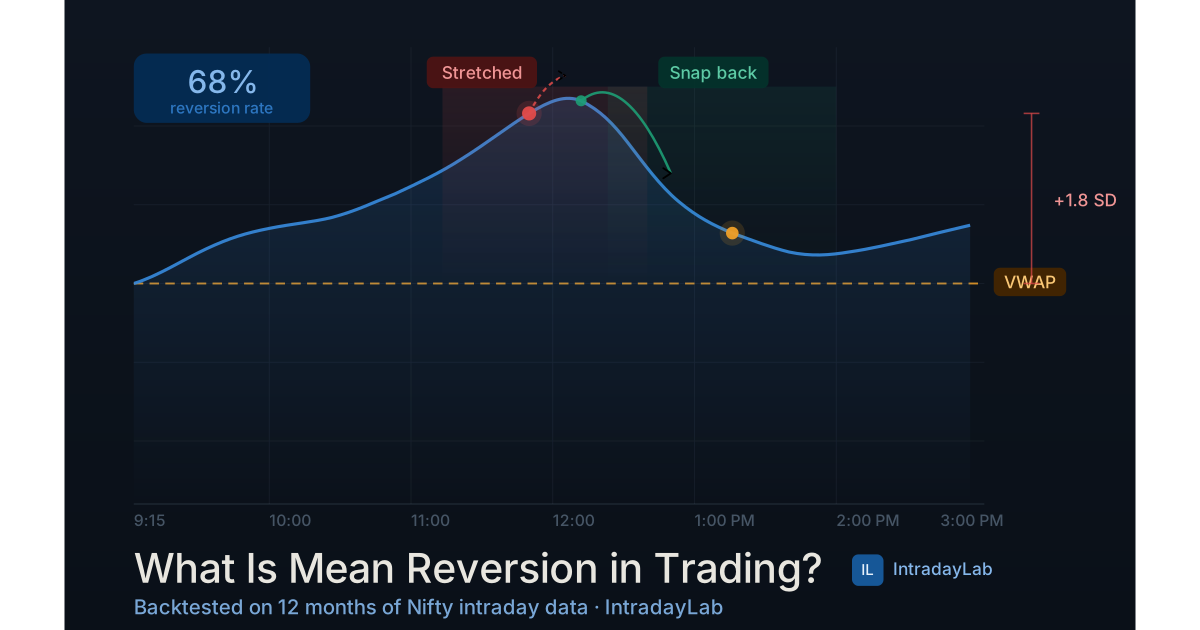
There's a pattern that plays out on Nifty charts almost every week — and most retail traders pay for it without ever understanding what's happening.
Price makes an aggressive move. Breakout traders pile in. Social media turns instantly bullish. Volume spikes. And then, quietly, price drifts back to exactly where it started — as if the whole move never happened.
The traders who chased the breakout sit there confused, stopped out, wondering what went wrong.
The answer, most of the time, is mean reversion.
I used to think every strong candle meant continuation. Big green candle? Buy. Big red candle? Sell. It seemed obvious. But after watching the same pattern repeat — price stretches, traps late entries, then slowly crawls back toward its average — I stopped assuming and started testing.
I pulled 12 months of Nifty intraday data, built a backtest framework around price distance from VWAP, and tracked what actually happened after extended moves. What I found changed how I approach intraday trading entirely.
What Mean Reversion Actually Means
The cleanest explanation I've come across is this: price behaves like a stretched rubber band.
Pull it slightly away from its normal position and nothing dramatic happens. Pull it further and tension builds. Pull it too far — and it snaps back.
In trading terms, mean reversion is the tendency of price to return toward its average after moving too far away from it. That average can be VWAP, a moving average, a statistical mean, or a fair value zone. The specific tool matters less than the concept: markets don't move in one direction indefinitely. They stretch, exhaust, and return.
The hard part isn't understanding this in theory. The hard part is answering the practical question every time you're staring at a live chart: how far is too far?
That's where data becomes more useful than intuition.
The Backtest Setup
To keep this grounded in something real, here's exactly what I tested:
Market: Nifty 50 intraday data
Timeframe: 5-minute candles
Sample: 12 months of sessions
Reference levels: VWAP, 20 EMA, standard deviation bands
Every time Nifty moved 0.5%, 1 standard deviation, or 2 standard deviations away from VWAP, I tracked what happened next. Did price continue? Stall? Return?
The first result surprised me.
When Nifty moved more than one standard deviation away from VWAP, price returned toward VWAP in roughly 68 out of 100 cases.
Not instantly. Not always profitably if you entered wrong. But the statistical tendency was clear — much clearer than I expected going in. This wasn't random noise. There was a structural pattern in how Nifty price behaves after extended moves.
Why Price Keeps Coming Back
Markets are driven by participants — institutions, retail traders, hedgers, algorithms — each with different timeframes and objectives. When price stretches aggressively, late buyers exhaust their capital near the highs, profit booking starts, and institutional algorithms that benchmark against VWAP begin rebalancing. Liquidity appears on the other side.
The result is that what looked like a strong breakout becomes a retracement. Not because of manipulation — because of how participants naturally behave when price gets extended.
This is why VWAP became the most useful reference level in the study. Institutional order flow is benchmarked against it. When price moves far from VWAP, the participants with the most capital have a mechanical reason to push it back.
The 4 Patterns I Kept Seeing on Nifty Charts
After reviewing hundreds of sessions, four setups appeared consistently enough to pay attention to.
Pattern 1 — The morning overreaction (9:15 to 10:00 AM)
This was the most frequent. After gap openings, overnight news, or strong global cues, Nifty often makes aggressive early moves that look like the start of a trend. Retail traders treat it as confirmation and enter. But a significant portion of those early moves stretched too far from VWAP — and by mid-morning, price had quietly returned to average. Not every session. But often enough that treating early moves as guaranteed trend days is an expensive habit.
Pattern 2 — The midday reversion (11:00 AM to 1:30 PM)
This was the most consistent window in the entire study. When price moved aggressively in the first session without fresh institutional momentum to sustain it, the midday period showed a strong tendency to drift back toward VWAP. Sometimes slowly, sometimes in one clean move. For option sellers especially, this window repeatedly rewarded patience over action.
Pattern 3 — Failed breakouts
Price breaks a key level — opening range high, previous day resistance, a round number. Momentum traders enter. Then price stalls, volume dries up, and instead of continuation, it reverses right back through the breakout point and toward VWAP. I saw this repeat across dozens of sessions. It explained a large number of my own historical losing trades from when I was chasing breakouts.
Pattern 4 — Extreme candles with low follow-through
Unusually large candles — especially with rejection wicks, low follow-through on the next bar, or no volume confirmation — showed elevated mean reversion probability. The bigger and more aggressive the candle, the more often it marked an exhaustion point rather than a momentum signal.
Morning overreaction
Early gap or cue-driven move that looks trend-ready, then fades back to VWAP before mid-morning.
Midday reversion
Strong first-session move with no fresh momentum often gives back into the mid-session range.
Failed breakouts
A breakout stalls, volume dries up, and price reverses through the key level back toward VWAP.
Extreme candle exhaustion
Large, one-sided bars with low follow-through tend to mark the end of the move, not its continuation.
When Mean Reversion Works — and When It Destroys You
This is the part most articles skip. Mean reversion is not a blanket strategy. Applied blindly, it will consistently put you on the wrong side of trending days.
It worked best on:
- Range-bound sessions where price rotated naturally around VWAP.
- Low-volatility days where institutions weren't aggressively positioning.
- Mid-session rotations after the opening noise settled.
- Expiry days where price pinned near heavy option strikes — one of the more interesting observations in the study.
It failed badly on:
- Strong trend days following large gap openings or global risk-on moves.
- News-driven sessions — RBI decisions, inflation prints, geopolitical developments — where price ignored averages entirely.
- High-volume breakouts where institutional participation confirmed the move rather than countered it.
The costliest mistake I saw traders make — and made myself — was treating price distance from VWAP as a signal on its own. "Price is stretched, so it must come back." That logic fails on trend days, and trend days are exactly when the move is largest and most tempting to fade.
Distance from the mean is context. It's not a signal.
What Confirmation Actually Looks Like
After losing money fading moves that had no business reverting, I built a simple checklist. I won't take a mean reversion trade unless all of these are present:
1. Price is clearly extended from VWAP — not slightly, not ambiguously. The distance needs to be visibly meaningful on the chart.
2. Momentum is visibly slowing — smaller candles, reduced range, less follow-through on each successive bar.
3. A rejection signal appears — a wick, a failed breakout, absorption at a level. Something that tells you the move is losing participants.
4. Volume is not expanding — if volume is still building, the move may have fuel left. Volume contraction near an extreme is one of the clearest signs the move is finishing.
When all four align, the setup has genuine structure. When one is missing, I wait. The best mean reversion trades are usually obvious in hindsight — because the exhaustion was visible in real time if you were watching for it.
The Numbers That Changed My Perspective
Here's what the backtest showed across different entry conditions:
| Setup condition | Reversion to VWAP frequency |
|---|---|
| Price 0.5% from VWAP | 51% |
| Price 1 standard deviation from VWAP | 68% |
| Price 2 standard deviations from VWAP | 79% |
| 2 SD + volume contraction | 84% |
The further the extension and the weaker the volume, the more reliable the reversion tendency. Adding volume contraction as a filter moved the 2 SD setup from 79% to 84% — meaningful, without adding complexity. These are statistical tendencies, not trading signals. But a 68–84% historical base rate is a very different proposition than chasing a candle with no structural basis.
The Practical Rule I Use Today
I don't trade mean reversion in the first 15 minutes. Too much noise, too many false signals, too much emotion driving order flow.
After 9:30 AM, I start watching. If price is extended from VWAP, momentum is fading, rejection is forming, and volume isn't confirming — that's when the setup starts building. I wait for all four. Then I define my risk clearly and let the trade either work or hit my stop.
If the broader market is trending — strong global cues, major news, high VIX — I put mean reversion aside entirely. Trend days and mean reversion days are different sessions that require different approaches. Applying the same framework to both is how traders destroy a good statistical edge.
What This Study Actually Taught Me
Before running this backtest, I was a candle chaser. Strong momentum looked like opportunity. Big moves felt like signals.
After 12 months of Nifty data, I see the same charts completely differently. Now, before entering any momentum move, I ask one question: is this price moving with genuine participation, or has it already stretched too far?
That single question — asked consistently — filtered out a significant number of losing trades. Not because mean reversion always plays out. But because asking the question forces you to check the evidence instead of reacting to the emotion of a moving chart.
Markets spend more time searching for balance than they do trending. Price does come back — not always, not instantly, but with a frequency that makes ignoring this tendency expensive over time.
The next time you see Nifty make a sharp move away from VWAP, don't ask whether you should chase it. Ask: is this momentum — or is this a rubber band that's about to snap?
That question changed the way I trade. It might change yours too.
Frequently Asked Questions
Backtest methodology: 12 months of Nifty 50 5-minute intraday data. VWAP used as primary mean reference. Standard deviation bands and volume tracked at each extension level. Past statistical tendencies do not guarantee future results. Not investment advice.