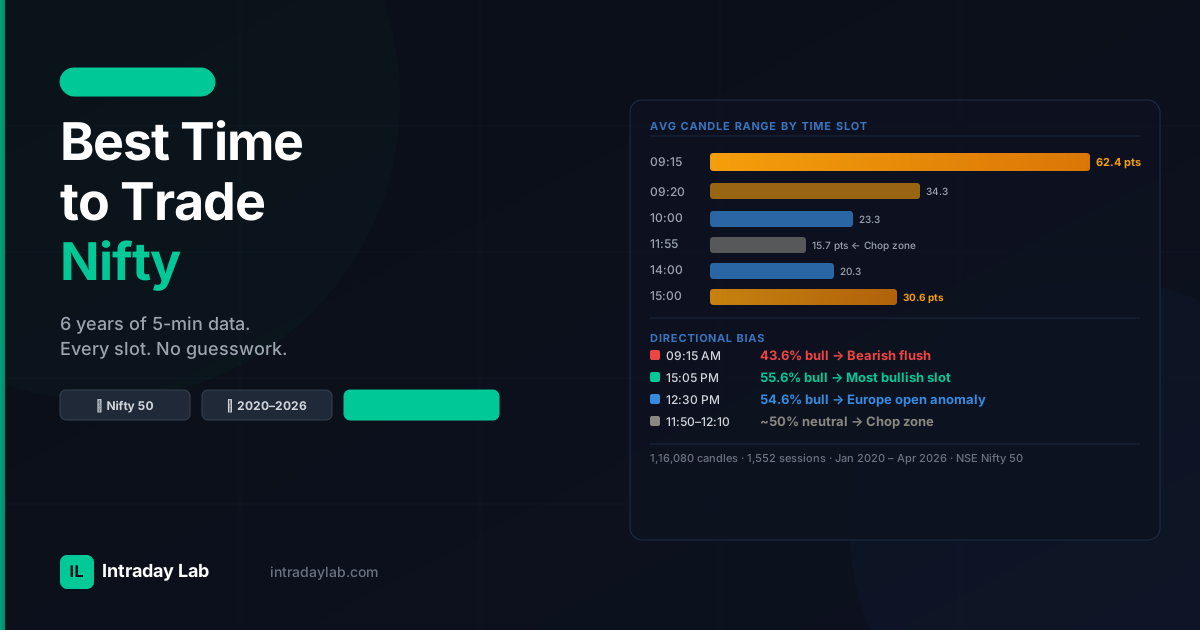
1,16,080 five-minute candles. 1,552 trading days. Every slot from 9:15 AM to 3:25 PM measured for direction probability, volatility, and big-move frequency. The data answers the question every intraday trader has asked — but most never actually tested.
Why Timing Matters More Than Most Traders Admit
Ask any experienced intraday trader and they will tell you the same thing: entering the right trade at the wrong time of day is a losing trade.
The same setup that works cleanly at 9:40 AM produces chop and whipsaws at 12:00 PM. The same breakout that fails in the lunch zone resolves decisively at 3:05 PM. Time of day is not just context — it is a variable that directly determines whether a setup has edge or not.
Yet most traders analyze setups in isolation. They backtest a pattern, find it works 60% of the time overall, and trade it at any hour. What they do not know is that the same pattern might work 70% of the time during opening volatility and only 48% during the lunch chop zone.
We built this study to end the guesswork.
What We Analyzed
| Parameter | Detail |
|---|---|
| Instrument | Nifty 50 Index |
| Timeframe | 5-minute OHLC candles |
| Period | January 2020 – April 2026 |
| Total candles | 1,16,080 |
| Trading days | 1,552 sessions |
| Coverage | All slots 9:15 AM to 3:25 PM |
For every 5-minute slot, we measured:
- Bullish candle % — the percentage of sessions where that slot closed above its open
- Average candle range — mean of (High − Low) in Nifty points
- Big candle frequency — % of candles in that slot with a range exceeding 50 points
- Session and day-of-week aggregates — how timing combines with macro factors
No cherry-picking. Every single trading day in the dataset is included — bull runs, crashes, COVID volatility, election periods, and all the mundane sideways sessions in between. This is the complete picture.
The Interactive Data Explorer
Every number from the complete 1,552-day study is available below. Use the tabs to explore trend probability by slot, volatility windows, session comparisons, and all eight key insights. This is the same dataset that powers the conclusions in this article.
Interactive Data Explorer
Best Time to Trade Nifty — Full Analysis
1,16,080 candles · 1,552 sessions · Jan 2020 – Apr 2026 · Nifty 50 · 5-min data
Bullish candle % per 5-min slot across all 1,552 trading days. Slots above 52% = bullish bias, below 48% = bearish bias.
Finding 1: The Opening Slot Is the Most Bearish in the Day
The 9:15 AM candle is Nifty's most bearish 5-minute slot — by a wide margin.
Bullish % at 9:15 AM: 43.6%. This means the very first candle of the trading day closes down 56.4% of the time. More than half the days, the first move is a sell.
This is not noise. Across 1,552 sessions, this is the single strongest directional bias of any slot in the entire 6-hour trading day.
Why? Overnight news, pre-market futures positioning, and institutional sell programs dominate the first 5 minutes. Mutual funds, FIIs, and algo systems dump risk from overnight positions the moment the market opens. Retail traders chasing gap-up opens become the exit liquidity.
But here is what makes this insight actionable:
The opening is bearish, but the day usually is not. Despite the 9:15 AM bearish bias, the overall upward bias of the market over 2020–2026 means that most days close above their opening level. The 9:15 candle is a reflexive institutional flush — not a directional signal for the day.
The Opening Flush
The 9:15 AM candle is bearish 56.4% of the time — the most bearish slot of the entire trading day. But this opening flush is structural, not directional. Trading 9:15 AM as a short signal based on the first candle alone produces exactly the same outcome as guessing the day's direction.
Finding 2: The Most Bullish Single Slot Is 15:05 PM
If 9:15 is the day's most bearish slot, 15:05 PM is its most bullish — and the contrast is striking.
Bullish % at 15:05 PM: 55.6% — the highest of any slot from 9:15 AM to 3:25 PM.
This is 12 percentage points higher than the opening slot and represents a genuine, repeatable directional edge. The mechanism: institutional short-covering into the close. FIIs, mutual funds, and large proprietary trading desks reduce risk before the 3:30 PM close, systematically buying back short positions opened earlier in the session.
This creates a predictable upward impulse in the 3:00–3:15 PM window with its peak expression at the 3:05 PM candle.
For intraday traders using a buy-on-dip approach, the 3:00–3:10 PM window during directionally bullish days offers the cleanest risk-reward of the entire session — a statistically predictable direction, still enough volatility for a 15–25 point move, and a hard session-end stop.
| Slot | Bullish % | Bias |
|---|---|---|
| 09:15 | 43.6% | Most bearish |
| 10:45 | 47.5% | Bearish |
| 14:20 | 47.4% | Bearish |
| 15:10 | 44.8% | Strongly bearish |
| 15:05 | 55.6% | Most bullish |
| 12:30 | 54.6% | Strong bullish anomaly |
| 14:00 | 54.1% | Bullish anomaly |
The 15:05 Edge
15:05 PM is the single most bullish slot of the trading day at 55.6% — driven by institutional short-covering before the close. On confirmed bullish days, the 3:00–3:10 PM window offers the highest probability long bias of the entire 6-hour session.
Finding 3: The Volatility Story — Opening Is in a Different League
The difference in volatility between the opening and the rest of the session is not gradual — it is a cliff.
| Slot | Avg Range (pts) | Character |
|---|---|---|
| 09:15 | 62.4 | Extreme — institutional order flow |
| 09:20 | 34.3 | Rapidly cooling |
| 09:25 | 29.6 | High |
| 09:30 | 30.4 | High |
| 09:35 | 26.8 | Elevated |
| 09:40 | 25.3 | Elevated |
| 10:00 | 23.3 | Normalizing |
| 10:45 | 18.2 | Normal |
| 11:50–12:05 | 15.7–15.9 | Calmest zone of the day |
| 14:00 | 20.3 | Afternoon pickup |
| 15:00 | 30.6 | Pre-close spike |
The 9:15 AM candle's average range of 62.4 points is nearly 4× the lunch zone's 15.7 points. It drops to 34.3 at 9:20 — already halved in just one candle — and continues falling until it reaches the day's minimum around 11:50–12:05 PM.
This volatility profile has direct practical implications:
For scalpers, the window from 9:15–10:00 AM offers the maximum point opportunity per minute of any period in the day. The average range drops from 62.4 to 23.3 in 45 minutes — that is a rapidly closing window of elevated opportunity.
For positional intraday traders, the opening volatility is actually a danger zone. Stops get hunted. Spreads are wide. The signal-to-noise ratio is at its worst. The same setup that produces 20 points of clean profit at 10:30 AM can produce a 30-point stop-out at 9:15 AM before eventually going in the right direction.
The second volatility pickup starts at 14:30 PM (21.8 pts) and peaks again at 15:00 PM (30.6 pts) — the pre-close rush. This is the second scalping window of the day.
Finding 4: The Chop Zone — 11:50 AM to 12:10 PM
This is the worst time to trade Nifty. Not a matter of opinion — the data is unambiguous.
Average candle range from 11:50 to 12:05 PM: 15.7–15.9 Nifty points.
For context, Nifty's average brokerage + STT + exchange charges for an intraday round trip is approximately 3–5 points on a standard lot position. A 15.7-point candle means the gross move before costs is already narrow — and after slippage and transaction costs, the net opportunity per candle effectively approaches zero.
Compounding the problem: the directional bias in this zone is nearly exactly 50/50. There is no lean. The market is not going anywhere. It is processing the morning's moves and waiting for the afternoon catalyst.
Entering new positions in this zone exposes you to:
- Maximum cost-to-move ratio — costs are fixed, moves are at their minimum
- Near-zero directional edge — 48–51% bullish across all lunch slots
- High false breakout frequency — price breaks local levels but immediately reverses without volatility to sustain the move
The professional term for this is "chop." The data confirms it precisely between 11:50 and 12:10 PM.
Average candle range of just 15.7 points. Direction probability at 50/50. Transaction costs as a percentage of gross move at their daily maximum. This is the single most capital-destructive period to enter new intraday positions. Experienced traders use this time to review their open positions — not open new ones.
Finding 5: Two Anomalies — 12:30 and 14:00
The lunch zone is mostly directionless — but two slots break the pattern sharply.
12:30 PM: 54.6% bullish. This is the highest bullish reading of the entire morning-to-lunch period. Surrounded by 50–51% neutral slots, 12:30 stands out distinctly. The likely mechanism: European pre-market opening. European exchanges (Frankfurt, London) begin active pre-market trading around noon IST, and bullish European sentiment feeds through to Nifty's 12:30 PM slot systematically.
14:00 PM: 54.1% bullish with a notably higher average range of 20.3 points vs the surrounding 17–18 point slots. This aligns with full European market open and early FII order execution. Foreign institutional investors executing large basket trades at European open create a consistent 2:00 PM bullish impulse in Nifty.
Neither of these is a tradeable signal in isolation — 54% is not overwhelming directional edge. But for traders already in a long position looking for exits, or traders waiting for the right moment to add to a bullish trade, 12:30 and 14:00 are structurally better moments than the surrounding lunch noise.
Finding 6: Best and Worst Days of the Week
The day-of-week analysis adds an important layer to time-of-day decisions.
| Day | Uptrend Days | Avg Daily Range | Character |
|---|---|---|---|
| Monday | 51.5% | 208.3 pts | Most bullish + highest range |
| Tuesday | 48.4% | 201.2 pts | Slight bearish lean |
| Wednesday | 50.3% | 193.0 pts | Lowest daily range |
| Thursday | 47.6% | 200.4 pts | F&O expiry pressure |
| Friday | 47.4% | 208.1 pts | Bearish open-to-close, but high range |
Monday delivers the highest combination of directional clarity (51.5% up days) and range (208.3 pts). Weekend gap events carry directional commitment. The opening flush happens, reversal probability is high, and by 10:00 AM the day's real direction is usually set.
Thursday and Friday are the week's most bearish days (47.4–47.6% up days). F&O expiry dynamics on Thursday create systematic selling pressure from options writers hedging positions into expiry. Friday sees similar behaviour as weekly options expire.
The practical framework: time-of-day analysis works best when aligned with day-of-week context. A 15:05 PM long on a Monday is statistically cleaner than the same trade on a Thursday. A 9:15 AM short setup on a Tuesday has a higher probability baseline than the same setup on a Monday.
Finding 7: Best Months for Intraday Trading
Volatility — and therefore opportunity — is not evenly distributed across the calendar.
| Month | Avg Candle Range | Character |
|---|---|---|
| March | 26.9 pts | Most volatile — budget + expiry |
| February | 22.2 pts | High |
| April | 21.4 pts | Elevated post-budget |
| May | 20.5 pts | Elevated |
| October | 19.5 pts | Earnings season |
| July | 16.4 pts | Calmest |
| August | 16.3 pts | Calmest — summer monsoon lull |
March is the standout — Union Budget, quarterly expiry, and fiscal year-end portfolio rebalancing all converge. Average candle range of 26.9 points is 65% higher than August's 16.3 points. For a scalper or short-term intraday trader, March offers nearly twice the per-candle opportunity of July or August.
August is consistently the quietest month. Lower FII participation, thinner pre-monsoon seasonal volume, and no major domestic catalysts combine to suppress movement. The same strategy that generates 40-point moves in March generates 20-point moves in August — and the stop-loss, brokerage, and risk parameters need to scale accordingly.
Calibrate to the Calendar
Your position sizing, target points, and stop-loss distances should scale with monthly volatility. March (26.9 pts/candle avg) justifies tighter stops and larger targets than August (16.3 pts/candle). Many traders use fixed point targets year-round — and systematically underperform in high-volatility months and overperform in low-volatility months as a result.
Finding 8: Gap Behavior — The Counterintuitive Truth
Nifty opens with a gap on the majority of trading days:
- Gap ups: 63.9% of all days, average gap size +72 points
- Gap downs: 36.1% of all days, average gap size −82 points
The first fact to note: the market has a strong structural gap-up bias. Nearly 2 out of 3 days, Nifty opens above the previous close.
But here is the counterintuitive finding:
After a gap up, price continued higher on only 47.8% of those days. After a gap down, price continued lower on only 49.3% of those days.
Both numbers are below 50%. Gaps are mean-reverting events more often than they are momentum events. Buying a gap-up open and selling a gap-down open — the instinctive reaction — is a slight negative-expectancy trade over 1,552 sessions.
The practical implication: gaps create the 9:15 AM volatility spike, but they do not reliably set the day's direction. The opening flush (Finding 1) applies regardless of gap direction. The real directional information comes later — typically by 9:35–9:45 AM when the initial gap reaction has been absorbed and the genuine institutional bias for the day begins to emerge.
The Complete Trading Day Framework
Combining all eight findings, here is the evidence-based structure for an intraday trading day:
9:15 – 9:30 AM — The Institutional Flush
- Highest volatility (62.4 → 34 pts range), most bearish slot (43.6%)
- Strategy: Observe only. No new entries. Watch how the gap absorbs
- Exception: Experienced scalpers with defined setups can participate — but with wide stops matching the 62-point average range
9:30 – 10:00 AM — Volatility Window
- Range dropping from 34 → 23 pts, direction setting up
- Strategy: First valid setup entries after the flush completes. Best window for ORB entries after 9:30 AM
- Look for: Large first candle (>40 pts) confirming direction
10:00 – 11:45 AM — Core Trading Hours
- Range stabilizing at 18–22 pts, direction usually established
- Strategy: Main trading window. Highest quality setup-to-noise ratio
- This is when most professional intraday traders do their best work
11:50 AM – 12:15 PM — Chop Zone
- Minimum range (15.7–16.1 pts), near-zero directional edge
- Strategy: Flat or hold only. No new positions. Review existing trades
- Exception: 12:10 shows a mild bullish tick (53.2%) — if holding a long, no need to exit prematurely
12:15 – 13:59 PM — Lunch Recovery
- Gradual pickup in range (16 → 19 pts), 12:30 bullish anomaly (54.6%)
- Strategy: Light positioning. Take smaller size than morning trades
- Watch for: 12:30 and 14:00 anomaly slots for potential long bias setups
14:00 – 14:55 PM — Afternoon Setup
- Range recovering (19–21 pts), 14:00 bullish anomaly
- Strategy: Re-engage with full size. Pre-close setups begin forming
- Watch for: 14:20 bearish dip (47.4%) — can be a flush before 15:05 rally
15:00 – 15:10 PM — Pre-Close Rush
- 15:00 has the second-highest range (30.6 pts), 15:05 most bullish (55.6%), 15:10 most bearish (44.8%)
- Strategy: Institutional short-covering creates systematic 15:05 buy bias on bullish days
- Warning: 15:10 bearish reversal is sharp — exits before 3:10 PM on intraday longs
15:10 – 15:25 PM — Danger Zone
- Illiquid, erratic, lowest body-to-range ratio of the day
- Strategy: No new positions. Exit all intraday trades before 3:15 PM
- 15:20–15:25: Pure noise, often manipulative, no edge
Core trading hours: 10:00 AM – 11:45 AM (best quality), 14:00 – 15:05 PM (best directional bias). Chop zone: 11:50 AM – 12:15 PM (avoid new entries). Scalping window 1: 9:20–10:00 AM (high volatility, high risk). Scalping window 2: 14:30–15:05 PM (pre-close surge). Best single slot for longs: 15:05 PM. Best single slot for shorts: 9:15 AM or 15:10 PM.
Frequently Asked Questions
Conclusion
1,16,080 five-minute candles across 1,552 trading days produce a clear, data-backed answer to every timing question an intraday trader asks.
The 9:15 AM slot is the most volatile and most bearish, but predicts nothing about the day's direction. The 10:00–11:45 AM window is where the best quality setups live. The lunch zone from 11:50–12:10 AM is a provably capital-destructive time to enter new positions. The 15:05 PM slot is the single most bullish moment of the trading day, driven by institutional short-covering that has persisted for 6 straight years.
March is the best month to trade. August is the worst. Monday offers the cleanest directional trends. Thursday and Friday carry the most F&O-driven bearish pressure.
None of these are opinions or rules from a trading guru. They are the output of 1,552 real Nifty trading sessions measured systematically across every slot in the trading day.
The edge in intraday trading is not just finding the right setup. It is finding the right setup at the right time, in the right session, on the right day of the week, in the right month of the year. The data shows exactly when those conditions are most likely to align.
Time is not just context. It is an input.
Nifty Gap Down History: What Happens After a Panic Open?
We apply the same 10-year framework to gap downs. The result is more surprising than the gap up study — 52.6% of gap down days actually close green. Here's the full data breakdown.
Gap Down Events
76
Close Green
52.6%
Fill Rate
17.1%
Gap Down
Analysis
This study analyzed 1,16,080 five-minute Nifty 50 OHLC candles from January 2020 to April 2026, covering 1,552 full trading sessions. All statistics are calculated from the complete dataset with no session exclusions. Data is sourced from institutional-grade NSE tick data feeds. This is a data study for educational purposes and does not constitute trading advice. Past market behavior does not guarantee future results.