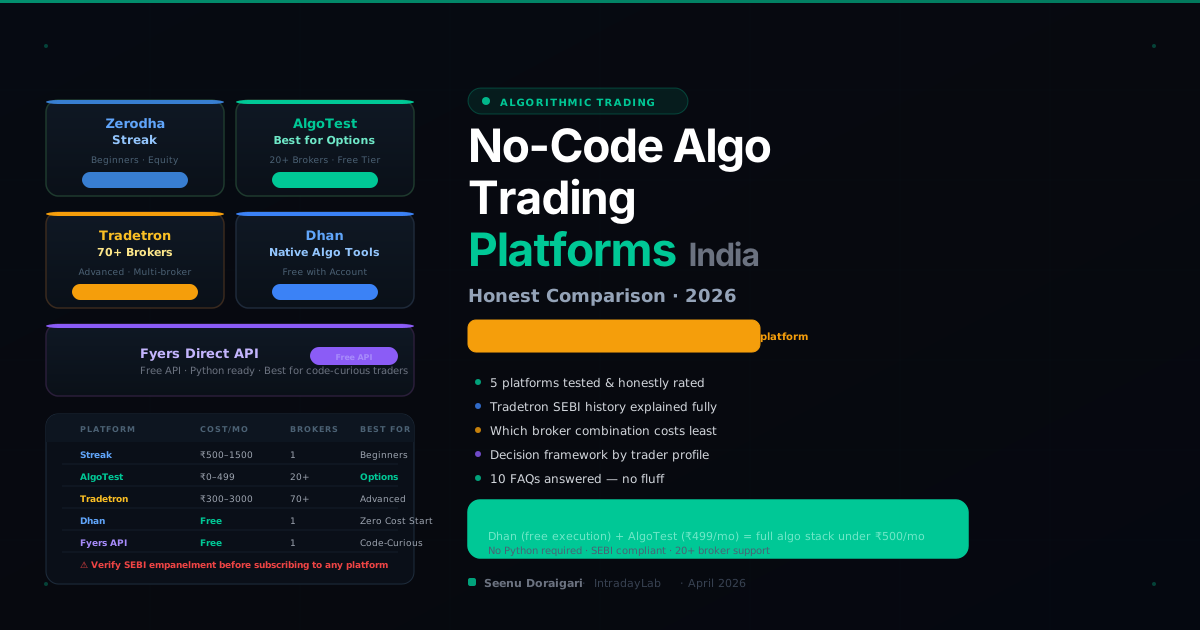
"Do I need to know Python to start algo trading?" It is the single most common question new traders ask. The answer in 2026 is no — but the platforms that promise code-free automation are not all equal, not all honest, and not all SEBI-compliant. This guide cuts through the noise.
The Truth About "No-Code" Algo Trading
Let's start with something every other comparison article skips: no-code does not mean no understanding.
When a platform tells you that you can automate your trades without writing a single line of code, that is technically true. What they don't tell you is that you still need to understand what your strategy actually does — which conditions trigger a buy, why you set the stop-loss where you did, what market environment the strategy was designed for. The platform removes the syntax. It does not remove the thinking.
Traders who use no-code platforms as a substitute for strategy understanding — picking a template, hitting deploy, and waiting for money to appear — are not algo trading. They are outsourcing their decisions to a tool they don't understand, which is arguably more dangerous than trading manually. The automation just makes the losses faster and more consistent.
That said, no-code platforms genuinely solve a real problem. Most retail traders who want to trade systematically — with defined rules, backtested on real data, executed without emotion — should not have to spend six months learning Python before they can test a single idea. These platforms are the right bridge, used correctly.
This guide tells you which platform works best for which trader, what each one actually costs, what SEBI's 2026 framework means for platform compliance, and — importantly — which platform carries regulatory history you need to know about before you put real money in.
The SEBI Context You Cannot Ignore in 2026
Before comparing platforms, one regulatory fact matters enormously to this decision.
From April 1, 2026, every algo platform offering strategies to retail clients must be formally empanelled with NSE/BSE as an algo provider. This is not optional — it is a hard requirement under SEBI's February 2025 circular. An unempanelled platform routing orders through your broker account is operating outside the legal framework, and your broker is on the hook for it.
There is also the Tradetron precedent, which is directly relevant here. In October 2024, SEBI issued show-cause notices to over 120 stockbrokers — including Zerodha, Angel One, ICICI Securities, HDFC Securities, and others — for their continued API association with Tradetron. The issue: certain strategies on Tradetron's marketplace had advertised "assured returns," which SEBI's 2022 circular explicitly prohibits. By early 2026, SEBI moved to formal adjudication orders against named brokers in this matter.
This is not a small compliance footnote. It is the reason the entire SEBI 2026 framework exists — unregulated algo marketplaces with unverifiable strategy claims caused real retail trader losses. When you choose a platform today, you are choosing between operators who built compliance in from the start and those who are retrofitting it.
Ask any platform: (1) Are you exchange-empanelled with NSE/BSE under the April 2026 framework? (2) If you offer a strategy marketplace, do creators have SEBI Research Analyst registration? (3) Is your server IP whitelisted with all broker partners? A legitimate platform answers all three without hesitation. A hedging answer on any of them is a warning sign.
With that context established, here is the platform comparison.
The Five Platforms That Matter for Indian Retail Traders
| Platform | Best For | Monthly Cost | Broker Lock-in | SEBI Status |
|---|---|---|---|---|
| Zerodha Streak | Zerodha users, pure beginners | ₹0–₹1,500 | Zerodha only | Compliant via Zerodha |
| AlgoTest | Options traders, backtesting depth | ₹0–₹499+ | 20+ brokers | Exchange-empanelled |
| Tradetron | Multi-broker automation | ₹300–₹3,000+ | 70+ brokers | Regulatory history — read section below |
| Dhan (native algo) | Dhan users wanting simplicity | Free with account | Dhan only | Compliant via Dhan |
| Fyers Direct API | Traders ready to write basic code | Free | Fyers only | Compliant via Fyers |
Platform 1: Zerodha Streak
Streak — What it is
Streak is Zerodha's in-house no-code strategy builder, fully embedded inside the Kite terminal. You log into streak.tech with your Zerodha credentials, build a strategy using a visual condition builder, backtest it on historical data, and deploy alerts or live orders — all without writing code.
It was one of the first retail no-code algo platforms in India, and it still has the largest user base among the platforms in this list.
Streak — What it does well
The interface is genuinely beginner-friendly. Creating a strategy means selecting an indicator from a dropdown — RSI, EMA, VWAP, Supertrend, Bollinger Bands, over 80 available — setting a condition ("RSI crosses below 30"), adding a second condition if needed, and defining stop-loss and target. It takes about ten minutes to have your first strategy built and backtesting.
The scanner tool is one of Streak's strongest features. You can run the same strategy logic across an entire watchlist — say, scan all Nifty 500 stocks for an EMA crossover signal — and get results ranked by signal strength. For swing traders looking for setups each evening, this alone is worth the subscription.
Paper trading is clean and well-implemented. You run a strategy in virtual mode against live market data, get notified when conditions trigger, and track what would have happened without risking capital.
Streak — Limitations
It only works with Zerodha. This is the biggest constraint and it is non-negotiable. If you ever want to shift brokers — for better margin rates, faster execution in F&O, or any other reason — you lose your entire Streak strategy library. Nothing is portable.
Strategy logic has a ceiling. The builder allows up to five conditions per strategy and does not support nested logic or multi-timeframe analysis. If you want to say "buy when RSI on the 15-minute chart is below 30 AND the daily chart is in an uptrend," that is not possible in Streak. You also cannot build multi-leg options strategies — straddles, strangles, spreads — which rules it out for the majority of active F&O traders.
Backtesting data quality is adequate but not deep. For equity strategies it works well. For options-based backtesting on historical strike data, Streak's depth does not match AlgoTest.
Streak — Pricing
Streak offers a 7-day free trial. Paid plans run from approximately ₹500–₹1,500 per month depending on the number of live strategies you want to run simultaneously. A free tier exists for Zerodha users but limits deployments significantly.
Best entry point for a retail trader who already uses Zerodha and wants to test systematic ideas without any technical setup. The broker lock-in is a meaningful long-term constraint, and the strategy builder hits a wall quickly for options-focused traders. Start here if you're on Zerodha and completely new to algo. Upgrade to AlgoTest when you need options backtesting depth or multi-broker flexibility.
Platform 2: AlgoTest
AlgoTest — What it is
AlgoTest is a backtesting-first algo platform built specifically around options and derivatives strategies. It was founded in 2021, has over 25,000 active users, and has positioned itself as the platform for traders who want to validate strategies rigorously before risking capital.
Unlike Streak, AlgoTest is broker-agnostic — it integrates with over 20 brokers including Zerodha, Dhan, Fyers, Angel One, Upstox, and others.
AlgoTest — What it does well
Backtesting quality is the best in class for options. AlgoTest lets you test multi-leg options strategies — straddles, strangles, iron condors, calendar spreads — on years of historical NSE data. The backtest engine accounts for slippage, brokerage, and STT, which means your results reflect what would actually have happened in your account, not an idealised scenario. Post-Budget 2026 F&O STT rates (0.05% for futures, 0.15% for options) are factored into charge calculations.
The 25 free backtests per week without any paid subscription is genuinely useful. You can fully validate a strategy before spending a rupee. That is the right model for retail traders — prove the edge first, then pay to deploy.
The simulator feature is a standout. You can pick any historical date, drop your strategy into that moment in time, and watch it execute trade by trade — seeing exactly what the P&L would have been at each step. It is the closest thing to time travel for strategy validation.
Multi-broker integration means your strategies travel with you. If you shift from Zerodha to Dhan next year, your entire AlgoTest strategy library remains intact and requires only a broker credential swap to redeploy.
Performance analytics are serious. Win rate, Sharpe ratio, max drawdown, Calmar ratio, average winner vs average loser — the reporting gives you the numbers that actually matter for evaluating edge, not just the headline return figure.
AlgoTest — Limitations
AlgoTest is primarily options-focused. If you are trading equity delivery or simple intraday futures with a moving average crossover strategy, the platform's depth is more than you need and the interface reflects that priority.
The platform requires some time to learn. The strategy builder is more powerful than Streak's but less immediately obvious — expect to spend an hour or two understanding the condition logic before you're fluent.
Live execution, while functional, has occasionally been reported by users as slightly slower to deploy compared to Streak's tight Zerodha integration. The broker-agnostic model introduces one layer of abstraction that a native tool does not have.
AlgoTest — Pricing
Free tier: 25 backtests per week and unlimited paper trading — enough to validate any strategy without paying. Live deployment requires a paid plan starting at approximately ₹499/month. This is the most cost-efficient entry into live algo execution in this comparison.
The best platform for Indian retail traders who trade options and want genuine backtesting depth before going live. The free tier is more useful than most platforms' paid features. At ₹499/month for live execution, it costs less than a single losing trade on a poorly-tested strategy. Build and validate on the free tier. Pay only when you deploy. Best for traders who have moved past the very basics and want serious, honest tools.
Platform 3: Tradetron
Tradetron — What it is
Tradetron is a cloud-based algo automation platform with the widest broker integration in India — over 70 brokers, including international ones. It has a no-code visual strategy builder, a strategy marketplace where users can subscribe to other traders' strategies, and a long track record in the Indian retail algo space.
The regulatory history you must understand
This section exists because no other comparison article covers it honestly, and as a retail trader putting real capital into a platform, you deserve the full picture.
In October 2024, SEBI issued show-cause notices to over 120 Indian stockbrokers for their continued API association with Tradetron. The core issue: certain strategies on Tradetron's marketplace had been advertised with claims resembling guaranteed or assured returns — a practice explicitly banned by SEBI's 2022 circular. Many of the brokers had previously submitted undertakings to SEBI that they had severed ties with Tradetron, yet API connectivity continued.
By early 2026, SEBI moved to formal adjudication orders against named brokers in this matter — a procedural escalation beyond the initial notice stage.
This does not mean Tradetron is currently illegal to use. The SEBI action targeted brokers for association, not retail users for trading. Tradetron has also been working toward the 2026 SEBI compliance framework alongside other platforms.
What it does mean: if you use Tradetron's marketplace to subscribe to other traders' strategies, verify carefully that those strategies do not make performance claims. Under the 2026 framework, all algo providers and strategy creators offering strategies to others must be exchange-empanelled. Demand to see it.
Tradetron — What it does well
Tradetron's 70+ broker integrations are unmatched. No other platform gives you the flexibility to run the same strategy across multiple broker accounts simultaneously — useful for traders who segment strategies by account or manage funds for family members.
The strategy builder uses a keyword-based logic system with over 150 keywords covering technical indicators, options Greeks, time conditions, and position management. For experienced traders who understand what they're building, the power is genuine.
Cloud execution means the algo runs from Tradetron's servers, not your laptop — no concerns about laptop sleep or home internet dropping mid-session.
Tradetron — Limitations
The interface has a steeper learning curve than Streak or AlgoTest. New users consistently report that the builder takes longer to become fluent in.
Pricing scales quickly. Entry plans start around ₹300–₹500/month, but meaningful usage — running multiple live strategies with adequate deployment limits — pushes most users into ₹1,500–₹3,000/month tiers.
The strategy marketplace has variable quality. Without formal SEBI Research Analyst vetting, some community-built strategies have no credible backtest history. Always demand: backtest data going back at least 2 years, out-of-sample results, and realistic slippage/cost assumptions before deploying any marketplace strategy with real capital.
The most powerful no-code platform for experienced traders who need multi-broker execution flexibility. The regulatory history is not a reason to avoid it permanently, but it is a reason to use it with full awareness — verify current exchange empanelment, use the platform's strategy builder rather than subscribing to marketplace strategies, and confirm your broker's current SEBI standing regarding the platform. Not the right starting point for beginners.
Platform 4: Dhan's Native Algo Tools
Dhan — What it is
Dhan is a relatively newer discount broker that has built algo-friendly features directly into its trading platform. Unlike the others in this list, there is no separate subscription — the tools come with your Dhan account.
Dhan's algo offering includes a strategy builder for basic systematic strategies, a free API (DhanHQ) for traders who want to write Python code, and paper trading support.
Dhan — What it does well
Zero additional cost. If you already have a Dhan account — or are opening one — the algo tools are included. For a beginner testing systematic trading for the first time, this is the lowest-friction entry point: open account, paper trade, validate a strategy, deploy small capital.
Dhan's API documentation is among the cleanest of any Indian broker. For traders who want to start no-code but eventually write Python, Dhan's API is a natural upgrade path without changing platforms.
Proactive SEBI 2026 compliance. Static IP whitelisting, 2FA session management, and order tagging were fully implemented ahead of the April 2026 deadline. If you are a beginner worried about navigating compliance, Dhan handles the complexity on the broker side cleanly.
Dhan — Limitations
The native strategy builder is basic — significantly less powerful than Streak, let alone AlgoTest. Condition complexity, backtesting depth, and options strategy support are all limited compared to dedicated algo platforms.
Dhan is broker-locked. If you move brokers, you lose your setup.
The platform is best understood as an entry point or execution layer, not a full strategy development environment. A sensible workflow: use Dhan for free live execution, pair it with AlgoTest (which integrates with Dhan) for backtesting and strategy validation.
Best free starting point for absolute beginners and cost-conscious traders. Use it as your broker and execution layer. For serious backtesting and options strategy development, pair it with AlgoTest rather than relying on Dhan's native tools alone. The Dhan + AlgoTest combination is the best value algo stack available to Indian retail traders in 2026.
Platform 5: Fyers Direct API (With Basic Python)
Fyers API — What it is
Fyers is included here not as a no-code platform — it isn't one — but because it occupies an important middle ground: a free, well-documented API that is genuinely accessible to traders with minimal Python knowledge.
The threshold for using Fyers API is lower than people assume. You do not need to be a developer. If you can follow a tutorial, copy and understand a 50-line Python script, and modify a few parameters — strike price, stop-loss level, entry condition — you can run a live algo on Fyers.
Fyers API — What it does well
The API is completely free. Unlike Zerodha's Kite Connect (₹2,000/month), Fyers charges nothing for API access. For a retail trader testing their first live algo on small capital, this meaningfully affects the viability calculation.
Fyers has been a model of proactive SEBI 2026 compliance. Static IP registration, 2FA enforcement, and order parameter updates were rolled out early and documented clearly in their developer portal.
The Python library (fyers-apiv3) is well-maintained with clear examples. The learning curve from zero to placing your first automated order is about a focused weekend.
Fyers API — Limitations
This is not a no-code platform. You will write code. If Python genuinely feels inaccessible to you right now, start with Streak or Dhan's native tools first, then revisit this when the platform ceiling starts constraining you.
Fyers is broker-locked to Fyers accounts only.
Best for traders who have outgrown no-code platforms and are willing to invest one weekend learning basic Python to gain full control over strategy logic. The free API and strong compliance documentation make it the most cost-effective path to custom live execution. If you've read the full Python algo trading guide and are comfortable with the basics — start here for live deployment.
The Decision Framework: Which Platform Is Right for You
Rather than a generic recommendation, here is the exact decision tree based on where you are right now.
You are brand new to algo trading and already use Zerodha: Start with Streak. Zero learning curve for the trading logic, and your first strategy can be backtested in an afternoon. Accept the broker lock-in for now — it is the right tradeoff at this stage.
You trade options — Nifty/BankNifty straddles, strangles, spreads — and want rigorous backtesting: Go directly to AlgoTest. Its free tier alone is worth more than most paid subscriptions on other platforms. Build and validate your strategy there before spending a rupee on live deployment.
You want to trade systematically but are completely new and cost-conscious: Open a Dhan account. Use the native tools for paper trading and learning. When you need deeper backtesting, AlgoTest integrates directly with Dhan — your execution stays on Dhan while your strategy development moves to a better tool. Total monthly cost: ₹499 for AlgoTest when you're ready to go live.
You are already trading semi-systematically and want the widest broker flexibility: Evaluate Tradetron, but do so with the regulatory context in mind. Verify current exchange empanelment status, use the platform's own strategy builder rather than subscribing to marketplace strategies, and confirm your broker's current standing with SEBI regarding the platform.
You understand basic Python or are willing to spend a weekend learning it: Use Fyers API directly. The free API plus AlgoTest for backtesting is the most powerful and cost-efficient combination available to retail traders in India today. This is the setup that serious retail algo traders are converging on in 2026.
The Ceiling That No-Code Cannot Cross
This section matters as much as the platform comparisons above. There are things no no-code platform can do for you, and knowing them in advance prevents the most common disappointment.
You cannot define truly custom logic. Every no-code builder works from a library of predefined conditions and indicators. If your edge requires a calculation that is not in their library — a custom volatility ratio, a proprietary signal derived from order flow, anything genuinely novel — you need code.
Execution speed has limits. No-code platforms add a layer between your strategy logic and the exchange. For strategies that need to react within milliseconds to a price move, this latency matters. For 5-minute bar strategies and daily setups, it does not matter at all.
Backtesting has a quality ceiling. Multi-leg options backtesting on Streak is limited. Equity-focused backtesting on AlgoTest is less deep than on dedicated Python libraries like vectorbt. At some point — not necessarily soon — a serious strategy developer needs access to raw data and a Python backtesting framework.
You cannot control execution parameters precisely. Dynamic slippage modelling, order routing logic, partial fill handling, and custom position sizing formulas all require code once you go beyond standard configurations.
None of this means no-code is wrong for you now. It means no-code is a starting point, not a permanent destination.
The Long View
Treat no-code platforms as the place where you develop strategy intuition and validate systematic ideas. Use them until the platform ceiling starts limiting what you can express. At that point — typically 6–12 months in — the right move is to learn Python basics and take full control. The traders who succeed at algo trading long-term always eventually write code. The ones who start with code from day one often burn out before they develop strategy intuition.
What to Do Before You Subscribe to Anything
Before paying for any algo platform in 2026, do three things.
One: Verify exchange empanelment. Ask the platform directly — or check their website — whether they are formally empanelled with NSE and BSE under the 2026 SEBI framework. A legitimate platform displays this clearly.
Two: Paper trade for 30 days minimum. Every platform listed here offers paper trading. Use it. Do not deploy real capital on any strategy that you have not watched generate signals on live market data for at least a month.
Three: Do the cost math before subscribing. If your intended capital is ₹2 lakh and the platform costs ₹1,500/month, that is ₹18,000/year — 9% of your capital in platform fees before a single trade. Your strategy needs to overcome that hurdle before it produces a rupee of net profit.
Use our Brokerage & Tax Calculator to model the full post-charge, post-platform-fee profitability of your strategy. Budget 2026 F&O STT rates are built in.
Frequently Asked Questions
The Bottom Line
No-code algo trading platforms in India have genuinely lowered the barrier to systematic trading. You do not need to write Python to test whether a Nifty ORB strategy has edge on 15-minute data. You do not need a developer to paper trade a straddle for 30 days. These platforms made that accessible.
What they have not changed is this: the strategy still needs an edge. The risk management still needs to be defined. The backtest still needs to be honest. The platform is infrastructure — it does not supply the thinking.
Start with the platform that matches your current level. Use it to build systematic habits: defined entry, defined stop-loss, defined position size, no deviation. Once those habits are solid and you understand what your strategy actually does and why — then worry about whether you need a better tool.
The traders who succeed at no-code algo trading treat the platform as a testing lab, not a profit machine.
If you want to understand the full picture — Python stack, backtesting methodology, SEBI compliance requirements, and live execution architecture — read the complete guide: Algorithmic Trading in India: Beginner to Pro Guide
Tools: Trading Outcome Simulator — validate your R:R and win rate before building any system · Brokerage & Tax Calculator — see what post-Budget 2026 charges do to your strategy's real profitability