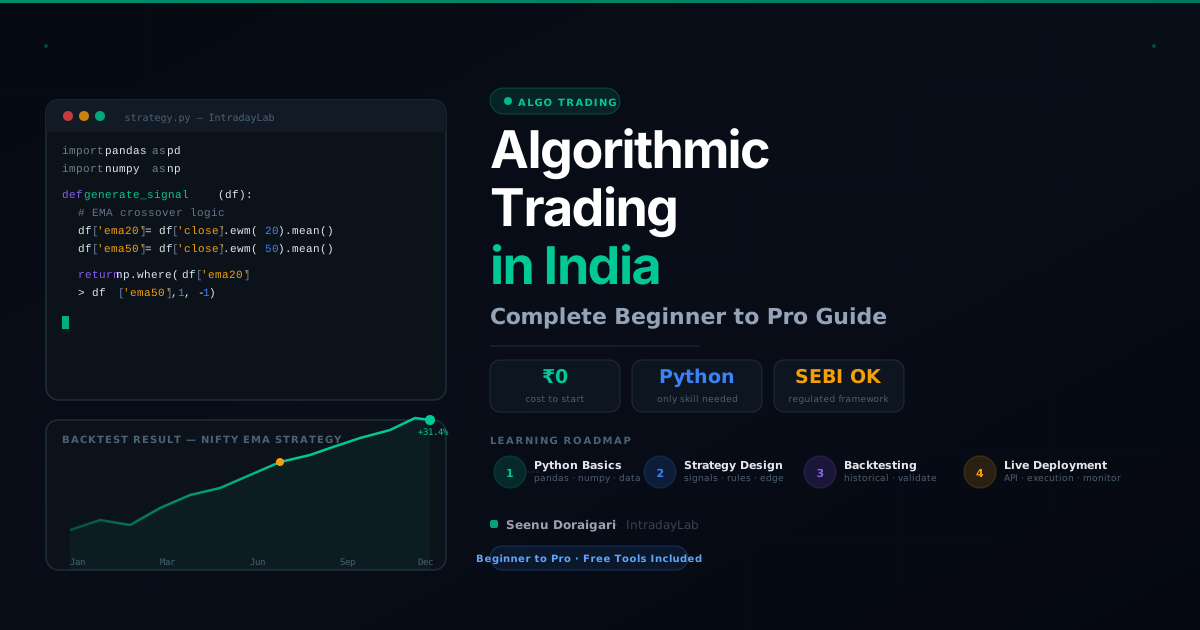
Every day, more than 50% of turnover on Indian exchanges is driven by algorithms — not human clicks. Not just institutions. Retail traders too. And yet most beginners have no idea how it actually works — or what the rules are as of April 2026.
What You Will Actually Learn Here
This is a ground-up, technically honest explanation of algorithmic trading in India — written for someone who has never written a single line of trading code, and structured so that someone already running a live algo can also find value.
By the end, you will understand:
- What algo trading actually is (not the romanticised version)
- The exact SEBI 2026 framework and what it means for your setup
- Static IP, Algo-ID, and compliance requirements explained plainly
- How to design a strategy with measurable edge
- How to backtest it on real Indian market data
- How to connect to a live broker API and execute orders
- What kills most beginners, and how to avoid it
Part 1: What Algorithmic Trading Actually Is
The real definition
Algorithmic trading means using a computer program to make trading decisions — and optionally execute those decisions — based on pre-defined rules.
That definition contains two distinct activities that beginners consistently conflate:
Systematic trading: You define the rules in advance. The computer identifies when those conditions are met. You execute the trade yourself.
Automated trading: The computer both identifies the signal and executes the order automatically through a broker API, with no human action required.
Most retail algo traders in India start with systematic and graduate to automated. Both are valid — but automated trading now carries specific SEBI compliance requirements as of April 2026.
What an algo is NOT
1. Algo trading is not about prediction. The best algorithms don't predict direction. They identify conditions where the probability of a favourable outcome is slightly better than random — and exploit that edge consistently across hundreds of trades.
2. Algo trading is not "set and forget." No algorithm works indefinitely without monitoring. Markets change. Strategies stop working. Live algos require active oversight and occasional rebuilding.
3. Algo trading is not exclusively for institutions. SEBI formally permitted retail algo trading in 2008 via Direct Market Access, but widespread retail access became practical only after broker APIs became widely available. As of 2026, algo trading accounts for over 50% of Indian equity market turnover.
The Core Insight
An algorithm is a rulebook for your trading. It eliminates the two things that destroy most retail traders — emotion and inconsistency. A system with a 40% win rate followed mechanically for 500 trades will outperform a strategy with a 55% win rate executed emotionally and inconsistently.
Part 2: Is Algo Trading Legal in India? The 2026 Rules
Yes — but the regulatory landscape has changed significantly. Here is the current framework, updated as of April 1, 2026.
SEBI's February 2025 Circular
SEBI issued circular SEBI/HO/MIRSD/MIRSD-PoD/P/2025/0000013 on February 4, 2025, introducing a comprehensive framework for safer retail participation in algo trading. After two deadline extensions, full compliance became mandatory on April 1, 2026 for all stock brokers and their API users.
This replaced the older 2013 framework with a far more structured set of requirements covering identity, traceability, security, and accountability.
The 2026 Compliance Framework — What Changed
1. Unique Algo-ID (Exchange-assigned identifier) Every order placed by an algorithm must now carry a unique Algo-ID issued by the exchange. This acts as a digital fingerprint — allowing regulators to trace any automated order back to its source. If your strategy does not carry a valid Algo-ID, it cannot legally trade on Indian exchanges.
2. Static IP Requirement — Critical for API Users Open APIs are banned. All API-based order placement must now originate from a whitelisted static IP address registered with your broker. Dynamic IPs — including regular home broadband, mobile data, or office WiFi — are not permitted for order placement via API.
As Zerodha's developer forum confirmed: "All order requests from an unregistered IP will be rejected." This applies from April 1, 2026.
How to get a static IP:
- Purchase a static IP from your ISP (most broadband providers offer this for ₹200–₹500/month extra)
- Use a cloud VPS (AWS, GCP, DigitalOcean) which provides a static public IP by default
- Register the IP in your broker's developer console (e.g.,
developers.kite.tradefor Zerodha Kite Connect)
3. 10 Orders Per Second (OPS) Threshold SEBI has set a clear OPS threshold:
- Below 10 OPS: You are classified as a regular API user. No exchange-level strategy registration required. Compliance requires only static IP + 2FA.
- Above 10 OPS: Classified as high-frequency. Mandatory exchange approval and strategy registration required.
For the vast majority of retail algo traders running intraday strategies, 10 OPS is well above what you will ever need. A 5-minute bar strategy fires at most a few orders per day.
4. Mandatory 2FA and Session Controls All API sessions must use OAuth-based login with Two-Factor Authentication. Every session must automatically log out before the next trading day's pre-open.
5. Audit Trail — 5-Year Log Retention Brokers must maintain complete logs of all API and algo activity for a minimum of 5 years. Every order carries a timestamp, Algo-ID, IP address, and strategy parameters.
6. White Box vs Black Box Algos
| Type | Definition | Who Can Use It |
|---|---|---|
| White Box | Logic is fully transparent and documented | Any retail trader for personal use |
| Black Box | Proprietary logic, hidden from user | Only SEBI-registered Research Analysts |
If you are writing your own Python strategy and understand every line of your logic — that is a white box algo. You can run it on your own account (and your immediate family's accounts) without RA registration.
7. Market Orders Now Require Market Protection Under the 2026 rules, market orders placed via API require a non-zero market protection parameter. Orders placed with market protection set to "0" will be rejected by exchanges.
If you are a retail trader running your own Python strategy via a broker API: (1) Register a static IP with your broker immediately. (2) Enable 2FA on your API account. (3) Ensure your order rate stays below 10 OPS. (4) Switch to compliant market order parameters. If your broker's API portal does not yet show static IP configuration, contact their developer support — non-compliant brokers were barred from onboarding new API clients from January 5, 2026.
What Still Requires Additional Registration
- Providing algo strategies to others: requires SEBI Research Analyst registration
- Running a black box algo: requires RA license + periodic performance disclosures
- Operating above 10 OPS: requires exchange-level strategy approval
For traders running their own white box strategies on personal capital below 10 OPS: the compliance checklist is static IP + 2FA + valid session management. Your broker's infrastructure handles the Algo-ID tagging.
Family Account Sharing
Static IPs can be shared within immediate family — self, spouse, dependent children, and dependent parents — with 2FA-verified consent logged by the broker. Sharing with anyone outside this definition is a compliance violation.
Part 3: The Honest Economics of Algo Trading
Trading charges eat algo profits
Algo strategies typically have smaller per-trade profit than discretionary trading. This makes trading charges a critical factor in viability.
Consider a simple intraday strategy:
- 5 trades per day, 20 trading days = 100 trades per month
- Average gross profit per trade: ₹150 → Monthly gross: ₹15,000
- Charges: ₹40–₹60 per round trip (brokerage + STT + exchange fee + GST + stamp duty)
- Monthly charges: ₹4,000–₹6,000
Actual monthly net: ₹9,000–₹11,000 — 30–40% lower than the gross.
Use our Brokerage & Tax Calculator to calculate exact post-charge profitability. Budget 2026 revised F&O STT to 0.05% — options-based algo strategies must recalculate their edge.
Realistic timelines
- Month 1–2: Python basics, getting data, understanding market structure
- Month 3–4: Building and backtesting first strategy
- Month 5–6: Forward testing, paper trading
- Month 7–9: Small live capital, monitoring, debugging live execution
- Month 12+: First realistic assessment of whether you have genuine edge
Traders who expect profitable live algos in 30 days fail. Traders who treat the first year as a learning lab succeed.
Part 4: The Python Stack You Actually Need
You do not need a computer science degree. You need functional proficiency in a small, well-defined set of tools.
The essential libraries
pandas — the foundation of all market data work. Load price data, resample timeframes, calculate indicators, filter signals.
import pandas as pd

df = pd.read_csv('NIFTY_5min.csv', parse_dates=['datetime'], index_col='datetime')
df_15min = df['close'].resample('15T').ohlc()
numpy — vectorised signal calculations and statistical analysis.
matplotlib / plotly — visualising equity curves and drawdowns. You cannot evaluate a strategy without seeing its visual output.
yfinance / nsepython / jugaad-trader — free historical data for Indian markets. nsepython and jugaad-trader provide NSE-specific data that Yahoo Finance often does not cover accurately.
vectorbt / backtrader — dedicated backtesting frameworks. vectorbt is faster for systematic testing; backtrader is more event-driven and closer to live trading logic.
The broker API layer
Every major Indian discount broker provides an API. As of 2026, all APIs require static IP registration to remain compliant.
| Broker | API Name | API Cost | Static IP Required |
|---|---|---|---|
| Zerodha | Kite Connect | ₹2,000/month | Yes (from April 1, 2026) |
| Fyers | Fyers API | Free | Yes |
| Dhan | Dhan API | Free | Yes |
| Angel One | SmartAPI | Free | Yes |
| Upstox | Upstox API v2 | Free | Yes |
For beginners, start with Fyers or Dhan — free APIs, good Python documentation, active developer communities, and both have updated their portals for static IP whitelisting.
Infrastructure for live trading
A standard laptop or desktop can run a retail algo — but from April 2026, your order API calls must come from a whitelisted static IP. If your home broadband does not provide a static IP, the practical options are:
- ISP static IP add-on: Call your broadband provider. Most offer static IPs for ₹200–₹500/month.
- Cloud VPS (recommended): A DigitalOcean or AWS t3.micro instance costs ₹500–₹1,500/month and comes with a dedicated static IP, guaranteed uptime, and no sleep/crash issues. For any capital above ₹5–10 lakh, cloud hosting is the sensible choice.
Part 5: Strategy Design — Where Most Beginners Go Wrong
The hypothesis-first approach
Every algo strategy starts with an observation about market behaviour — not an indicator.
Wrong starting point: "Let me try RSI + MACD and see what win rate I get."
Right starting point: "NIFTY tends to mean-revert after making a new 5-day high in the first 30 minutes. Let me define rules to test whether this observation holds statistically."
Random indicator combinations produce random results. Hypotheses rooted in market structure give you a reason to believe the edge might persist.
Five strategy categories that work in Indian markets
1. Trend-following: Buy when trending up (EMAs, momentum indicators), short when trending down. Profitable in trending markets, painful in choppy ones.
Example: EMA 20/50 crossover on Nifty 15-minute bars, entered only when ADX > 25.
2. Mean reversion: Securities that move significantly in one direction tend to return toward their average.
Example: Buy BANKNIFTY when it falls more than 1.2 standard deviations below the 20-period Bollinger Band midpoint, exit at midpoint.
3. Opening Range Breakout (ORB): Define the high and low of the first 15–30 minutes. Go long on breakout above, short on break below.
IntradayLab's ORB backtest on real NSE data is published here.
4. Gap strategies: Statistically measurable tendencies when a security opens significantly above or below the prior close. See our Gap-Up and Gap-Down analyses.
5. Statistical arbitrage: Pairs trading between correlated instruments (NIFTY vs BANKNIFTY, TCS vs Infosys). Bet on convergence when spread diverges beyond normal range.
Non-negotiable rules every strategy must define
Every strategy must specify before you write a single line of backtest code:
- Entry rule: Exact, objective, calculable condition — no ambiguity
- Stop-loss: Price level where you exit regardless of anything else
- Target: Fixed, percentage, or indicator-based profit exit
- Position size: Based on capital at risk, not conviction
- Filters: Time of day, volatility thresholds, news events
If any of these is undefined, your backtest results are unreliable.
Too many parameters. Every indicator period, threshold, and filter is another dial your backtest can overfit to historical data. A strategy with 3 parameters tested on 500 trades is meaningful. A strategy with 15 parameters tested on 100 trades is curve-fitting, not trading.
Part 6: Backtesting on Real Indian Market Data
Getting free historical data
# Option 1: nsepython (NSE-specific, free)
from nsepython import equity_history
df = equity_history("RELIANCE", "EQ", "01-01-2024", "31-12-2024")

# Option 2: yfinance (good for indices)
import yfinance as yf
nifty = yf.download("^NSEI", start="2022-01-01", end="2025-01-01", interval="1d")

# Option 3: jugaad-trader (intraday data, free registration)
from jugaad_trader.nse import NSELive
A complete vectorised backtest in Python
import pandas as pd
import numpy as np
import matplotlib.pyplot as plt

df = pd.read_csv("NIFTY_15min.csv", parse_dates=["datetime"], index_col="datetime")
df = df.sort_index()

df["ema20"] = df["close"].ewm(span=20).mean()
df["ema50"] = df["close"].ewm(span=50).mean()

df["signal"] = np.where(df["ema20"] > df["ema50"], 1, -1)
df["signal"] = df["signal"].shift(1)  # avoid lookahead bias

df["ret"]       = df["close"].pct_change()
df["strat_ret"] = df["signal"] * df["ret"]

total_return = df["strat_ret"].add(1).prod() - 1
sharpe       = df["strat_ret"].mean() / df["strat_ret"].std() * np.sqrt(252 * 26)
cum          = (1 + df["strat_ret"]).cumprod()
max_dd       = ((cum - cum.cummax()) / cum.cummax()).min()

print(f"Total Return:  {total_return:.2%}")
print(f"Sharpe Ratio:  {sharpe:.2f}")
print(f"Max Drawdown:  {max_dd:.2%}")

cum.plot(title="Strategy Equity Curve", figsize=(12, 5), color="#00C896")
plt.tight_layout()
plt.savefig("equity_curve.png", dpi=150)
The metrics that actually matter
Sharpe Ratio — return divided by volatility. Above 1.0 suggests genuine edge. Above 2.0 is exceptional.
Maximum Drawdown — largest peak-to-trough decline. Target below 15–20% for a live strategy. A 40% annual return with a 35% drawdown is not practically tradeable.
Profit Factor — total gross profit divided by total gross loss. Above 1.5 is acceptable; above 2.0 is strong.
Win Rate + Reward:Risk together — neither alone is sufficient. A 30% win rate with 3:1 R:R beats a 60% win rate with 1:1.5 R:R every time.
Use our Trading Outcome Simulator to calculate your strategy's breakeven win rate before building a full backtest.
The three ways backtests lie
Lookahead bias — using future data in your calculations. Fix: always use .shift(1) to ensure signals use prior bar data.
Survivorship bias — testing only on stocks that still exist today excludes companies that went bankrupt or were delisted. Nifty 50 components today are not the same as in 2015.
Overfitting — optimising parameters until the backtest looks perfect, then deploying live only to see it fail. Fix: use 70% of data to optimise, test final parameters on the remaining 30% you never touched.
The Backtest Truth
A backtest tells you whether your strategy had consistent edge across different market conditions. That consistency — not the raw return number — is what you are actually testing for.
Part 7: Forward Testing and Paper Trading
Forward testing means running your coded strategy on live market data without placing real orders. This step is essential and catches what backtesting cannot:
- Execution gaps: Backtests assume fills at signal price. Live markets have slippage.
- Data quality issues: Live feeds have gaps and spikes that may not exist in historical data.
- Signal logic bugs: Code that looked correct in backtesting sometimes misbehaves in a live loop.
Forward test for a minimum of 30–50 trades before going live. For low-frequency strategies (3–5 trades per week), this may take 2–3 months. That is the price of confidence.
Part 8: Live Execution — Connecting to Broker APIs
Setting up Fyers API (2026-compliant example)
from fyers_apiv3 import fyersModel

# Authentication requires OAuth flow + 2FA (mandatory from April 2026)
CLIENT_ID = "YOUR_CLIENT_ID-100"

fyers = fyersModel.FyersModel(
    client_id=CLIENT_ID,
    is_async=False,
    token=access_token,  # from OAuth flow (session created from whitelisted static IP)
    log_path=""
)

# Get live quote
response = fyers.quotes(data={"symbols": "NSE:NIFTY50-INDEX"})
ltp = response["d"][0]["v"]["lp"]
print(f"Nifty LTP: {ltp}")

# Place a limit order (market orders require market_protection parameter from April 2026)
order = {
    "symbol":      "NSE:NIFTY-I",
    "qty":         75,
    "type":        1,            # 1 = Limit order (recommended for retail algos)
    "side":        1,
    "productType": "INTRADAY",
    "limitPrice":  ltp,
    "validity":    "DAY",
    "disclosedQty": 0,
    "offlineOrder": False
}
response = fyers.place_order(data=order)
print(response)
Note: From April 2026, market orders via API require a non-zero
market_protectionparameter. Brokers have specific values for this — check your broker's updated API documentation.
The live algo structure
A robust live algo has four components:
1. Data engine — fetches live OHLCV from the broker at defined intervals. Handles reconnections and data validation.
2. Signal engine — applies strategy logic to incoming data. Identical to your backtest signal generation code.
3. Order engine — converts signals into orders, manages positions, handles stops, prevents duplicate orders.
4. Risk manager — the circuit breaker. If daily loss exceeds a threshold (e.g., 2% of capital), halt all new orders and send an alert. Non-negotiable.
import time, datetime, logging

logging.basicConfig(level=logging.INFO, filename="algo.log")

MAX_DAILY_LOSS = -5000
daily_pnl      = 0
position       = 0

def run_algo():
    global daily_pnl, position

    while True:
        now = datetime.datetime.now()

        if now.hour < 9 or (now.hour == 9 and now.minute < 20):
            time.sleep(30)
            continue
        if now.hour >= 15 and now.minute >= 15:
            if position != 0:
                exit_position()
            break

        if daily_pnl < MAX_DAILY_LOSS:
            logging.warning(f"Daily loss limit hit: {daily_pnl}. Halting.")
            break

        df     = fetch_latest_data("NSE:NIFTY-I", "5")
        signal = generate_signal(df)

        if signal == 1 and position != 1:
            place_buy_order()
            position = 1
        elif signal == -1 and position != -1:
            place_sell_order()
            position = -1

        time.sleep(300)

if __name__ == "__main__":
    run_algo()
Part 9: The Mistakes That Kill Algo Traders
Over-optimisation — finding that (12, 34) EMA spans are optimal on your historical data and deploying that live. The market does not know your backtest. Pick parameter values based on logic, not optimisation. If you must optimise, hold out 30% for out-of-sample validation.
Ignoring slippage — backtests fill at signal price. Reality doesn't. Add a slippage assumption:
SLIPPAGE_PCT = 0.001  # 0.1% per trade
buy_price  = signal_price * (1 + SLIPPAGE_PCT)
sell_price = signal_price * (1 - SLIPPAGE_PCT)
No circuit breaker — a runaway algo is the most dangerous scenario. Every live algo must have: daily loss limit, max open positions limit, order rate limiter (SEBI mandates max 10 OPS anyway), and Telegram/SMS alerts on every order and error.
Ignoring the static IP requirement — as of April 1, 2026, any API call from an unregistered IP is rejected by exchanges. This is not optional. If you deploy your algo on a cloud server with a new IP but forget to whitelist it with your broker, every order will fail silently.
Part 10: Building Your First Strategy (Step by Step)
Week 1–2: Install Python 3.10+, pandas, numpy, matplotlib, vectorbt. Open a paper trading account with Fyers or Dhan. Download 2 years of Nifty 50 daily OHLCV data via yfinance. Register a static IP with your broker.
Week 3–4: Implement ORB on Nifty 15-minute data. Open range = first 30 minutes. Buy on breakout above range high, stop at range low, target 2× the range. Backtest on 2 years of data. Calculate Sharpe, max drawdown, win rate, profit factor.
Week 5–6: Hold out the most recent 6 months as out-of-sample data. Run the optimised strategy on this holdout. If Sharpe drops dramatically, simplify the strategy parameters.
Week 7–8: Connect your code to the broker API in paper mode. Run live during market hours for 4 weeks. Log every signal and would-have-been P&L. Ensure your static IP and 2FA are configured.
Week 9–12: Deploy with 10–20% of intended capital. Monitor every order manually for the first two weeks. Fix bugs as they appear.
Month 4+: Once you have 50+ live trades consistent with your backtest, consider scaling capital. Simultaneously begin developing strategy #2 — no serious algo trader runs a single strategy on all their capital.
The One Rule
Do not go live until you have: (1) a backtest with at least 200 trades and Sharpe > 1.0, (2) 30+ days of paper trades matching backtest expectations, (3) a static IP whitelisted with your broker, and (4) a written risk management plan with a defined daily loss limit.
Part 11: Advanced Topics
Walk-forward optimisation — optimise on a rolling window, test on the next window. Move forward and repeat. Produces a realistic estimate of how your optimisation process performs in live conditions.
Monte Carlo simulation — randomly reshuffle your trade returns 1,000 times. The distribution of max drawdowns tells you: "What is the worst realistic drawdown this strategy could produce?" If 95% of simulations show max drawdown below 15% and your live drawdown hits 20%, the edge may have disappeared.
Market regime detection — a strategy that works in trending conditions will destroy capital in choppy markets. A regime filter identifies current market conditions and only deploys strategies appropriate to that regime.
from ta.trend import ADXIndicator

adx = ADXIndicator(df["high"], df["low"], df["close"], window=14)
df["adx"]    = adx.adx()
df["regime"] = np.where(df["adx"] > 25, "trending", "ranging")
Frequently Asked Questions
Where to Go From Here
You have the complete framework. The next step is execution, not more reading.
- Install Python and the core libraries
- Download Nifty 50 daily data via yfinance
- Implement the EMA crossover backtest from Part 6
- Register a static IP with your broker's developer console
- Run the backtest, generate the equity curve, study the metrics
Read next:
- What is Backtesting? Free Tools + Real Data
- Is Intraday Trading Gambling? Data-Backed Reality Check
- Nifty ORB Strategy Backtest
Tools:
- Trading Outcome Simulator — validate your R:R and breakeven win rate
- Brokerage & Tax Calculator — exact post-charge profitability at Budget 2026 rates
Algorithmic trading in India is not a shortcut to profits. It is a framework for removing emotion and inconsistency from a probabilistic game. The SEBI 2026 framework adds structure — not barriers — to how retail traders access this technology.
The code is learnable. The compliance is manageable. The edge — if you build it properly — is real.
Start with one strategy. Test it properly. Get compliant. Deploy it small. Prove the edge before scaling it.