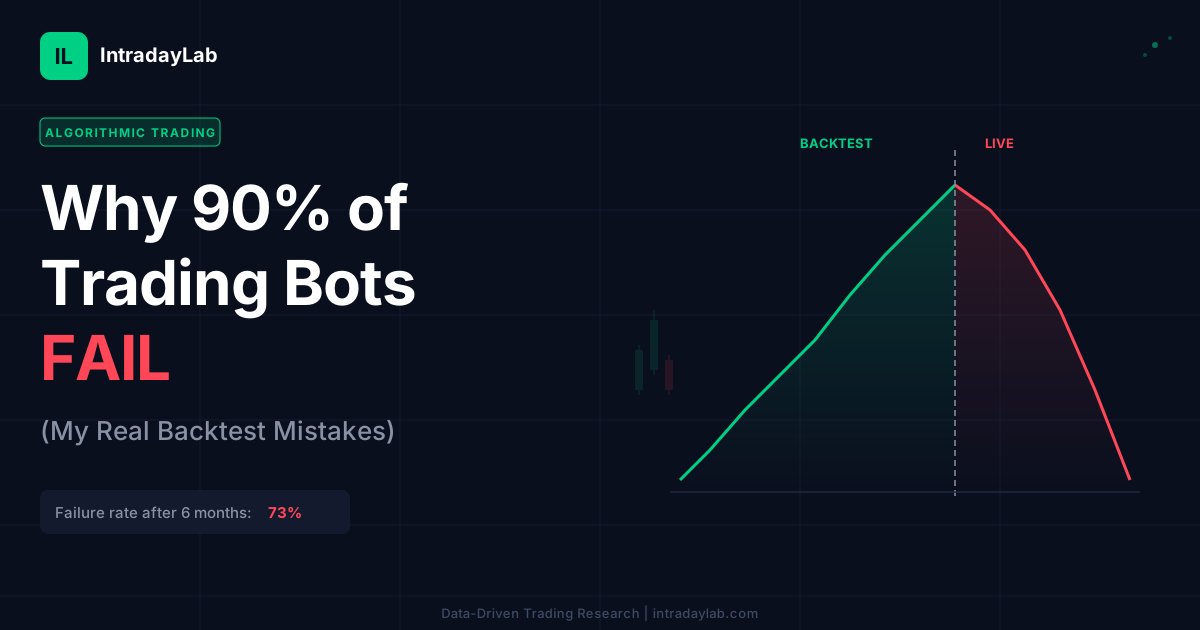
Your backtest shows a 78% win rate. Equity curve going from bottom-left to top-right like a dream. You deploy the bot live on NSE. Two weeks later — the account is down 23%.
Sound familiar?
This is not a story I read somewhere. It's what happened to us — and to thousands of algo traders across India every single year. The Indian algorithmic trading market hit ₹8,770 crore in 2024 and is growing at 14.3% CAGR. More money, more bots, more failures. The failure rate hasn't improved.
Here's the hard truth: most trading bots don't fail because algo trading doesn't work. They fail because the backtest was lying from the start.
Key Stats
- 73% of automated trading accounts fail within six months of going live
- 44% of published trading strategies fail to replicate backtest results on new data
- The backtested-to-live failure rate for traditional algos is estimated at 80%+
- 22% of live algo trading losses among retail traders are caused by infrastructure failures — not bad strategy design
- Only 60% of retail traders even run proper historical validation before going live
Mistake #1 — Overfitting: The Silent Killer of Every "Perfect" Backtest
This one mistake accounts for more blown accounts than any other. And I made it embarrassingly late in my journey.
Overfitting happens when you tune your strategy so tightly to historical data that the bot starts "learning" random noise instead of actual market patterns. A study of 888 algorithmic strategies found that backtested Sharpe ratios are poor predictors of real-world performance — the R² was less than 0.025. Near zero. That means your beautiful backtest Sharpe ratio tells you almost nothing about how the bot will actually perform live.
Here's how it happens in practice: you start with a simple moving average crossover on Nifty 50. It looks average. You start tweaking — 37-period MA instead of 50, RSI threshold at 66.19 instead of 65, stop-loss at ₹217.34 exactly. The backtest gets better with every tweak. You feel like you're "optimizing."
You're not. You're memorizing the past.
That 37-period MA isn't special. It just happened to work best on your specific slice of historical data. The moment markets shift — a new budget announcement, RBI rate decision, FII selling cycle — your "optimized" bot has no idea what to do.
The fix: Test your parameters across a range, not a single value. If your strategy only works at exactly RSI-66 and falls apart at RSI-65 or RSI-67, it's curve-fitted garbage. A robust strategy should work reasonably well across a band of parameters.
Overfitting Reality
Overfitting is the #1 killer — if your parameters only work at one specific value, the strategy is curve-fitted to history, not to markets. A study of 888 strategies found R² < 0.025 between backtested Sharpe and live performance — essentially zero correlation.
Mistake #2 — Look-Ahead Bias: Winning with Tomorrow's Data
This one is sneaky and harder to catch.
Look-ahead bias occurs when your backtest accidentally uses information that would not have been available at the time of the trade. For example: you're calculating a daily pivot level and entering a trade "at the open" — but your code is using the full day's high/low to compute that pivot. In live trading, you'd never have that data at 9:15 AM IST.
Or worse — your backtest uses closing prices to generate a signal, then executes the trade also at the closing price. In real markets, that's impossible. By the time you get the signal, the candle is already closed.
We ran a momentum strategy on Bank Nifty that showed 2.4x returns over 3 years. When we fixed the look-ahead bias in the code, it dropped to 0.9x — a net loser after brokerage.
The fix: Always use a strict "signal on close, execute on next bar open" rule. Walk through your code line by line and ask: "Would I have had this data at this exact moment in real time?" If the answer is no, your backtest is invalid.
Signal Integrity
Look-ahead bias silently inflates backtests — always use signal-on-close, execute-on-next-open discipline. Real-time data is never complete; backtests with future data are invalid, no matter how good the returns look.
Mistake #3 — Ignoring Transaction Costs (The NSE Tax Nobody Talks About)
Paper trading feels free. Live trading is expensive.
Most beginner algo traders in India backtest without factoring in the full cost stack: brokerage, STT (Securities Transaction Tax), exchange transaction charges, GST on brokerage, SEBI turnover fees, and most critically — slippage.
Slippage is the difference between the price you expected and the price you actually got filled at. In illiquid strikes of Nifty 50 weekly options, slippage of ₹2–5 per lot is common. For a high-frequency strategy taking 15–20 trades per day, this destroys the edge entirely.
Here's a rough cost illustration for a Nifty F&O scalping bot (per round trip, 1 lot = 50 units):
| Cost Component | Approximate Amount |
|---|---|
| Brokerage (flat ₹20/order × 2) | ₹40 |
| STT on sell side | ₹12–18 |
| Exchange charges + GST | ₹8–12 |
| Slippage (₹2–3 per unit) | ₹100–150 |
| Total per round trip | ₹160–220 |
A strategy that makes ₹150 per round trip in a backtest is actually a loser in live markets once you account for this. We've seen strategies with 60% win rates that were still net negative after costs.
The fix: Build your cost model before you build your strategy. Set a minimum edge threshold per trade. If the gross profit per trade doesn't comfortably exceed your full cost stack, the strategy has no business being live.
The Cost Tax
Cost modelling is non-negotiable — slippage + STT + brokerage routinely erases strategies that look profitable on paper. A ₹150/trade strategy becomes a loser after ₹160–220 in round-trip costs on NSE F&O.
Mistake #4 — Survivorship Bias in Data
If you're backtesting on stocks, this one will silently inflate your results.
Survivorship bias means you're only testing on stocks that currently exist in the index — ignoring all the companies that got delisted, went bankrupt, or dropped out of the Nifty 500 over the years. Those stocks often had the worst returns. By excluding them from your data, your backtest looks much better than reality.
For NSE stock-based strategies, this is particularly dangerous. The Nifty 500 composition changes regularly. A mean-reversion strategy backtested on today's Nifty 500 constituents is implicitly using hindsight — you're only picking from "winners" that survived to 2025.
The fix: Use point-in-time data. Your historical database should reflect exactly which stocks were in any given index on any given date — not today's composition projected backward. Vendors like True Data, QuantQuote India, or Algoji provide survivorship-bias-free NSE datasets.
Data Bias Alert
Survivorship bias distorts stock-based backtests — use point-in-time index composition data for NSE strategies. Testing only current Nifty 500 constituents silently inflates results by excluding delisted and bankrupt companies.
Mistake #5 — No Walk-Forward Testing (The Most Skipped Step)
So you've avoided overfitting, fixed look-ahead bias, added realistic costs. Your backtest still shows strong results. You go live.
And it still fails.
Why? Because a single backtest over one fixed historical period can still be a coincidence. Maybe that specific 5-year window happened to suit your strategy perfectly — but the next 12 months look nothing like it.
Walk-forward testing splits your data into rolling windows: optimize on a training period, test on the immediately following out-of-sample period, then move the window forward and repeat. It simulates how the strategy would have actually been developed and deployed in real time.
Most retail algo traders in India skip this entirely. It's time-consuming and the results are usually less flattering. But it's the closest thing to a real-world stress test you can run before risking actual capital.
The fix: Run a minimum of 5 walk-forward folds before trusting any strategy. If performance degrades sharply in out-of-sample periods, your in-sample results are meaningless.
Validation Standard
Walk-forward testing is the minimum standard — one backtest period proves nothing; test across rolling out-of-sample windows. If your strategy's out-of-sample Sharpe falls below 60% of in-sample, it was overfit.
Mistake #6 — Ignoring Market Regime Changes
A bot trained on trending markets will bleed in ranging markets. A bot trained on low-volatility 2017-style Nifty will get destroyed in the high-VIX environment of 2020 or 2024's pre-election swings.
Markets have regimes. Regime changes are not gradual — they snap. In May 2025, algorithmic bots across global markets sold $2 billion worth of assets in just three minutes during a flash crash event. These bots were optimized for "normal" conditions and had zero adaptive logic for sudden volatility.
On NSE, the F&O expiry dynamics have shifted dramatically since SEBI's 2024 circular restricting weekly expiries. Strategies that worked perfectly on Thursday Bank Nifty expiry had to be entirely reworked. Bots that weren't built to handle regime shifts failed — sometimes spectacularly.
The fix: Add regime filters. Classify market conditions (trending/ranging/volatile) using simple metrics like ADX, VIX India levels, or rolling realized volatility. Switch strategy behavior — or pause the bot entirely — when the regime shifts outside training parameters.
Regime Awareness
Regime awareness separates robust bots from fragile ones — build filters, not just rules. Bots optimized for trending markets bleed in ranges; SEBI's 2024 expiry circular broke strategies that didn't adapt.
Mistake #7 — Treating Deployment as the Finish Line
This one is a mindset failure, not a technical one.
Once live, the bot starts generating real P&L. And real losses hurt differently than simulated ones. Most traders start "helping" the bot — overriding stop-losses, pausing it after three consecutive losses, manually interfering with position sizing.
The moment you do this, you've broken the system. Now you're running a hybrid of algo discipline and emotional decision-making — and you'll get the worst of both.
Infrastructure failures compound this. A 2025 analysis found that 22% of live algo trading losses among retail participants were caused by API failures, broken data feeds, and broker connectivity issues — not strategy problems. When your broker's API goes down at 9:17 AM IST and your position is open without a stop-loss in place, the strategy is irrelevant.
The fix: Set strict rules before going live: under what conditions will you override the bot? (Answer: almost none.) Build redundancy — SMS alerts, secondary monitoring, kill-switch logic. Treat bot maintenance as an ongoing part of the job, not a weekend setup.
Live Operation Rules
Post-deployment discipline is as important as pre-deployment testing — set override rules before you go live, not during a drawdown. Infrastructure failures cause 22% of live algo losses; emotional interference causes most of the rest.
Trader's Quick Reference
Backtest Mistake Checklist — NSE Algo Traders
| Mistake | How to Detect | Fix |
|---|---|---|
| Overfitting | Results collapse with ±1 parameter change | Test across parameter ranges, not single values |
| Look-ahead bias | Live results dramatically worse than backtest | Signal on close, fill on next bar open |
| Ignoring costs | Gross edge < ₹200/round trip on F&O | Build cost model first |
| Survivorship bias | Testing only current Nifty 500 stocks | Use point-in-time historical constituents |
| No walk-forward test | Single backtest period only | Minimum 5 rolling out-of-sample folds |
| No regime filter | Bot runs identically in all market conditions | Add ADX / India VIX filter |
| Over-interference | Manual overrides during drawdowns | Pre-define override rules; document them |
Frequently Asked Questions
Conclusion
The 90% failure statistic isn't pessimistic. It's clarifying.
It means that getting a trading bot to actually work in live markets — not just on paper — is genuinely hard. Not because markets are random, but because the gap between a backtest and reality is filled with dozens of silent errors that most traders never diagnose. Overfitting feels like optimization. Look-ahead bias feels like a great signal. Ignoring costs feels like conservatism. Each mistake individually seems minor. Together, they guarantee failure.
The traders who survive in algo trading don't have smarter strategies. They have more rigorous processes. They treat every backtest as a hypothesis, not a proof. They validate obsessively before risking a single rupee. They build in regime filters, cost models, and override rules before deployment — not after the first drawdown.
If you've blown an algo account before, go back to the checklist in this article. The error is almost certainly in there. Fix the process, rebuild the strategy, and test again — the right way this time.
A backtest doesn't tell you what your bot will do. It tells you what your bot would have done — in a world that no longer exists.