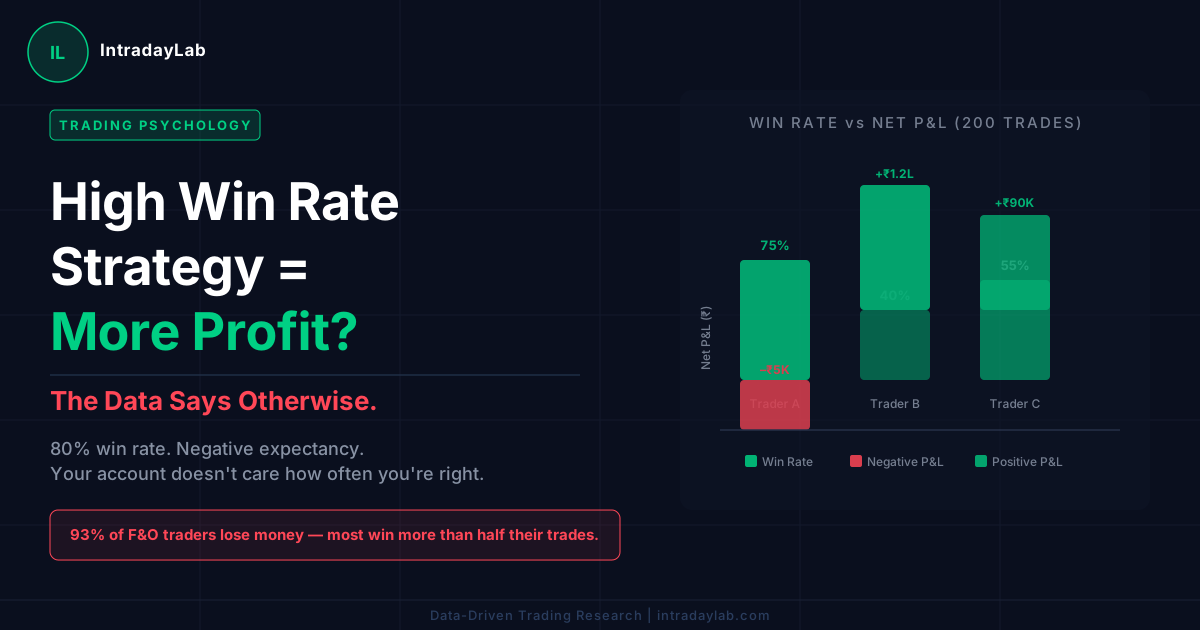
KEY INSIGHT: Win rate tells you how often you're right. Expectancy tells you how much you make. Only one of them shows up in your bank account. Spoiler: it's not win rate.
The Dangerous Indian Trading Myth
You have a strategy that wins 8 out of every 10 trades. Feels unbeatable, right?
Now imagine your 8 winning trades each make ₹500. And your 2 losing trades each lose ₹3,000.
Net result after 10 trades: ₹4,000 profit — minus ₹6,000 loss = -₹2,000.
An 80% win rate strategy just blew up your account. Welcome to the most dangerous myth in retail trading.
Why Traders Are Obsessed With Win Rate (And Why That's a Problem)
Win rate is seductive because it maps perfectly to how the human brain tracks success. We count wins. We remember wins. We post wins on Telegram. Wins feel good neurologically — each one triggers a small dopamine hit that reinforces the behaviour.
The Indian retail trading community has it particularly rough here. Walk into any trading group on Telegram or WhatsApp and the measuring stick is always: "Bhai, kitne percent accuracy hai teri?" Nobody asks about average win-to-loss ratio. Nobody asks about maximum drawdown per trade. Just accuracy.
This cultural fixation creates a specific and measurable problem: traders optimise for the wrong variable.
SEBI's FY2024 study on F&O traders found that over 93% of individual traders in Futures & Options lost money over a three-year period. Among those surveyed informally in trading communities, the majority reported maintaining win rates between 55–75%. They were right more often than not — and still losing money.
That is not a paradox. That is what happens when you optimise for win rate instead of expectancy.
The Real Metric That Determines Profitability: Expectancy
Expectancy is the average amount you can expect to make (or lose) per rupee risked, per trade, over a large sample. The formula is simple:
Expectancy = (Win Rate × Average Win) – (Loss Rate × Average Loss)
Let's run three real scenarios:
Scenario A — The "High Win Rate" Trader
- Win Rate: 75%
- Average Win: ₹800
- Average Loss: ₹2,500
Expectancy = (0.75 × 800) – (0.25 × 2500) = ₹600 – ₹625 = –₹25 per trade
This trader wins 3 out of 4 trades and is slowly bleeding to death. Over 200 trades, they lose ₹5,000 — before brokerage and STT.
Scenario B — The "Low Win Rate" Trader
- Win Rate: 40%
- Average Win: ₹3,000
- Average Loss: ₹1,000
Expectancy = (0.40 × 3000) – (0.60 × 1000) = ₹1,200 – ₹600 = +₹600 per trade
This trader loses 6 out of 10 trades. Anyone watching would think they're terrible. Over 200 trades, they make ₹1,20,000.
Scenario C — The Balanced Trader
- Win Rate: 55%
- Average Win: ₹1,800
- Average Loss: ₹1,200
Expectancy = (0.55 × 1800) – (0.45 × 1200) = ₹990 – ₹540 = +₹450 per trade
A modest win rate with disciplined risk management compounds into serious returns over time.
| Trader Type | Win Rate | Avg Win | Avg Loss | Expectancy/Trade | P&L (200 Trades) |
|---|---|---|---|---|---|
| High Win Rate | 75% | ₹800 | ₹2,500 | –₹25 | –₹5,000 |
| Low Win Rate | 40% | ₹3,000 | ₹1,000 | +₹600 | +₹1,20,000 |
| Balanced | 55% | ₹1,800 | ₹1,200 | +₹450 | +₹90,000 |
The table above is not theoretical. It reflects the actual distribution of outcomes that separate profitable traders from the majority who lose money in Indian markets.
Key Takeaway
Win rate alone means nothing. A 75% win rate with poor risk-reward is mathematically losing. Always calculate expectancy before you trust any strategy.
How High Win Rate Strategies Actually Destroy Traders
There's a specific trap that high win rate setups create — and it's psychological as much as it is mathematical.
The Averaging Down Trap
Most high win rate strategies in retail trading are actually just poorly disguised "average down" or "hold and hope" approaches. A trader enters a Nifty 50 futures position, it goes against them, they hold, it eventually recovers. Win recorded.
This works — until it doesn't. The strategy appears to have a 78% win rate across 50 trades. Then on trade 51, the market gaps down 400 points on an unexpected macro event. The one loss wipes out months of small wins.
The Moving Stop-Loss Problem
To maintain a high win rate, many traders unconsciously do something lethal: they move their stop-losses further away when the trade goes against them. The logic? "I don't want to book a loss, it'll ruin my accuracy."
This behaviour is so common among Indian intraday traders that experienced prop desk managers at NSE-registered brokers have documented it as one of the top three account-blowing behaviours, alongside over-leveraging and revenge trading.
Options Selling Without Understanding the Tail Risk
Selling options on weekly Nifty 50 or Bank Nifty expiries can produce win rates of 70–85% over several months. Premiums decay, most options expire worthless, and the seller collects repeatedly.
But the risk-reward is deeply asymmetric. You collect ₹2,000–5,000 per lot repeatedly — and then a single gap event or major news shock destroys ₹30,000–80,000 in one session. The win rate looked beautiful. The expectancy was negative the entire time.
If your strategy's edge disappears when a single loss grows bigger than your average win, you are not trading a profitable system — you are trading a probability illusion.
What Professional Traders Actually Optimize For
Institutional desks, prop trading firms, and consistently profitable retail traders all share one characteristic: they measure and manage expectancy, not win rate.
1. Define Risk Per Trade First
Before entry, the question is not "will this work?" The question is "how much am I willing to lose if this doesn't work?" A fixed risk per trade — typically 0.5% to 2% of trading capital — ensures that no single loss can derail the account.
2. Let Winners Run, Cut Losers Fast
This sounds obvious. It is almost universally ignored. The data on Indian intraday traders shows the exact opposite behaviour — losses are held, profits are booked early (the disposition effect). The result is low average wins and high average losses — the death formula.
3. Track Expectancy, Not Accuracy
Maintain a trading journal — not to count wins and losses, but to calculate your rolling expectancy every 20–30 trades. If expectancy is positive and rising, you're doing something right. If it is negative despite a "good" win rate, you have a position sizing or exit problem.
4. Accept That Losing Streaks Are Normal
A strategy with 45% win rate will produce 5–6 consecutive losses regularly — statistically, it will happen. Traders who track expectancy survive these streaks because they know the math is still working in their favour. Traders who track win rate abandon the strategy at exactly the wrong moment.
Try It Yourself — Expectancy Calculator
Interactive Tool
Expectancy Calculator
Enter your strategy's metrics — see if it has a mathematical edge
Expectancy/Trade
+₹200
Avg Win
+₹2,000
Avg Loss
-₹1,000
Over 100 Trades
+₹20,000
Simulated 20-trade sequence at these metrics
10 wins / 10 losses → +₹10,000 P&L over 20 trades
Adjust sliders to test different strategies · Expectancy = (Win% × Avg Win) − (Loss% × Avg Loss)
The Real-World Data on Profitable Traders and Win Rate
Studies on hedge fund and CTA performance data — particularly from CFTC-registered trend-following firms — show something surprising: the best-performing trend funds historically maintain win rates of 35–45%.
They win less than half the time. And they significantly outperform buy-and-hold over 20+ year periods during volatile markets.
In Indian markets, a 2023 analysis of algo trading systems backtested on Nifty 50 and Bank Nifty data (2015–2022) found that momentum breakout strategies with win rates of 38–48% consistently outperformed mean-reversion setups with win rates of 65–75% — when measured by net returns adjusted for brokerage, STT, and slippage.
The mean-reversion setups looked better in casual observation. The breakout strategies actually made more money.
Why This Myth Persists (The Psychological Reason)
The win rate obsession is not random. It is hardwired.
Loss aversion — the bias where losses feel roughly twice as painful as equivalent gains feel pleasurable — means traders will do almost anything to avoid recording a loss. Including holding losers too long. Including cutting winning trades too early. Including building entire strategies designed primarily to avoid the pain of being wrong.
The result is a massive population of traders with high win rates, negative expectancy, and steadily declining accounts — who genuinely believe they are "almost there" because they're right 70% of the time.
The market does not care how often you are right. It only deposits money for how well you manage the difference between your winners and losers.
What Matters Most
• Win rate alone means nothing. A 75% win rate with a poor risk-reward ratio can be mathematically losing. • Expectancy is the scorecard: (Win% × Avg Win) – (Loss% × Avg Loss). • The best traders often win less than 50% of the time. Their edge comes from larger winners and smaller losers. • Moving stop-losses and holding losers to "protect accuracy" is the #1 account-destroying behaviour in Indian retail F&O trading. • Options selling can show 75–85% win rates and still have negative expectancy because of tail-risk events. • Track your rolling expectancy every 20–30 trades, not your win percentage.
Frequently Asked Questions
Conclusion
The trading industry has done retail participants a disservice by glorifying win rate. Social media, trading courses, and tip providers all sell accuracy — because accuracy is a number most people can understand and feel good about.
What they don't sell is the harder truth: a losing strategy can look like a winning strategy for months, even years, if the sample size is small enough.
The math is unforgiving and it doesn't negotiate. Every trade you take, your account is not asking how often you've been right — it's silently calculating your average win, your average loss, and multiplying.
Positive expectancy compounds. Negative expectancy drains. There is no third outcome.
The traders who survive long enough to become consistently profitable in Indian markets — whether in Nifty 50 futures, Bank Nifty options, or MCX commodities — share one habit: they stopped chasing accuracy and started engineering expectancy.
Win rate is a vanity metric. Expectancy is the only scorecard that matters.