Every year, millions of Indians start intraday trading. Within 12 months, most of them quit — convinced they were gambling. A small number don't quit. And the difference between those two groups isn't luck. It's one concept most traders never learn.
The Question the Data Actually Answers
Here's a question that circulates endlessly in trading communities, family WhatsApp groups, and finance forums:
"Isn't intraday trading just gambling with extra steps?"
It's a fair question. And here's the honest answer: for most people who do it — yes, it effectively is.
But that's not because intraday trading is gambling. It's because most traders approach it as if it were gambling — without a system, without data, without any concept of edge.
The question isn't whether intraday trading can be different from gambling. The question is: what does the data actually show when someone builds a rule-based system and tests it properly?
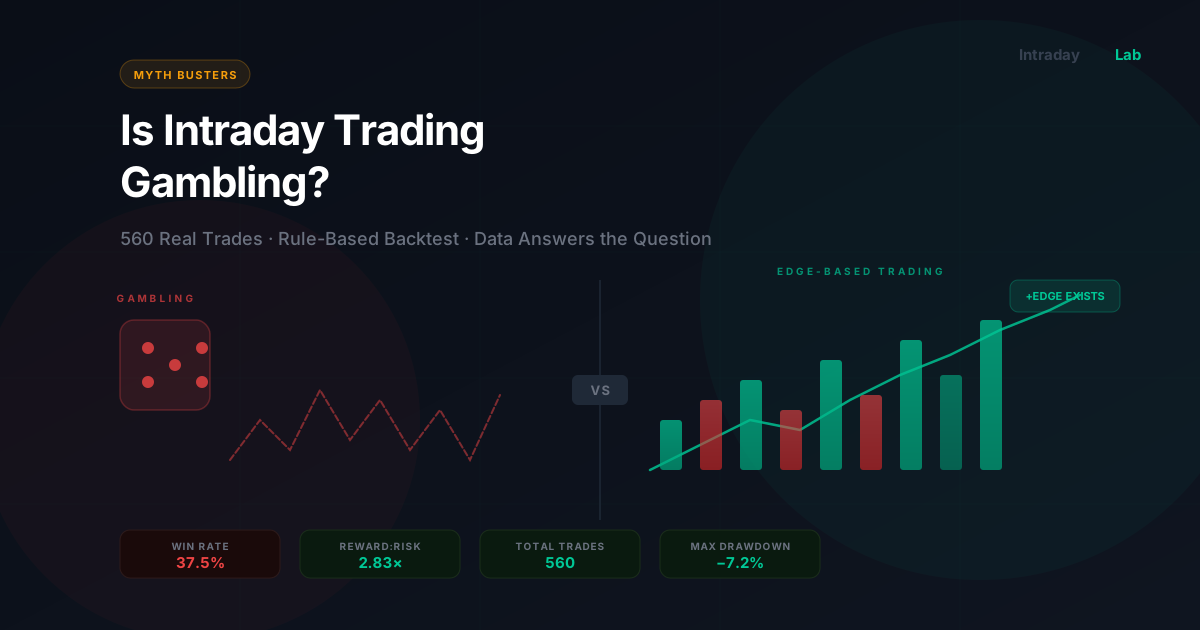
We ran that test. 560 trades. Real market data. Rule-based entry and exit criteria. No discretion, no gut calls, no emotion.
The results answer the question definitively.
What Is Intraday Trading — and Why It Gets Misunderstood
Intraday trading means opening and closing all positions within the same trading session — no overnight holdings. In the Indian market, that means entering and exiting before 3:30 PM.
To an outsider, it looks identical to placing a bet:
- You put capital at risk
- The outcome is uncertain
- You can win or lose within minutes
- Large losses can happen fast
This surface similarity is why the gambling comparison persists. But the comparison breaks down the moment you examine the structure of what's happening beneath the surface.
In gambling, the expected value is structurally negative — the house takes a cut, the odds are fixed against you, and no amount of skill or analysis changes the probabilities. In a casino, the roulette wheel doesn't care how well you've studied it.
In trading, the expected value is determined by your system — and systems can be built, tested, measured, and improved. The market doesn't have a house edge baked in. Your edge (or lack of one) comes entirely from your approach.
That's the fundamental difference. But it only matters if you actually build and test a system.
Why Most Intraday Trading Feels Like Gambling
Let's be precise about this. The traders who confirm the "gambling" narrative typically do all of the following:
- Enter trades based on tips, Telegram signals, or gut feel
- Have no defined exit rule — they exit when fear or greed peaks
- Risk inconsistent amounts per trade (sometimes 2%, sometimes 20%)
- Have never calculated their win rate, average win, or average loss
- Have never backtested a single strategy over 50+ trades
- Chase losses — doubling down to recover drawdowns
Under those conditions, the outcome is statistically indistinguishable from random. The market provides a constant stream of noise, and an undisciplined trader will pattern-match that noise into "signals" that have no predictive value.
This is not a character flaw. It's a cognitive trap — the human brain is wired to find patterns even in pure randomness. But in trading, acting on false patterns while ignoring risk management is how capital disappears.
Most traders don't lose because markets are random. They lose because they treat a probabilistic skill game as if it were a coin flip — no system, no edge calculation, no risk control. The market doesn't cause the loss. The approach does.
Gambling vs Edge-Based Trading: The Core Distinction
Before we look at the data, here is the framework that explains everything:
Factor
🎲 Gambling
📊 Edge-Based Trading
Outcome
Purely random — the house always wins long term
Probabilistic — edge-based systems win over time
Edge
None — odds are structurally against you
Exists — backtestable, measurable, repeatable
Risk Control
Fixed — you lose the full bet or win fixed payout
Variable — stop-loss defines your max loss
Win Rate Needed
>50% just to break even (minus house cut)
37.5% can be profitable with 2.83× reward:risk
Skill Impact
Zero — skill cannot change the odds
High — better entries, exits, sizing change results
Long-term Result
Certain loss (expected value is negative)
Depends entirely on system quality
Data & Analysis
Irrelevant — outcomes are independent events
Critical — past data informs strategy development
The difference isn't the activity — it's whether an edge exists and is tested
The critical insight from that table: a 37.5% win rate can be highly profitable. This is the concept that separates traders who survive from those who don't.
In gambling, if you win 37.5% of your bets, you are losing money — guaranteed, mathematically, inevitably. The casino wins.
In trading with a 2.83× reward-to-risk ratio, winning 37.5% of the time produces a strongly positive expected value. You lose more often but win more decisively when you're right.
Most retail traders intuitively assume that a good system must win more than 50% of the time. This assumption is wrong, and it leads them to cut winners short (to "protect" a win) and hold losers long (waiting to "break even"). Both behaviors systematically destroy the edge that would otherwise exist.
The Backtest: 560 Trades, Real Data
This is where the theoretical distinction becomes empirical proof. We applied a rule-based intraday strategy to real Indian equity market data. Every trade had a defined entry trigger, a predefined stop-loss, and a predefined target. No discretion was exercised once the rules were set.
The backtest results:
| Metric | Result |
|---|---|
| Total trades | 560 |
| Win rate | 37.5% |
| Reward:Risk ratio | 2.83× |
| Average winning trade | ₹8,485 |
| Average losing trade | ₹2,993 |
| Max drawdown | −7.2% |
| Max consecutive losses | 11 trades |
The win rate is 37.5%. The strategy loses more often than it wins — by a significant margin. By gambling logic, this strategy should be ruinous.
At 37.5% win rate with 2.83× reward:risk — for every ₹100 risked, the strategy returns a positive expected value per trade. Losers happen more often. Winners matter more. This is how professional trading systems work — not by being right most of the time, but by controlling what happens when they're wrong.
The Expectancy Calculation — The Number That Proves It
Expectancy is the single most important concept in systematic trading. It answers: "What is the average outcome per trade over a large sample?"
The formula:
Expectancy = (Win Rate × Avg Win) − (Loss Rate × Avg Loss)

= (0.375 × ₹8,485) − (0.625 × ₹2,993)
= ₹3,182 − ₹1,871
= +₹1,311 per trade
A positive expectancy means the system makes money over a large sample of trades regardless of any individual outcome. Each trade is just one data point in a statistical distribution — its outcome is irrelevant. The aggregate result over 560 trades is what matters.
This is the math that gambling does not and cannot have. A slot machine with 37.5% win frequency and the house keeping 62.5% of losing bets cannot produce positive expectancy by any configuration. Trading can — and this backtest demonstrates it.
Expectancy Is Everything
+₹1,311 per trade is the expected value of this system across 560 trades. That number comes purely from the combination of win rate and reward:risk ratio — not from predicting the market, not from luck, not from tips. From having a tested edge and following it mechanically.
The Part That Tests Every Trader's Mind
Here's where the gambling comparison becomes psychologically seductive again — even for traders who understand the math.
This system had a maximum consecutive losing streak of 11 trades.
Eleven losses in a row. One after another. A week or more of trading where every single position goes against you. During that stretch, the strategy looks exactly like gambling. It feels like gambling. Every instinct says "this system is broken, stop."
But statistically, a losing streak of 11 trades is completely expected for a system with 37.5% win rate. It's not a signal. It's noise.
Here's the probability: with a 37.5% win rate, the chance of a losing streak of 11 or more in 560 trades is not small — it's essentially guaranteed to happen at least once. A trader who abandons the system during that streak locks in the losses and never reaches the positive expectancy that follows.
An 11-trade losing streak on a 37.5% win-rate system is statistically normal, not a system failure. The traders who quit during drawdowns are the ones who transform a profitable system into a loss. They don't lose because the system failed. They lose because they couldn't distinguish statistical noise from a broken edge.
Random Trading vs Systematic Trading: The Real Comparison
The gambling debate is actually a proxy for a more precise distinction:
Random trader (no system):
- Entries based on emotion, tips, or pattern intuition with no edge
- Position size changes based on confidence (which is unreliable)
- Exit triggered by fear or greed, not rules
- Win rate: approximately 50% (random), but risk:reward typically negative because losses are held and winners cut
- Long-run result: loss, regardless of market conditions
Systematic trader (rule-based edge):
- Entries defined by backtested criteria with measurable edge
- Position size fixed by risk percentage (e.g. 1% of capital per trade)
- Exit defined by stop-loss and target set before entry
- Win rate: whatever the system produces — can be 35%, 60%, anything, as long as reward:risk compensates
- Long-run result: determined by expectancy, not luck
The difference isn't skill at predicting the market. Nobody consistently predicts markets. The difference is in whether the system has positive expectancy and whether the trader follows it when it's uncomfortable.
What Actually Makes Intraday Trading Hard
Intraday trading is genuinely difficult — but not for the reason most people think.
It's not difficult because markets are random. It's difficult because:
1. Developing a real edge takes time. A strategy needs 100+ trades before you can statistically measure its win rate and reward:risk with any confidence. Most traders quit before they have enough data to evaluate their system.
2. Following a system mechanically is psychologically taxing. When you're in a losing streak, every human instinct says to stop, adjust, override. The traders who succeed follow the system anyway. This is harder than it sounds.
3. Risk management is counterintuitive. Keeping losses to 1% of capital per trade feels overly conservative. But it's what allows a 7.2% maximum drawdown instead of a wipeout.
4. Most "strategies" circulating online have never been properly backtested. They're based on chart patterns that look convincing in hindsight but have no predictive edge when applied systematically going forward.
None of these difficulties make intraday trading gambling. They make it a discipline — one that rewards rigour and punishes shortcuts.
Is Intraday Trading Profitable in India?
This is the question most people are actually asking when they search "is intraday trading gambling."
The data-backed answer: yes, it can be — with the right framework.
The conditions:
- You have a strategy with measurable positive expectancy (tested over 100+ trades minimum)
- You risk a fixed, small percentage of capital per trade (1–2% maximum)
- You calculate your win rate and reward:risk before trading live
- You follow the system through drawdowns without discretionary overrides
- You track every trade and review your statistics regularly
Without those conditions, intraday trading is not technically gambling — but it produces gambling-like outcomes. The market does not care about your intentions. It responds only to the quality and consistency of your system.
The Verdict
Intraday trading is not gambling — but only if approached as a data-driven, rule-based activity with measurable edge and disciplined risk management. Without those elements, it produces outcomes that are statistically indistinguishable from gambling. The distinction lives entirely in the trader's approach, not in the activity itself.
The Five-Step Framework to Build Real Edge
If you want to be on the right side of this distinction, here's the process:
Step 1 — Define your rules precisely. Entry trigger, stop-loss level, and target must all be specified before you enter any trade. "I'll exit when it looks ready" is not a rule.
Step 2 — Backtest on at least 100 historical trades. Use real data. Record every trade. Do not cherry-pick. Calculate win rate, average win, average loss, and expectancy.
Step 3 — Calculate expectancy before going live. If expectancy is negative, the system loses money over time regardless of any individual trade. Fix the system before risking capital.
Step 4 — Size positions by risk, not by conviction. Risk the same percentage of capital on every trade — 1% is a reasonable starting point. Conviction is not a reliable signal. Position size based on conviction destroys systems with positive expectancy.
Step 5 — Track performance and review periodically. A system's edge can erode as market conditions change. Review your statistics every 50 trades. If expectancy has turned negative over a meaningful sample, investigate — don't override.
Frequently Asked Questions
Conclusion
The question "is intraday trading gambling?" is answered not by philosophy but by mathematics.
When a rule-based strategy produces positive expectancy across 560 trades — when winners are nearly three times larger than losers, when the math works out to a positive number per trade regardless of a 37.5% win rate — that is not gambling. That is a statistical business.
But the question carries a more uncomfortable implication that deserves a direct answer: most people who currently trade intraday are effectively gambling. Not because they chose to gamble. Because nobody told them that the win rate doesn't matter as much as the reward:risk ratio, that losing streaks are expected not exceptional, and that positive expectancy — not prediction — is the actual goal.
The market is not a casino. But it will take money from everyone who treats it like one.
The 560-trade backtest described in this article used a rule-based strategy on real Indian equity market data. Win rate, reward:risk, and drawdown figures are from that historical test. Past performance does not guarantee future results. This is research and education, not financial advice.