Most traders don't lose because they have a bad strategy. They lose because they never tested it. This guide will change how you think about trading — permanently.
Before You Read This
Every new trader makes the same sequence of mistakes:
- Finds a strategy on YouTube or Telegram
- Paper trades it for 2–3 days (or skips this entirely)
- Goes live with real money
- Loses several trades in a row
- Concludes "this strategy doesn't work" — and moves to the next one
The problem isn't the strategy. The problem is the trader never had evidence that it works at all — in their hands, on their timeframe, with their risk management.
Backtesting is how you get that evidence.
What Is Backtesting in Trading?
Backtesting means applying a trading strategy's rules to historical market data to see how it would have performed if you had traded it in the past.
In the simplest terms: you are asking "would this have made money?" — and answering with data instead of guesses.
Here's how it differs from other forms of testing:
| Method | Data Used | Risk | Insight Quality |
|---|---|---|---|
| Backtesting | Historical data | Zero | High — covers many market conditions |
| Paper trading | Live data (no money) | Zero | Medium — only current market |
| Forward testing | Live data (small money) | Low | High — real execution |
| Live trading | Live data (full size) | Full | Learned after the fact |
Backtesting comes first because it covers years of data quickly and costs nothing to run. A proper backtest over 500+ trades tells you more about a strategy than 3 months of paper trading.
Key Takeaway
Backtesting doesn't predict the future. It tells you whether your strategy had a statistical edge in the past — and gives you the confidence (or warning) you need before risking real capital.
Why This Matters More Than Any Indicator
You can have the cleanest chart setup, the most precise entry signal, the best indicator combination. None of it matters if you don't know:
- What your win rate actually is (not what you hope it is)
- What your average win and average loss are
- What the worst losing streak you should expect is
- Whether the strategy is profitable overall despite individual losses
Without backtesting, you are flying blind. With it, you have a map.
This is the core insight that separates systematic traders from gamblers.
The Metric Most Traders Get Wrong: Win Rate
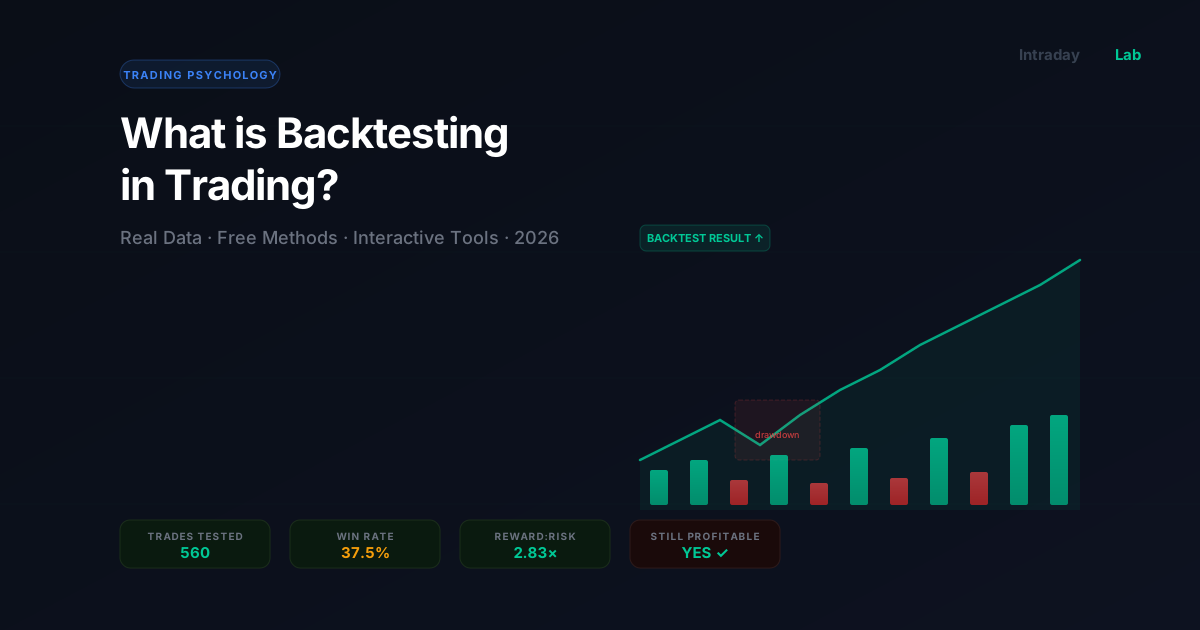
Here's a real backtest result from a rule-based strategy we've tested:
| Metric | Value |
|---|---|
| Trades tested | 560 |
| Win rate | 37.5% |
| Reward:Risk ratio | 2.83× |
| Average winning trade | ₹8,485 |
| Average losing trade | ₹2,993 |
| Max drawdown | −7.2% |
The win rate is 37.5%. The strategy loses more often than it wins.
A beginner looks at this and thinks: "This strategy is terrible."
A systematic trader looks at this and thinks: "Does the math work?"
Let's check with the expectancy formula:
Expectancy = (Win Rate × Avg Win) − (Loss Rate × Avg Loss)
= (0.375 × ₹8,485) − (0.625 × ₹2,993)
= ₹3,182 − ₹1,871
= +₹1,311 per trade
Positive expectancy. The strategy makes money — not because it wins often, but because winners are nearly 3× larger than losers.
A strategy that wins 37.5% of trades can be significantly more profitable than one that wins 60% — if the reward:risk ratio is better. Win rate alone tells you almost nothing. Expectancy tells you everything.
Try It Yourself — Expectancy Calculator
Use this to test the math on your strategy. Adjust the sliders and see instantly whether your system has a real edge:
Interactive Tool
Expectancy Calculator
Enter your strategy's metrics — see if it has a mathematical edge
Expectancy/Trade
+₹200
Avg Win
+₹2,000
Avg Loss
-₹1,000
Over 100 Trades
+₹20,000
Simulated 20-trade sequence at these metrics
10 wins / 10 losses → +₹10,000 P&L over 20 trades
Adjust sliders to test different strategies · Expectancy = (Win% × Avg Win) − (Loss% × Avg Loss)
Notice how a 40% win rate with 2.5× reward:risk produces positive expectancy — while a 55% win rate with 0.8× reward:risk produces a losing system. Most traders chase win rate when they should be optimising reward:risk.
The Biggest Misconception About Backtesting
Most beginners believe: "A good strategy must win at least 60% of the time."
This comes from a natural place — we're wired to avoid loss. But in trading, this belief causes two specific, measurable behaviours:
1. Cutting winners early — you close a trade as soon as it shows profit to "lock in a win." This reduces your average winner and destroys the reward:risk ratio.
2. Holding losers too long — you don't want to close a loss, so you wait for the trade to recover. This increases your average loser and makes the expectancy worse.
Both behaviours come from optimising for win rate at the expense of everything else. Backtesting reveals this trap before it costs you money.
Why Most Traders Skip Backtesting
Three Ways to Backtest (Choose What Fits You)
Manual Backtesting
Understanding strategy logic, building intuition
Cost
Free
Speed
Slow
Accuracy
Medium
Coding
None required
Tools
TradingView, Charts
✓ Pros
- →Builds deep market understanding
- →No technical knowledge needed
- →Free to start immediately
✗ Cons
- →Time-consuming (hours per 100 trades)
- →Human bias can creep in
- →Hard to test over 500+ trades
Recommendation: start manual → graduate to no-code → learn algo as you scale
The right choice depends on where you are. If you've never backtested anything, start with manual — it builds pattern recognition you can't get any other way. If you've done manual testing and want speed, move to no-code tools. Algorithmic backtesting comes when your strategies are well-defined enough to codify precisely.
How to Backtest a Strategy in 5 Steps
Step 1 — Pick exactly one strategy
Don't test three variations at once. Pick a single, fully defined strategy — breakout, moving average crossover, gap fade, anything — and test only that. Testing multiple strategies simultaneously muddles the results.
Step 2 — Get historical data
You don't need to buy data. For Indian markets:
- TradingView (chart replay) — free, excellent for manual backtesting
- Fyers / Zerodha API — free historical OHLC data for algorithmic testing
- NSEIndia.com — free daily data downloads for Nifty/Bank Nifty
Step 3 — Define rules precisely before looking at results
Entry trigger, stop-loss level, and target must be written down before you start reviewing historical trades. If you allow yourself to adjust rules as you go ("well, I would have moved my stop here"), you're not backtesting — you're curve-fitting.
Step 4 — Record every single trade
Track: entry price, exit price, direction (long/short), profit/loss, and whether it was a win or loss. Use a simple spreadsheet. The minimum sample size for statistical relevance is 100 trades — 200+ is better.
Step 5 — Calculate these 5 metrics
# The 5 metrics that tell you everything about your strategy

wins = [trade for trade in results if trade > 0]
losses = [trade for trade in results if trade < 0]

win_rate = len(wins) / len(results) * 100
avg_win = sum(wins) / len(wins) if wins else 0
avg_loss = abs(sum(losses) / len(losses)) if losses else 0
reward_risk = avg_win / avg_loss
expectancy = (win_rate/100 * avg_win) - ((1 - win_rate/100) * avg_loss)

print(f"Win Rate: {win_rate:.1f}%")
print(f"Reward:Risk: {reward_risk:.2f}x")
print(f"Expectancy: ₹{expectancy:,.0f} per trade")
print(f"Edge exists: {'YES' if expectancy > 0 else 'NO'}")
The Metric Everyone Ignores: Drawdown
Every backtesting guide talks about win rate and profit. Almost none talk about drawdown — the most psychologically important number in your results.
Drawdown is the peak-to-trough decline in your account equity during the backtest. If your account went from ₹1,00,000 to ₹82,000 before recovering, that's an 18% drawdown.
Why this matters more than most traders realise:
A 25% drawdown doesn't just require a 25% gain to recover. It requires a 33.3% gain — because you're recovering from a smaller base. A 50% drawdown requires a 100% gain just to get back to flat.
Interactive Tool
Drawdown Reality Check
See what a drawdown actually means for your trading capital
Select Drawdown Level
Drawdown
18%
Risk Level
Notable
Capital Lost
₹18,000
Recovery Needed
22.0%
⚠️ To get back to ₹100,000, you need a 22.0% gain from ₹82,000
This is why drawdown management matters more than win rate · A 50% drawdown requires a 100% gain to recover
Now adjust the capital slider to your actual trading capital and select the 18% drawdown level. That's the number in our backtested strategy. Is that drawdown something you could psychologically handle for weeks before recovering? If the answer is no, the position size is too large — not the strategy itself.
Most traders quit profitable strategies during drawdowns — not because the strategy stopped working, but because they were never prepared for the drawdown their own backtest showed was possible. The backtest tells you what to expect. The discipline is believing it.
What Backtesting Cannot Do
Backtesting is powerful but not omniscient. Before you rely on it completely, know its limits:
Overfitting — if you test and re-test on the same data, adjusting rules each time to improve results, you end up with a strategy optimised for the past, not the future. The fix: test on one period (2016–2022), validate on a separate period (2023–2026).
Execution gaps — your backtest assumes you enter and exit at the candle's close price. In live trading, slippage, bid-ask spreads, and order delays mean you'll likely get slightly worse prices. Add a conservative slippage assumption to your metrics.
Market regime changes — a strategy that worked in a trending 2021 market may not work in a volatile 2022 market. Always check if your backtest results are consistent across different years or if one anomalous period drives all the returns.
Survivorship bias — if you're testing on a list of current Nifty 500 stocks, you're missing all the companies that went bankrupt or were delisted. Your results will look better than reality.
The Right Frame
Treat backtesting as evidence, not proof. A positive backtest means "this strategy had an edge in the past under these conditions." It justifies moving to live testing with small size. It does not guarantee future performance — nothing does.
What Actually Makes a Strategy Profitable
Not a high win rate. Not a fancy indicator. Not a specific timeframe.
The two factors that determine long-term profitability:
1. Positive expectancy — the mathematical edge (as calculated above). This is non-negotiable. A negative expectancy strategy cannot be made profitable through discipline alone.
2. Consistency of execution — a strategy with positive expectancy only makes money if you execute it consistently across all trades, including the ones during losing streaks. This is a psychological challenge, not a technical one — and it's where most traders fail even with a working system.
Backtesting serves both. It builds the math (expectancy), and it builds the mental preparation (you know exactly what a normal drawdown looks like, so you don't panic when it arrives).
The Final Step: When to Go Live
After backtesting, follow this progression before trading full size:
- Backtest — 200+ historical trades → confirm positive expectancy
- Paper trade — 30 days live → confirm you can identify setups in real time
- Small live — 10% of intended size → confirm execution matches backtest assumptions
- Scale up — only after consistent results at small size
Skipping any step increases risk. The backtesting step is the foundation — skip it, and everything built on top is unstable.
Frequently Asked Questions
Conclusion
Backtesting is not a guarantee of profits. It's a filter — a way to reject strategies that don't work before they cost you real money, and to build confidence in strategies that do.
The traders who backtest properly come to live trading with something most retail traders never have: realistic expectations. They know their strategy's win rate, they've seen a 11-trade losing streak in the data, they know what the maximum drawdown looks like — and so when these things happen in live trading, they don't panic.
They just keep executing.
The market doesn't reward guessing. It rewards the traders who did the work before they risked the money.
Strategy metrics referenced in this article (560 trades, 37.5% win rate, 2.83× reward:risk, −7.2% max drawdown) come from a real backtested rule-based system on Indian equity data. For full methodology, see our Is Intraday Trading Gambling? study. This is education, not trading advice.