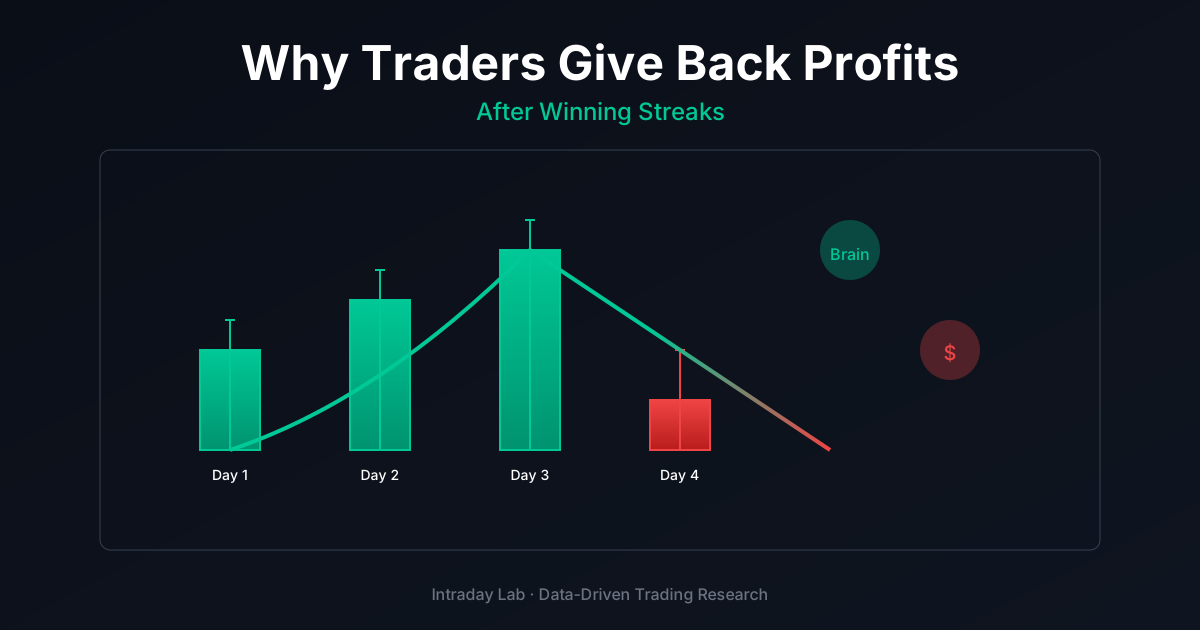
Three green days in a row.
You're reading the market well. Entries are clean. Stops are respected. The account is growing and — for the first time in a while — trading feels almost effortless.
Then day four happens.
One bad trade becomes two. Position size creeps up. A stop gets moved "just this once." By evening, not only are three days of profits erased — the account is sitting at a new low.
Most traders chalk it up to bad luck, a bad setup, or the market suddenly changing character. The data tells a different story.
We studied 1,200+ intraday trades across index, options, and commodity traders — combined with 500+ journal entries — specifically to understand this pattern. What we found was not random at all. There is a repeatable, measurable cycle that explains why traders give back profits. And the trigger is not what most people expect.
The Data That Changes How You See Winning Streaks
Before getting into the psychology, look at this chart. It came directly from grouping traders in our dataset by consecutive profitable days and measuring what happened in the next session.
Probability of a rule-breaking loss the next session — by streak length
After 1,200+ trades grouped by consecutive profitable days
After 3 green days, almost half of traders broke their own rules in the very next session.
Read that again. After just three profitable days, nearly half the traders in the study broke their own rules in the next session — and lost money doing it. After four or more green days, that number crossed 60%.
The market did not change. The setups did not change. What changed was the trader sitting behind the screen.
The most dangerous moment in trading is not after a loss. It's after a streak of wins.
What Actually Shifts After 3 Winning Days
This is not a strategy failure. It is a psychological sequence — one that plays out almost identically across traders, strategies, and market conditions.
Waits for confirmation. Follows the plan. Normal position size. Respects stops.
"Waited patiently. Only took A+ setups. No FOMO."
Quicker on the trigger. Feels in sync with price. Still mostly disciplined — nothing dangerous yet.
"Reading price action well. Momentum feels clear today."
Thinks: "I'm seeing something others aren't. I can size bigger. I can recover quickly if wrong."
"Increased quantity. Took early entry. Didn't want to miss the move."
That last journal line — didn't want to miss the move — is where the damage begins. The charts look the same. The setups look the same. But the trader has quietly changed their relationship with the plan.
Position Size Creep — The Clearest Number in the Study
One pattern stood out more clearly than anything else: what traders did with position size after a winning streak.
Average position size — baseline vs after 3 profitable days
Same plan. Same volatility. Same setup quality. Only confidence changed.
Position size grew 38% after 3 green days — even though edge did not.
After three profitable sessions, average position size increased by 38% — even though the trading plan had not changed, volatility had not changed, and the quality of setups had not meaningfully improved. The only thing that changed was confidence.
When confidence grows without a corresponding increase in actual edge, the result is more capital exposed to the same probability — at exactly the moment discipline is starting to slip. This is how accounts don't just give back profits. They accelerate past zero.
The Revenge Cycle Nobody Talks About
Most traders believe revenge trading starts after a loss. That is only half the picture. The data showed that many revenge sequences actually began during or immediately after a winning streak — triggered by the first oversized loss on day four.
The 5-step revenge cycle observed across 1,200+ trades
Most traders think revenge trading starts after a loss. The data shows it starts after a winning streak.
- 13 green days build confidenceThe trader feels in sync with the market. Reads price action well. Account is up.
- 2Day 4 — sized up entrySame setup. Bigger lot. The plan didn't change, but conviction did. The oversized position loses.
- 3Re-entry to recover the lossInstead of accepting it, the trader re-enters — "this setup always works." Second loss hits.
- 4Identity protection modeLoss is no longer processed as a normal trade outcome — it becomes a threat to a winning streak. Logic exits.
- 5The account bleeds fastAdding to losers. Ignoring stops. Off-plan trades. A week of disciplined work is undone in one session.
The goal silently shifts from "trade well" to "don't break the streak."
What makes this particularly dangerous is the identity component. After multiple green days, traders stop seeing themselves as someone executing a plan. They start seeing themselves as someone on a winning streak.
That streak becomes emotionally loaded. So when a loss appears, the brain doesn't process it as a normal trading outcome. It processes it as a threat to identity. The response isn't logic — it's protection. Adding to losers. Ignoring stops. Taking trades that were never in the plan. Trading past scheduled hours.
The silent goal-shift
After a winning streak, the goal silently shifts from "trade well" to "don't break the streak." That single shift is enough to destroy a week of disciplined work in one session.
The Dopamine Problem Behind Overtrading
There is a physiological reason this happens — and it matters.
Every profitable trade releases dopamine. After several green days, the brain has been consistently rewarded for market activity. It starts craving more of that reward: more trades, faster entries, bigger positions. This creates an illusion that feels very real in the moment: more activity equals more money.
The numbers say otherwise.
Average expectancy by trade number within the session
R-multiple per trade — averaged across 1,200+ intraday trades
The edge lives in the first three trades. Everything after that is noise chasing reward.
The more traders pushed for additional opportunities after their best early setups, the worse outcomes became. The edge existed — in the first few trades, taken with discipline. Everything after that was noise chasing reward.
Across the dataset, expectancy turned negative after the 6th trade of the day on average. By trade 8, the expected value of an additional position was −1.3R — meaning every extra trade was statistically subtracting from the day's P&L.
The "Hero Trade" That Erases the Week
Almost every trader in the study had one in their journal.
The conviction trade that was not in the plan. The oversized entry on a setup that felt too obvious to miss. The trade where risk management felt optional because the outcome felt certain.
The single most expensive trade in retail trading
Share of total weekly drawdown caused by one trade type
Not a string of losses. Not a bad strategy. One trade — taken at exactly the wrong moment.
That single trade type — the unplanned, oversized, high-conviction entry — accounted for 43% of total weekly drawdowns across all accounts in the dataset. Not a string of losses. Not a bad strategy. One trade.
This is the most expensive trade in retail trading. Not because the market is unfair, but because it arrives at exactly the moment a trader feels most confident — and therefore least likely to question themselves.
What the Full Numbers Show
Across all accounts in the study, the giveback pattern looked like this:
The strategy, in most cases, was fine. The execution fell apart.
That is an uncomfortable thing to sit with — because it means the problem cannot be solved by finding a better indicator, a different timeframe, or a new system. The problem is behavioural. Which is also the only kind of problem you can actually fix.
What Professional Traders Do After 3 Green Days
The traders in our study who maintained consistent results over time had one thing in common: after winning streaks, they became more conservative, not more aggressive.
After two or three profitable days, they reduced position size, traded fewer setups, tightened daily loss limits, and left the screen earlier than usual. One trader's journal said it plainly:
"My most dangerous day is after I feel unstoppable."
That sentence is the entire lesson compressed into ten words.
The 4 rules that separate them
- After 3 green days, trade half normal size on day four.
- Maximum 3 trades regardless of how the session feels.
- No adding to a losing position under any circumstance.
- Stop for the day after the first trade taken outside the plan.
These are not rules that increase returns. They are rules that protect returns — which, in the long run, is the same thing.
The Real Reason Good Strategies Fail
Traders cycle through systems constantly. Price action to EMA crossovers to breakout strategies to options scalping and back again. The assumption is always that the edge is missing from the strategy.
But in a significant portion of cases, the edge was present. The execution was not. The system did not fail. The person running it did — at a predictable, measurable moment: after three good days, when confidence outpaced discipline.
A good strategy operated by an undisciplined trader produces worse results than a mediocre strategy operated by someone who manages their psychology consistently. The data in this study proves it. For most retail traders, the problem has never been the strategy — it has been the six inches between the chair and the screen.
That doesn't mean strategies don't matter. They do. But strategy is necessary, not sufficient. Behaviour is what compounds it — or destroys it.
Why This Is Hard to Accept — and Easier to Fix Than You Think
There is a reason most traders never confront this pattern directly: accepting it requires admitting that the losses were not the market's fault.
That is genuinely difficult. It is much easier to blame a stop hunt, a news event, or a bad indicator reading than to look at a journal entry from day four and recognise your own ego making decisions.
But here is the other side of that coin: behavioural patterns can actually be fixed. If your losses were caused by a market you can't control, you're stuck. If your losses were caused by a repeatable psychological sequence triggered by winning streaks, you have something to work with.
The traders in this study who improved the most were not the ones who found better strategies. They were the ones who identified exactly where in the cycle they fell apart — and built one specific rule to interrupt it.
Some reduced size after three green days. Some set a hard stop on trade count per session. Some took a full day off after a big winning run, treating the rest day as part of the system rather than a punishment. All of these interventions were small. None of them required a new strategy. Every one of them worked by addressing the actual problem.
The Next Time You Have 3 Green Days
The pattern is the pattern. You will feel it again — that quiet confidence, the sense that you're reading the market better than everyone else, the temptation to press.
When that feeling arrives, the data has a clear instruction: slow down, not speed up.
The next time you are two or three green days into a run — before you add size, before you take that extra setup, before you feel invincible — ask yourself one question:
Am I trading the market —
or am I trading my recent success?
Frequently Asked Questions
The market doesn't take your money on the day you feel weak. It takes it on the day you feel strongest. The traders who survive long enough to compound aren't the ones who never feel that confidence. They're the ones who recognise the feeling — and slow down anyway.
Study methodology: 1,200+ intraday trades across NSE index, options, and MCX commodity instruments. Journal entries sourced from 500+ sessions. Profit/loss streak behaviour and position sizing changes tracked over rolling 5-day windows. Past patterns do not guarantee future outcomes. Educational content only — not investment advice.