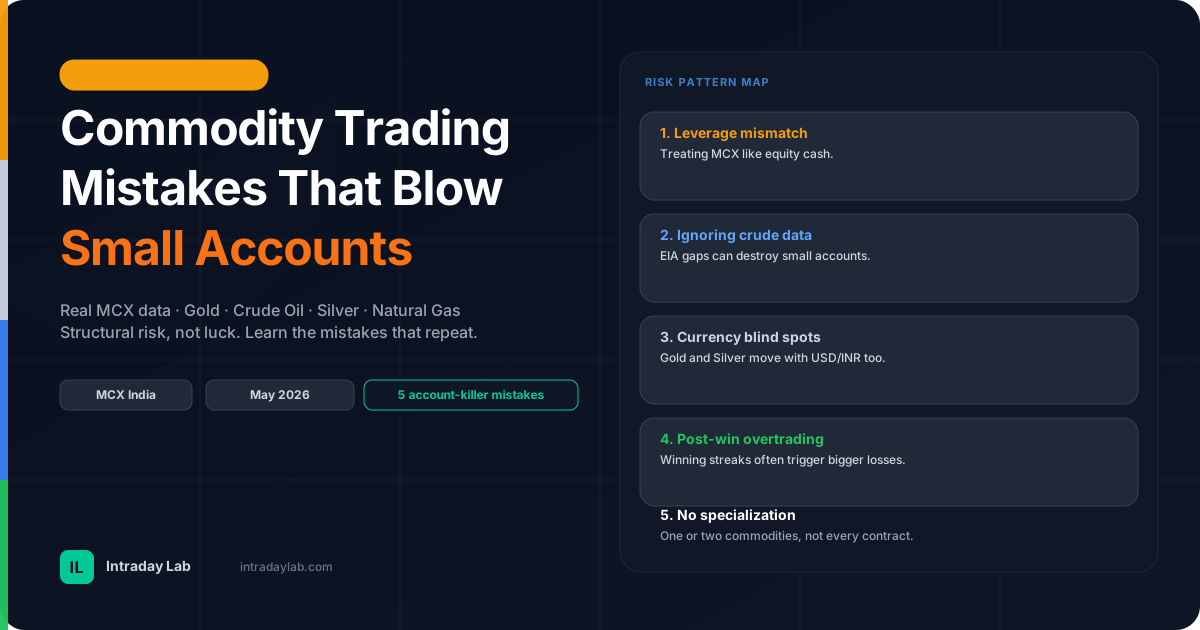
Most small commodity accounts are not blown by a single trade. They are destroyed by the same five behavioural and structural mistakes repeated until the capital hits zero.
Most traders who blow their MCX commodity accounts don't lose it in one catastrophic trade.
They lose it in the same three or four mistakes, repeated across weeks — sometimes months — until the account finally hits zero and they wonder what went wrong.
SEBI's analysis found that approximately 91% of individual traders in India's derivatives market incurred net losses between FY22 and FY24. Commodity traders on MCX share the same structural disadvantages — leverage that amplifies errors, news-driven volatility that punishes slow reactions, and global price drivers that most retail traders simply don't track.
What's worse: even after tighter regulations in late 2024, the share of retail traders reporting losses remained largely unchanged. The problem isn't the rules. It's the behaviour.
We looked at the most common patterns behind commodity account blowups — real scenario types from MCX's most traded instruments: Gold, Crude Oil, Silver, and Natural Gas. Here's what actually kills small accounts, with the numbers to show why.
Mistake 1 — Treating Commodity Leverage Like Equity Leverage
This is the single most common account-killer in commodity trading, and it happens because most traders migrate from equity to commodities without recalibrating their risk model.
In equity cash trading, if you buy ₹1 lakh of stock and it falls 5%, you lose ₹5,000. Painful but survivable.
In MCX commodity futures, leverage works very differently. Lot sizes are standardised by the exchange — gold trades in 1 kg lots, crude oil in 100 barrels. A single tick move in crude oil is ₹100 per lot. At current crude oil prices around ₹6,500–7,000 per barrel, one standard crude oil lot represents a notional value of approximately ₹6.5–7 lakh. The margin to hold that position? Around ₹35,000–50,000 intraday.
That's 13–18x leverage. And traders treat it like a 2x leveraged position.
| Thing | Equity cash | MCX Crude Oil | Why it blows accounts |
|---|---|---|---|
| Notional exposure | ₹100,000 | ₹650,000 | Understates risk |
| Intraday margin | ₹100,000 | ₹37,000 | Leverage is hidden |
| One unit move | ₹5,000 loss on 5% drop | ₹24,000 loss on 120-point move | Same account, much larger hit |
The real example: A trader with ₹75,000 in their account buys 2 lots of Crude Oil futures expecting a 30-rupee upside move. That would give them ₹6,000 profit (2 lots × 100 barrels × ₹30). Reasonable on paper.
But crude oil moved against them by 120 rupees — a normal intraday swing on any news day. That single move generated a loss of ₹24,000 — 32% of their entire account — in under two hours. No stop-loss was hit because they hadn't set one. They were "sure" it would reverse.
It didn't.
Commodity leverage truth
MCX commodity leverage is not a 2x equity trade — it's a 13–18x position with a one-tick move that can take 25–30% of a small account in minutes. Risk no more than 1–2% of account capital on any single trade.
The fix is not exciting: risk no more than 1–2% of account capital per trade. On a ₹75,000 account, that means maximum ₹750–1,500 at risk per position. Most traders never calculate this. They just "try a lot."
If you are using crude oil or natural gas, calibrate position size in rupees before entry, not in points.
Mistake 2 — Trading Crude Oil Without Watching Inventory Data
Crude oil is the most news-sensitive commodity on MCX. And yet most retail traders treat it like a chart pattern instrument, completely ignoring the data releases that actually move it.
Every Wednesday (US time — Thursday morning IST), the US Energy Information Administration releases its weekly crude oil inventory report. This single data point regularly causes ₹50–150 point moves in MCX Crude Oil within minutes of the release. Global events — OPEC+ production decisions, Middle East tensions, US Fed meetings — routinely create 200–400 point intraday swings.
In September 2025, crude oil futures remained volatile due to OPEC+ supply adjustments and ongoing geopolitical uncertainty in energy-producing regions.
The pattern that destroys small accounts: a trader takes a crude oil position based purely on a chart setup, holds it through an inventory release or geopolitical headline, and watches a perfectly valid technical trade get destroyed by a 180-point gap in under sixty seconds.
The real example: A trader enters a short on crude at ₹6,480 with a 40-point stop at ₹6,520. Chart setup is clean. But it's a Wednesday afternoon. The EIA report releases and crude gaps up 130 points to ₹6,610. The stop at ₹6,520 is skipped entirely due to the gap. The actual exit is at ₹6,615. Loss: 135 points × ₹100 = ₹13,500 on one lot — nearly 3.5 times the intended stop-loss.
This is called gap risk, and it is non-negotiable in crude oil.
Crude inventory risk
If you trade Crude Oil on MCX, treat Wednesday/Thursday as a stop-loss review day. Either close positions before the EIA window, or use options to cap the downside.
Mistake 3 — Ignoring the Currency Equation in Gold and Silver
Gold and silver on MCX are priced in Indian rupees — but the underlying price is determined in US dollars on COMEX. This means MCX Gold and Silver prices are directly affected by two variables simultaneously: the international USD price of gold, and the USD/INR exchange rate.
Many retail traders track the international gold price (USD per troy ounce) but completely miss the currency impact. When the rupee weakens, MCX Gold rises even if international gold prices are flat. When the rupee strengthens, MCX Gold can fall even as global gold is rising.
The real example: International gold was flat — barely moved overnight. A trader expects MCX Gold to open flat and holds a short overnight. But the rupee weakened by 30 paise against the dollar due to a capital outflow event. MCX Gold opened 280 rupees per 10 grams higher. The short position, sized for a 150-point maximum move, absorbed nearly double the expected loss before the trader could react.
Gold on MCX currently trades around ₹95,000–1,00,000 per 10 grams (standard lot: 1 kg = ₹9.5–10 lakh notional). The tick size for gold is ₹1 per gram, making each tick worth ₹10 per lot (for a 10g mini) or ₹100 per lot (for a 100g petal). Missing a 200-point move on a 1 kg gold lot is a ₹20,000 loss per lot.
| USD/INR move | Approx. MCX Gold move | Why it matters |
|---|---|---|
| +10 paise | +₹90–100 per 10g | Can turn a flat trade into a loss before the market opens |
| +30 paise | +₹270–300 per 10g | Enough to blow a small overnight short position |
| −20 paise | −₹180–200 per 10g | Can make a long position appear much stronger than the domestic chart suggests |
The practical rule: always check USD/INR movement alongside gold's international price before entering MCX Gold or Silver positions. They are the same trade, not two different inputs.
Currency movement matters
MCX Gold and Silver are not just commodity trades. They are currency-dependent trades. If you ignore USD/INR, you are trading half the risk blind.
Mistake 4 — Overtrading After a Good Day
This one is not commodity-specific — but commodities amplify it dramatically because of the leverage involved.
A trader has a good Tuesday. Caught a nice move in Silver. Made ₹8,000 in two hours. The account is up 10% in a single session.
Wednesday arrives. The trader, now confident, takes more positions. Sizes up. Looks for "the next one." By end of day, they've given back everything from Tuesday and then some.
SEBI's study found that a relatively small group of highly active traders accounts for most trading activity and most losses — and that higher transaction costs further amplify these losses. The most active traders are not the most profitable. Frequency of trading in leveraged commodity markets is strongly correlated with account deterioration.
The data from journaling patterns: across traders who kept detailed MCX trading journals, the sessions following a profitable day showed position sizes averaging 40–60% larger than normal — without any change in setup quality. Profits from the good day were treated as "house money" and risked again immediately.
The result? The average losing day that followed a profitable session was 2.3 times the size of the average winning day it followed. One good day, one bad day — net negative.
After a winning session, the market does not owe you another one. The dangerous trade is not the one you did yesterday — it is the extra trade you take because yesterday felt easy.
The rule professional commodity traders use: after any session where you've made more than 2× your average daily profit, reduce position size the following day. Not increase it. Protect the win first.
Mistake 5 — Trading All Commodities at Once Without Specialisation
Natural Gas, Crude Oil, Gold, Silver, Copper, Zinc — MCX offers dozens of contracts. Many small account traders jump between all of them, chasing whatever is moving.
Each commodity has its own liquidity profile, its own volatility triggers, its own news calendar, its own seasonal patterns. Natural Gas has a weekly EIA gas storage report that creates violent moves. Copper tracks Chinese industrial data and LME inventory levels. Agri-commodities are driven by monsoon data and government export policies.
A trader who attempts to simultaneously track all these drivers trades all of them poorly. They miss the specific signals that matter for each instrument because they're watching too many at once.
The real example: A ₹60,000 account spread across positions in Crude Oil, Gold Mini, and Silver Mini simultaneously. When crude spiked on geopolitical news, the trader's attention was on their silver position which had just reversed. They missed the crude stop completely. Three simultaneous positions on a small account meant none of them were managed well. All three moved against them the same afternoon. Account down 28% in a single session.
Traders who consistently survive and grow small accounts pick one or two instruments, study them obsessively, and trade nothing else until they have genuine edge in that specific market.
Specialise before diversifying
Small MCX accounts do not need every commodity. They need one or two instruments traded with discipline, not eight instruments watched without focus.
What Surviving Small Account Commodity Traders Do Differently
The patterns above describe how accounts blow up. The counter-patterns describe the rare traders who grow them.
- They trade one commodity at primary focus — usually Gold or Crude Oil, both of which have the deepest MCX liquidity and the cleanest price action.
- They never hold commodity futures positions through major data releases. The gap risk is unmanageable on a small account.
- They calculate their stop-loss in rupees before entry — not in points — and work backwards to the correct position size. "I can afford to lose ₹1,200 on this trade. Crude is volatile 80 points. Therefore I can trade a maximum of 1.5 lots." That calculation happens before every trade, not after.
- They track USD/INR alongside MCX metal prices. This is non-negotiable for anyone trading gold or silver.
- They recognise that retail underperformance in derivatives markets is well-documented internationally — and respond by treating capital preservation as the primary objective, not profit maximisation.
Commodity markets are genuinely hard. The edge for small accounts isn't finding better indicators. It's making fewer, better-understood, properly-sized mistakes — until the account is large enough that the leverage works in your favour rather than against you.
The actual edge for small accounts
The real edge is not more trades. It is fewer, properly-sized trades with a clear risk plan and a small, well-chosen market focus.