Most traders pick a commodity the same way they pick a cricket team — loyalty, habit, or because someone they know trades it. Gold, Silver, Crude Oil, and Natural Gas share the same exchange but they're completely different instruments. Different capital requirements, different hours, different global drivers, different personalities. Here's how to pick the one that actually fits you.
Same Screen. Four Completely Different Games.
Open MCX on Zerodha Kite at 9 PM on any weekday. You'll see Gold moving a few hundred rupees. Silver dancing ₹1,000 up and down. Crude Oil lurching on every American tweet about OPEC. Natural Gas potentially moving 8% in 20 minutes because of a cold weather forecast in Texas.
Four commodities. One platform. Wildly different risks.
The mistake most retail traders make: they treat these as interchangeable. Same lot size thinking, same stop-loss logic, same position sizing. Then they wonder why the same ₹200-point stop that works fine in Gold gets hit in 4 minutes flat in Natural Gas.
This guide compares all four — accurately, with verified 2026 numbers — and ends with a framework to pick the right one for your capital, schedule, and temperament.
The Verified Contract Specs (April 2026)
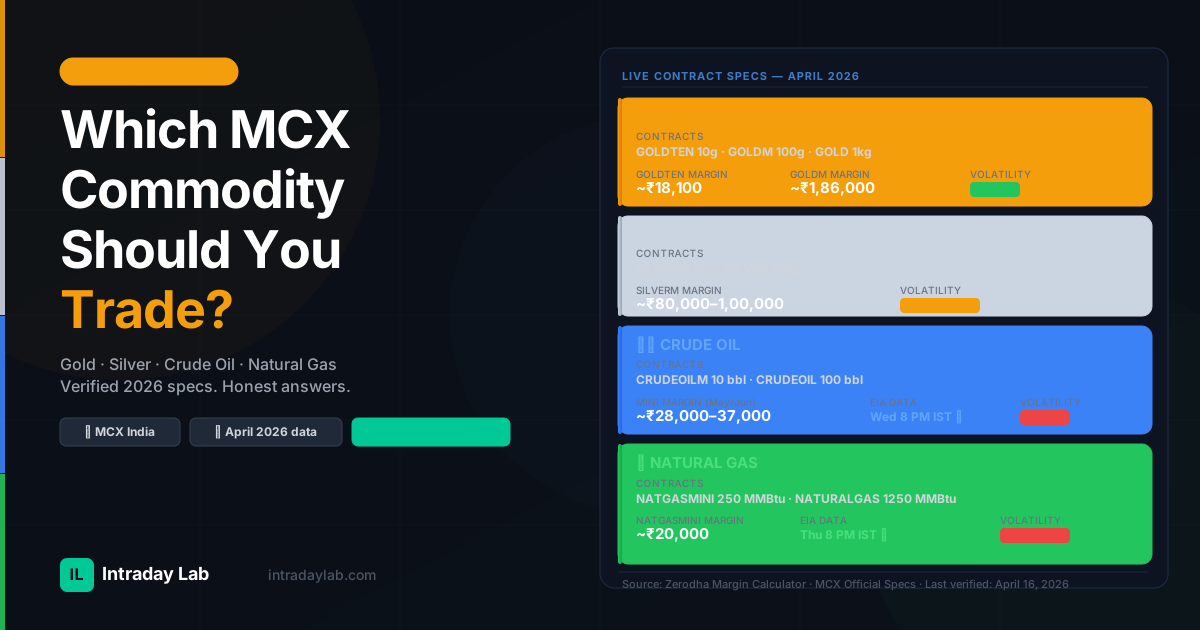
Before the comparisons, every number here is verified. Margins sourced from Zerodha's live margin calculator (last updated April 16, 2026). Lot sizes from MCX official specifications.
| Commodity | Main Lot | Mini Lot | Mini Margin (NRML) | Price per unit |
|---|---|---|---|---|
| Gold | 1 kg | 100 gm (GOLDM) | ~₹1,86,000 | ₹1,53,900/10g |
| Gold Ten | — | 10 gm | ~₹18,100 | ₹1,52,700/10g |
| Silver | 30 kg | 5 kg (SILVERM) | ~₹80,000–1,00,000* | ₹2,44,000/kg |
| Crude Oil | 100 bbl | 10 bbl (CRUDEOILM) | ~₹28,000–37,000 | ₹8,350/bbl |
| Natural Gas | 1,250 MMBtu | 250 MMBtu (NATGASMINI) | ~₹20,000* | ₹274/MMBtu |
Silver Mini and Nat Gas Mini margins vary with volatility — always check current figures on MCX or your broker's margin calculator before trading.
🥇 Gold — The Predictable Heavyweight
Gold is MCX's most prestigious contract — and right now, one of its most expensive to trade. With the precious metal recently at ₹1,52,393 per 10 grams, even the 100-gram mini (GOLDM) requires roughly ₹1.86 lakh in NRML margin.
If that's too steep, MCX also offers GOLDTEN (10-gram lot) with margin around ₹18,100 — making it genuinely accessible to traders with smaller capital. It tracks the same price as GOLDM, just in smaller units.
What makes Gold move:
Gold's price drivers are few but powerful:
- US Dollar Index (DXY) — the single most consistent driver. Dollar weakens → Gold rises. Mechanically reliable.
- Real interest rates — specifically US 10-year Treasury yield minus inflation. When real rates fall, Gold's opportunity cost shrinks and it rallies.
- Central bank buying — India, China, and Russia have been aggressive buyers since 2022. Watch quarterly World Gold Council reports.
- Rupee depreciation — MCX Gold is priced in rupees. Even if COMEX Gold is flat, a weaker rupee lifts MCX prices. This India-specific driver catches many traders off guard.
When it moves on MCX:
Gold trades across both sessions but comes alive in the evening. The real action follows two global overlaps: London open (~1:30 PM IST) and COMEX New York open (~7:30 PM IST). That 7:30–10:00 PM window is where Gold's biggest intraday moves happen.
Morning session Gold (9–12 PM) is mostly Asian cue-driven — smaller moves, more range-bound, decent for positional entries on continuation setups.
The honest limitation:
Because everyone watches the same Gold drivers (DXY, yields, geopolitics), moves that are "obvious" in hindsight often get front-run. Morning breakouts regularly fail because institutions already repositioned overnight.
Gold in one line
Highest capital requirement of any mini contract. Most logical and trackable drivers. Best for traders who want to understand why a commodity is moving before entering. Active evenings, usable mornings.
🥈 Silver — More Volt, More Risk
Silver is what happens when you take Gold's price drivers and add industrial demand, solar panel production cycles, and significantly higher volatility into the mix.
The Silver Mini (SILVERM) is a 5-kg contract on a commodity currently trading around ₹2,44,000/kg. That means each SILVERM contract represents roughly ₹12 lakh of underlying silver. Margins are commensurately higher than what many beginners expect.
Why Silver is harder to read than Gold:
Gold is primarily a monetary metal — its price reflects fear, inflation expectations, and dollar strength. Silver is both a monetary metal and an industrial input (electronics, solar panels, EV components). This dual personality means:
- In a risk-on rally, Silver often outperforms Gold — industrial demand is strong, and speculators pile in.
- In a fear-driven flight to safety, Gold outperforms Silver — industrial demand weakens, and the "poor man's gold" narrative loses steam.
- During economic pivot moments (like a sudden recession signal or surprise rate cut), Silver's direction can flip violently as the market reprices both the monetary and industrial components simultaneously.
A trader who thinks Silver is "just cheaper Gold" will get caught by this divergence at the worst possible time.
The volatility gap is significant:
On a typical active day, Gold Mini might move ₹800–1,500 per 100 grams. Silver Mini (5 kg) can swing ₹5,000–20,000 per lot on the same day. That's not just more opportunity — it's more stop-loss hunting, more whipsaw, and less time to react before your position is underwater.
Silver in one line
Higher reward potential than Gold but demands tighter position sizing and a clear view on whether the market is in risk-on or risk-off mode. Not a beginner instrument despite the "affordable" reputation.
🛢️ Crude Oil — The Evening Specialist
Crude Oil is the most traded commodity on MCX — over ₹3,000 crore of daily turnover — and the one that has the most interesting capital structure for retail traders.
The Crude Oil Mini (CRUDEOILM) with a 10-barrel lot is MCX's most accessible high-liquidity contract for retail traders. Current NRML margin runs roughly ₹28,000–37,000 depending on month and current volatility (the April expiry had elevated margins at ₹37,155 due to delivery-related mechanics; the May/June contracts are closer to ₹28,000). That makes it genuinely tradeable with a ₹50,000–70,000 account if you're intraday disciplined.
Crude Oil at ₹8,350/barrel means a 1-barrel move = ₹100 on a Mini lot (10 barrels). A ₹200 intraday move — perfectly normal — is ₹2,000 of P&L on one Mini lot. That's the math that makes crude attractive. And the exact same math that wipes out undercapitalised accounts when the move goes the wrong way.
What makes Crude Oil move (and what most Indian traders miss):
| Driver | Timing (IST) | Impact |
|---|---|---|
| US EIA Crude Inventory | Every Wednesday ~8 PM | Most important weekly catalyst. Big surprise = ₹200–500 move |
| API Crude Inventory | Every Tuesday ~8:30 PM | Preview of EIA. Softer catalyst but moves prices |
| OPEC+ meetings/decisions | As announced | Biggest structural catalyst. Can move ±5% |
| USD/INR rate | Continuous | Weaker rupee = higher MCX crude (even if international prices flat) |
| Middle East geopolitics | Unpredictable | Sudden spikes. Can gap ₹300+ overnight |
The pattern that matters: Crude Oil is an evening instrument. The best activity is in the 7–11 PM IST window when New York trading overlaps with MCX. Trading Crude in the morning session (9 AM–12 PM) is like watching a film with the sound off — the price moves, but without the global context that's actually driving it.
The one thing every Crude trader in India needs to do: Set a calendar reminder for Wednesday 8 PM IST. That's EIA inventory data. Check the consensus expectation (from Bloomberg or Reuters) before 7 PM. Know your position size before the number drops. If you're flat, it's the most reliable weekly volatility window in all of Indian commodity trading.
Crude Oil in one line
Best evening instrument on MCX. Low barrier to entry via Mini contract. Every Wednesday 8 PM is the most important 30 minutes of your week if you trade crude. Don't trade it if you can only be at your screen from 9 AM to 3 PM.
🔥 Natural Gas — The One That Breaks Rules
Let's set the record straight on Natural Gas first, because it's often misrepresented:
MCX offers TWO Natural Gas contracts:
- NATURALGAS (main): 1,250 MMBtu lot
- NATGASMINI: 250 MMBtu lot — one-fifth the size, launched March 2023, options added April 2024
A ₹1 move in the main contract = ₹1,250 P&L. In NATGASMINI = ₹250 P&L. The mini makes Natural Gas genuinely accessible for retail traders — but accessible doesn't mean easy.
Natural Gas currently trades around ₹274/MMBtu. The mini margin is approximately ₹20,000. That sounds cheap. The danger is what's hiding behind that number.
Natural Gas has the most chaotic intraday profile of any MCX commodity:
On a normal day: 4–6% intraday range. On a US EIA inventory Thursday: 10–20% moves are not unusual. In 2022–23, during the European energy crisis, Indian MCX Natural Gas saw days with 25–30% intraday swings. The mini margin of ₹20,000 represents a fraction of what a bad day can cost without proper position sizing.
What drives Natural Gas (and why it's the hardest to predict):
Unlike Crude Oil — which has at least a consistent weekly schedule (EIA Wednesday) — Natural Gas has multiple overlapping unpredictable drivers:
- US EIA Natural Gas Storage report — Thursdays ~8 PM IST. The primary catalyst.
- US weather forecasts — A polar vortex update in the US Midwest at 10 PM IST can move MCX Natural Gas 5% before you finish reading the headline.
- LNG export volumes — Higher exports from US terminals reduce domestic US storage, pushing prices higher.
- The "shoulder season" problem — March–April and October–November are low-demand transition periods. These are when Natural Gas is most range-bound and most prone to violent fake breakouts on thin volume.
The critical distinction that separates Natural Gas traders from Natural Gas gamblers: professionals trade Thursday EIA specifically. They know the consensus storage estimate, they size positions for a 10%+ move, they set entry and exit levels before the data drops, and they don't hold positions through the announcement without a clear thesis. The rest of the week, they're largely flat or using tight ranges.
The ₹20,000 mini margin makes NATGASMINI look like an affordable alternative to Crude. It's not. It's a completely different risk profile — higher percentage volatility, weather-dependent price swings, and a single weekly catalyst (Thursday 8 PM EIA) that drives most of the real opportunity. Trade it with a specific strategy, not as a general intraday instrument.
The Session Map: When Is Each Commodity Actually Worth Trading?
| Time (IST) | Gold | Silver | Crude Oil | Nat Gas |
|---|---|---|---|---|
| 9:00–12:00 AM | 🟡 Light | 🟡 Light | 🔴 Avoid | 🔴 Avoid |
| 12:00–5:00 PM | 🟡 Light | 🟡 Light | 🟡 Watch | 🟡 Watch |
| 5:00–7:00 PM | 🟢 Active | 🟢 Active | 🟡 Warming | 🟡 Warming |
| 7:00–11:00 PM | 🟢 Peak | 🟢 Peak | 🟢 Peak | 🟢 Peak |
| Wed 8 PM | 🟡 | 🟡 | 🔴 High risk/reward | — |
| Thu 8 PM | 🟡 | 🟡 | — | 🔴 High risk/reward |
🟢 Active trading | 🟡 Light positioning only | 🔴 High volatility event window (planned trades only)
The structural insight that changes everything for Indian commodity traders:
MCX runs till 11:30 PM (currently, until US DST ends in November 2026 when it reverts to 11:55 PM). The equity market closes at 3:30 PM. If you're a working professional who can only trade in the evenings — you're actually better positioned for MCX commodities than for equities. The best hours are yours.
Which One Is Right For You?
Answer honestly:
If your account is under ₹1 lakh: → Start with Crude Oil Mini (May/June contract, ~₹28,000–30,000 NRML margin). Trade evenings only. Set your Wednesday EIA calendar alert. Ignore the morning session entirely.
If your account is ₹1–3 lakh: → Crude Oil Mini for volatility or Gold Ten (10g contract, ~₹18,100 margin) for steadier moves. Gold Ten is seriously underrated for smaller accounts — same Gold price, manageable margin.
If your account is above ₹3 lakh: → Gold Mini (GOLDM) gives you full access to gold's price movements. Consider Silver Mini only if you understand the industrial demand component and can handle the wider swings.
If you trade 9 AM–3 PM only: → Honestly? Gold or Silver for positional trades. Not Crude, not Natural Gas — their real hours haven't started yet.
If you specifically want to trade EIA data events: → Crude Oil Mini (Wednesdays) and/or NATGASMINI (Thursdays). These are structured volatility plays, not random intraday trades. Plan the position before the data drops.
Frequently Asked Questions
The Bottom Line
Gold, Silver, Crude Oil, and Natural Gas all deserve their place on MCX. But they are not interchangeable.
Gold rewards patience and macro awareness. The GOLDTEN contract makes it accessible even with limited capital.
Silver is Gold with amplifiers — more reward, more noise, needs more experience to position correctly.
Crude Oil is the best daily-opportunity commodity for evening traders who are willing to follow US market events. The Mini makes it genuinely accessible.
Natural Gas is not for random intraday trading. It is for traders who specifically study the US gas market and target Thursday EIA data with a clear strategy.
Pick one. Learn its specific drivers. Trade it for 3 months before touching another. The traders who master one commodity on MCX consistently outperform those who dabble in all four.
Contract specifications and margin data sourced from MCX official site and Zerodha's margin calculator (last updated April 16, 2026). Margins change with volatility — verify current figures at mcxindia.com or your broker's margin tool before trading. MCX trading hours reflect the March 9, 2026 DST adjustment (11:30 PM close until November 2026). This article is for educational purposes and does not constitute financial advice.