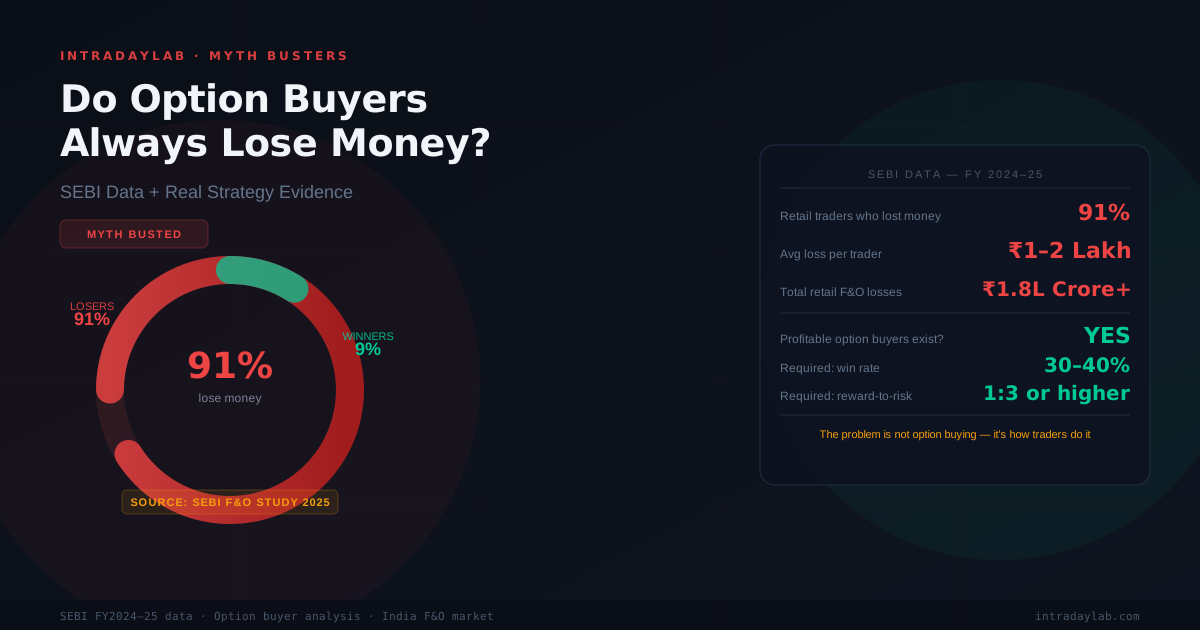
SEBI studied every retail F&O trader in India across three years. The verdict: 91% lost money. Average loss: ₹1–2 lakh per year. Total retail losses: over ₹1.8 lakh crore. But buried inside that same data is a finding most people miss — a small, consistent minority makes money. This article explains exactly what separates them.
The Question Everyone Gets Wrong
There are two extreme opinions about option buying in India, and both of them are wrong.
Opinion 1: "Option buying is basically gambling. Retail traders always lose. The whole thing is rigged."
Opinion 2: "You can make 10x returns easily if you catch the right move."
The first opinion treats a conditional truth as an absolute one. The second ignores everything the data actually shows. Neither helps you trade better.
The real question is not whether option buyers lose money. Most of them clearly do — the SEBI numbers are unambiguous. The real question is why they lose, and whether those reasons are structural (inevitable) or behavioural (fixable).
The answer to that second question determines whether option buying is a viable strategy or a trap.
What SEBI Data Actually Says
Every few years, SEBI publishes a study on profit and loss in the F&O segment. The FY2024–25 study is the most comprehensive and most damning picture of retail trading behaviour in India's history.
SEBI Official Data
Who Actually Loses Money in F&O Trading?
Source: SEBI Study on Profit and Loss of Individual Traders in Equity F&O Segment
Key observation: The loser % has stayed between 89–93% across all four years — this is structural, not a bad year anomaly. The winners are consistently the same minority: those who trade with tested systems and defined risk management.
The numbers across four consecutive years are not random noise. They are structural. 89–93% of retail traders losing money every single year, regardless of whether the market went up or down, regardless of volatility regime, regardless of which products were most popular.
This consistency is the most important finding. It means the losses are not caused by bad luck or a particularly difficult market year. They are caused by how retail traders approach options.
The SEBI Verdict
91% of individual F&O traders lost money in FY2024–25. The average retail trader lost ₹1–2 lakh that year. This pattern has repeated across FY22, FY23, FY24, and FY25 with only minor variation — it is structural, not circumstantial.
Does This Mean Option Buying Is Broken?
No. And this is the nuance most commentary misses.
SEBI's data shows that retail traders lose money. It does not show that option buying is inherently unprofitable. Those are different claims.
Consider: the same data shows that proprietary traders — firms that trade options professionally with sophisticated systems — are profitable. Institutional players who take the other side of retail trades are consistently profitable. The strategy itself is not the problem. The execution is.
What the data actually reveals is this: option buying is one of the most unforgiving strategies for undisciplined or underprepared traders, and one of the most powerful tools for disciplined ones.
The mechanism is the same for both groups. The outcome is completely different.
Option buyers do NOT always lose money. But 91% of retail option buyers in India DO lose money — every year, consistently. The difference between the 9% who profit and the 91% who don't is not access to better tips or better charts. It is risk management, strike selection, and whether they trade only in conditions where the strategy has a genuine edge.
Why 90% of Option Buyers Lose Money
This is where most articles stop at the surface. "Theta is bad. OTM options are risky." That is true but incomplete. Here is the full picture — ranked by actual impact on retail losses.
Option Trading Analysis
The Real Picture — What Data Shows
| Factor | Option Buyer | Option Seller |
|---|---|---|
| Max Loss | Limited (premium paid) | Unlimited / margin-based |
| Max Profit | Unlimited (in theory) | Limited (premium received) |
| Win Rate | ~30–40% | ~60–70% |
| Time decay | Enemy (theta hurts you) | Friend (theta earns daily) |
| Capital needed | Low (pay premium only) | High (margin required) |
| Volatility | Need IV to expand | Prefer IV to shrink |
| Who profits? | Momentum traders | Patient range traders |
The honest truth: Option selling wins more often, but the losses when they come are large. Option buying loses more often, but losses are capped. Neither is inherently safer — both require skill. The SEBI data shows sellers are also not immune: 48% of prop traders lose money too.
The deepest cause is worth dwelling on: the structural math of option buying requires you to be right about direction, right about timing, and right about the speed of the move — simultaneously. Miss any one of these and the trade fails even if your market view was broadly correct.
This is why professional option buyers restrict themselves to a fraction of all trading days. They don't try to buy options when conditions are mediocre. They wait for specific setups where the probability of a fast, strong directional move is high — and even then, they accept a 30–40% win rate as normal and size positions so that winners are 3× their losers.
That last sentence contains the entire edge.
The Math That Makes Option Buying Work (Or Fail)
Let's be precise. Most retail traders assume a profitable strategy must win more than 50% of the time. This assumption is incorrect and costly.
Here is the actual math:
| Win Rate | Avg Win (R) | Avg Loss (R) | Expectancy Per Trade |
|---|---|---|---|
| 50% | 1.0 | 1.0 | ₹0 — break even |
| 40% | 1.0 | 1.0 | −₹0.20 — slow death |
| 35% | 1.0 | 1.0 | −₹0.30 — losing |
| 35% | 3.0 | 1.0 | +₹0.40 — profitable |
| 30% | 3.5 | 1.0 | +₹0.35 — profitable |
The bottom two rows describe how profitable option buyers actually operate. They win less than 35–40% of the time. But when they win, their average winner is 3–4× the size of their average loser. That asymmetry, compounded over enough trades, produces positive expectancy.
The retail trader who loses does the opposite: cuts winners early (because a 30% gain feels good) and holds losers (hoping the option will recover). This systematically destroys the reward:risk asymmetry that is the entire basis of the strategy.
The Critical Insight
A 30–35% win rate is not a problem — it is the expected reality of disciplined option buying. What turns that win rate from a loss into a profit is maintaining a reward-to-risk ratio of 3:1 or better. Every decision to cut a winner early or hold a loser long directly destroys this ratio and the edge that depends on it.
Option Buying vs Option Selling: The Honest Comparison
Before we continue — the natural question: if option sellers win 60–70% of the time, why not just sell?
The answer is that win rate alone tells an incomplete story.
Option selling collects premium regularly, which produces a high win rate and a smooth equity curve — until a large directional move wipes out weeks of gains in a single session. The Nifty Bank Nifty crash in March 2020 eliminated accounts that had been profitably selling options for years. The SEBI data confirms this: even among proprietary traders (who mostly sell), 48% lose money.
The honest answer: neither buying nor selling is inherently better. Both require skill, risk management, and the right conditions. The retail trader who treats option selling as "safer" because it wins more often is misreading the data as badly as the one who buys OTM options hoping for 10x.
What Option Buyers Who Profit Actually Do
The profitable 9% share specific, measurable characteristics — and none of them involve finding a secret indicator or better tips.
1. They only trade on trend days and breakout setups. Option buyers need momentum. On sideways, choppy days — which represent the majority of all trading sessions — disciplined option buyers don't trade. The biggest mistake retail traders make is buying options every day.
2. They buy slightly ITM or ATM strikes, not the cheapest OTM. Cheap OTM options have delta of 0.10–0.20. A 200-point Nifty move gives you only 20–40 points on that option — often less than theta decay took away. ATM and near-ITM options have delta 0.40–0.55 and move meaningfully with the market.
3. They have a hard exit rule, always. Profitable option buyers define their maximum loss before entering. If the option loses 40–50% of its value, they exit — no exceptions. This is what keeps average losers at 1R while average winners reach 3R.
4. They trade fewer setups, not more. The 75% of retail traders who continue trading despite consistent losses share one trait: they overtrade. Every day, multiple times per day. Profitable option buyers wait — sometimes for days — for the right setup, then act with conviction.
5. They don't fight the trend. Option buyers who trade against strong prevailing trends — buying puts in a bull market without a clear catalyst, buying calls in a downtrend — are fighting two enemies simultaneously: price direction and theta. Both eat premium.
The Right Questions to Ask Before Buying Any Option
Before entering any option trade, a disciplined trader asks:
Is today a trend day or a range day? If range day, no trade.
What is my maximum loss if this goes wrong? If you cannot answer this in rupees before entry, you are not ready to trade.
What is my target, and is it at least 3× my risk? If not, the trade has negative expectancy even with a 50% win rate.
Am I buying because of a specific catalyst or setup, or because I feel like something should happen? Only the first category qualifies as a trade.
How many days does this option have left to expiry? Options with less than 5 days to expiry experience accelerating theta decay. Buying them requires a very fast, strong move to profit — the setup must justify the urgency.
These questions are not complicated. The retail traders who lose money consistently are not asking them.
The Five Structural Mistakes That Cause Most Retail Losses
| Mistake | What It Does to Your Edge |
|---|---|
| Buying OTM weekly expiry options every Monday | Delta 0.10–0.15, theta destroys 50–60% of value by Thursday |
| Averaging down on a losing option | Turns a controlled 1R loss into a 3–5R loss |
| Taking profits at 20–30% | Converts potential 3R winners into 0.3R winners, destroys RR ratio |
| Trading without a stop loss | One bad trade can exceed 10 winning trades combined |
| Trading 4–5 times per day | At ₹500 brokerage per trade, 20 trades/week = ₹10,000/month just in costs |
Every one of these mistakes has the same root: treating option trading as a prediction game rather than a probability management business.
Can You Learn to Be Profitable? Realistic Expectations
Yes — with honest expectations.
Timeline: Expect 6–12 months of learning before you have a statistically valid sample of trades to evaluate. Paper trade for the first 2–3 months. Use real money only when you can define your edge precisely.
Capital: Never risk more than 1–2% of your trading capital on a single option trade. At 30% win rate, you will have losing streaks of 8–10 trades in a row. With 1% risk per trade, that is a 8–10% drawdown — manageable. With 10% risk per trade, the same streak wipes 60–70% of your account.
Strategy: Restrict option buying to: (a) clear breakout days with strong momentum confirmation, (b) pre-scheduled high-impact events where directional bias is clear, (c) trend continuation setups in trending markets. Do not buy options on random days because "the market might move."
Win rate expectation: Do not chase a 60% win rate in option buying — it will cause you to overtrade low-quality setups. Accept 30–40% win rate as the sustainable reality, and focus entirely on maintaining 3:1 reward-to-risk.
Profitable option buying is possible for retail traders — but it requires 6–12 months of learning, strict capital risk limits (1–2% per trade), a genuine edge verified over 100+ trades, and the discipline to sit out on days when conditions don't favor the strategy. It is not a shortcut to wealth. It is a probabilistic business that rewards patience and punishes overtrading.
Frequently Asked Questions
Conclusion
The question "do option buyers always lose money?" has a precise, data-backed answer: no, but the vast majority do.
SEBI's studies across four consecutive years show 89–93% of retail F&O traders losing money annually. The losses are structural — caused by specific, identifiable behaviours: wrong strike selection, overtrading, cutting winners short and holding losers, and trading on days with no real edge.
The 7–9% who profit are not geniuses, and they don't have access to better information. They restrict option buying to high-momentum, high-conviction setups. They use ATM and near-ITM strikes. They have a hard rule for maximum loss per trade. They target 3:1 or better on winners. And they sit out — a lot — on days when the setup isn't there.
The strategy itself is not broken. The typical approach to it is.
If you take one thing from this article: option buying is a tools business, not a prediction business. The tools are probability, reward:risk, strike selection, and timing. The traders who master those tools — even with a 30% win rate — beat the 91% consistently.
The data proves it's possible. The question is whether you are willing to approach it that way.
Nifty Gap Down History: What Happens After a Panic Open?
We apply the same 10-year framework to gap downs. The result is more surprising than the gap up study — 52.6% of gap down days actually close green. Here's the full data breakdown.
Gap Down Events
76
Close Green
52.6%
Fill Rate
17.1%
Gap Down
Analysis
Data sourced from SEBI's official study on "Profit and Loss of Individual Traders in Equity F&O Segment" for FY2024–25 and prior fiscal years. All references to win rates and strategy performance reflect published research and market structure analysis. This article is for educational purposes only and does not constitute financial or investment advice. Options trading involves significant risk of capital loss.